
Key facts
- After post-processing, the F444W data reached contrast levels of 2×10^-6 at 1 arcsecond (5.1 au), 1.5×10^-7 at 2 arcseconds (10.3 au), and a few ×10^-8 beyond 4 arcseconds (20 au).
- Using the Sonora Flame Skimmer atmospheric and evolutionary models, the contrast limits translate to sensitivity below Jupiter's mass beyond 5 au and below Saturn's mass beyond 10 au.
- Several candidate point sources appeared in the first-epoch field, but the second epoch confirmed none were co-moving with Altair and their colors match background stars.
- Applying FLIP to archival JWST Cycle 1 NIRCam coronagraphic observations of 51 Eridani revealed the known planet 51 Eridani b, which the standard pipeline had not detected in that dataset.
Astronomers imaged Altair with JWST’s NIRCam on Oct. 11, 2024, and May 26, 2025, searching for giant planets around the nearby star Altair.
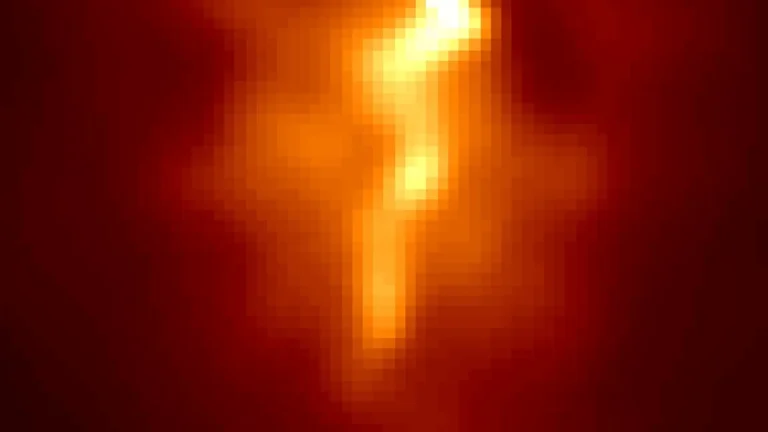
Altair is an A7V star of apparent V magnitude 0.765 and mass 1.86 solar masses. Its rapid rotation, 221 km/s, and extreme brightness make radial velocity and transit searches impractical, leaving coronagraphic imaging as the promising route for wide-separation companions. The star spins at about 74 percent of breakup velocity and is visibly oblate, with an equatorial radius roughly 22 percent larger than its polar radius.
The star’s age has been revised to 88±10 million years, placing it among the youngest stars near the Sun, and its distance is 5.130±0.015 parsecs, about 16.7 light years. Altair is the second nearest A-type star to the Sun after Sirius. It has no known companions, no detected debris disk, and no stellar association, yet its youth and proximity keep it a high-priority target for future high-contrast imaging.
The campaign used JWST/NIRCam’s MASK430R coronagraph, a mask that blocks a star’s glare, for simultaneous F444W and F200W imaging. The first epoch ran under program 4534 and the second under program 8507. Each epoch combined two roll angles separated by roughly eight degrees and totaled about 2.3 hours on sky. Vega served as the reference star for reference differential imaging, observed with 5 dithered pointings of 140 integrations each.
After ADI+RDI processing, image processing that subtracts starlight, the F444W data reached contrast levels of 2×10^-6 at 1 arcsecond, about 5.1 au, and 1.5×10^-7 at 2 arcseconds, about 10.3 au. Beyond 4 arcseconds, or 20 au, contrast reached a few ×10^-8. Inside roughly 2 arcseconds, sensitivity is limited by coronagraph mask throughput and residual PSF subtraction artifacts. Using the Sonora Flame Skimmer atmospheric and evolutionary models, the limits translate to sensitivity below Jupiter’s mass beyond 5 au and below Saturn’s mass beyond 10 au, though the authors caution the mass limits depend on the assumed atmosphere.
The missing cold disk is unexpected because the star’s age falls in the tens-to-hundreds-of-million-year range when A-type debris disks are most common. CHARA/FLUOR interferometry detects a 3.07±0.24 percent K-band excess from an extended circumstellar source, hinting some inner material may remain. The star shows no significant 24-micrometer infrared excess at the 1 percent level.
Several candidate point sources appeared in the first-epoch field, but the second epoch, taken about seven months later, confirmed none were co-moving with Altair. Their colors match background stars, and the northern candidates at about 4 arcseconds separation would have implied Saturn-mass or smaller companions at 20 to 30 au if bound. Two rounds of JWST imaging found no confirmed planets around Altair, and all candidate points of light proved consistent with background stars.
Altair could serve as a reference star for future campaigns, including the Roman Space Telescope Coronagraph Instrument, because it will stay at least a few arcseconds from background stars over the next 10 to 20 years. The paper lists positions and brightness of 11 background stars in the field to aid planning, with the brightest background star due south detailed in a table.
The Altair campaign sits alongside a new image-processing technique called FLIP, or Physics-based Learning for Imaging Planets. FLIP constructs a software replica of JWST’s NIRCam to model and subtract the instrument-specific glare of a target star. Instead of borrowing a reference-star image taken at a different time and thermal state, it simulates how the target’s starlight travels through a virtual telescope and fits millions of optical parameters to the actual data.
Researchers applied FLIP to archival JWST Cycle 1 NIRCam coronagraphic observations of 51 Eridani and revealed the known planet 51 Eridani b, which the standard pipeline had not detected in that dataset. The planet is roughly three times Jupiter’s mass, has an effective temperature around 750 Kelvin, orbits at a Saturn-like distance, and lies about 96 light-years away in Eridanus. It was discovered with the Gemini Planet Imager in December 2014 and announced in August 2015.
On different test targets, FLIP raised detection sensitivity by between two and fifteen times over current methods. A factor-of-two gain means detecting planets roughly one-quarter as luminous as existing methods allow, and the biggest improvements occur close to stars where Earth-like planets tend to orbit.
“What’s exciting is that we’re showing how computation can help overcome limitations of the telescope itself,” said Katie Bouman, a Caltech professor whose group developed core algorithms behind the first Event Horizon Telescope black hole image in 2019. Jason Wang, the senior author and Ferrer-Chavez’s PhD supervisor at Northwestern, described the work as the first demonstration beyond the telescope stability limit.
The FLIP paper Imaging exoplanets below the telescope stability limit was published Nov. 4, 2026, in Nature volume 659, issue 8139, page 58. Its authors are Rodrigo Ferrer-Chavez, Brandon Y. Feng, William T. Freeman, Dimitri Mawet, Laurent Pueyo, Marshall D. Perrin, Katherine L. Bouman, and Jason J. Wang. The research was funded by the Space Telescope Science Institute, the Sloan Foundation, an Amazon AI4Science Discovery Award, and the National Science Foundation.
Dimitri Mawet of NASA’s Jet Propulsion Laboratory, who was not involved in the study, said model-based starlight removal had been discussed for over a decade but could not beat reference-star methods until FLIP. Jason Wang said JWST is optically stable to the nanometer level but that stability is still limiting. He said the technique is not limited to JWST.
The FLIP team plans to apply the algorithm to the full JWST NIRCam coronagraphic archive and extend it to the Roman coronagraph, ground-based 8-to-10-meter adaptive optics, and ESO’s Extremely Large Telescope. “If our approach works, building this new observatory may be really hard but not really, really, really hard,” Ferrer-Chavez said. NASA’s Roman Space Telescope launched Aug. 30, 2026, aboard a Falcon Heavy and is in commissioning, with Coronagraph Instrument power-on testing expected in the coming weeks.
JWST can detect Saturn-sized worlds beyond Pluto’s orbit, but imaging Earth-sized worlds would require a telescope 100 to 1,000 times more stable than JWST, not yet achieved even in laboratories. NASA’s next flagship, the Habitable Worlds Observatory, is planned for the 2040s at a cost of at least $11 billion and aims to image and characterize at least 25 potentially habitable Earth-sized worlds around nearby Sun-like stars.



Join the discussion