
Key facts
- Kenta Kiuchi and colleagues posted a study to the arXiv preprint server proposing that magnetars can form when two neutron stars physically touch.
- The merged neutron star's field can exceed 300 times the strength of the initial fields of the two stars.
- The event EP250704a, also called GRB 250704B, was detected on July 4, 2025 by the SVOM, Insight-HXMT and Einstein Probe satellites.
- Niccolò Passaleva called the X-ray emission the longest-lasting prompt flash ever recorded from a neutron star merger.
In 2026, Kenta Kiuchi and colleagues shared an arXiv preprint proposing that two neutron stars physically touching can give birth to a magnetar.
These objects make up roughly 1% of neutron stars, and their magnetic fields can reach up to 1,000 times the strength of ordinary neutron stars. A typical neutron star’s field is already about 100,000 times stronger than the strongest magnetic fields producible on Earth. Many researchers see magnetars as a probable source of powerful cosmic outbursts such as fast radio bursts and soft gamma-ray repeaters.
Most mergers of binary neutron stars go past the Tolman-Oppenheimer-Volkoff threshold of roughly 2.6 solar masses, which makes the remnant collapse into a black hole. Neutron stars generally pass the Chandrasekhar ceiling of about 1.4 solar masses that applies to white dwarfs, though some neutron stars have smaller masses. If the combined mass stays below that threshold, the two stars can merge into a single neutron star instead of a black hole. That narrow pathway is what the Kiuchi team set out to model.
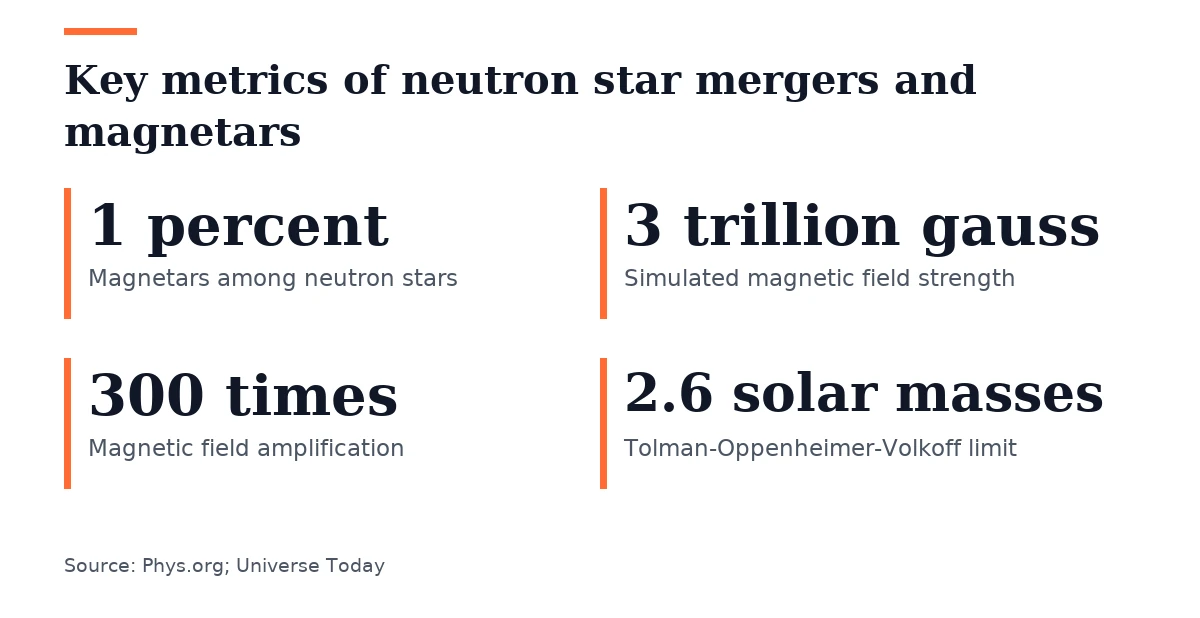
Researchers from the Kiuchi group used the Japanese supercomputer FUGAKU for high-resolution simulations of low-mass neutron star binary mergers. The runs started from magnetic fields around 3 trillion gauss, a level in the upper range for ordinary neutron stars, and followed the binaries from just before collision until just after contact. The setup simplified the binary by assigning identical masses to the two neutron stars while otherwise treating them as typical neutron stars.
Right after contact, within milliseconds, the neutron fluid at the boundary enters a Kelvin–Helmholtz instability and turns turbulent, mixing the neutron material thoroughly and rapidly. That process produces significant magnetic field amplification, pushing the merged remnant’s field beyond 300 times the strength of the two starting fields. That amplified field travels through the stars in about a millisecond and could shape how the merger unfolds and what the remnant looks like.
The authors caution that even stronger fields could emerge from later turbulence, though that stage lies beyond what the FUGAKU runs were able to follow. The Kiuchi team says more study remains necessary to work out how the rapid amplification affects the merger and the remnant. The arXiv study concludes that magnetars can form through mergers of low-mass neutron star binaries.
Researchers said they may have seen the birth of a magnetar from two colliding neutron stars on July 4, 2025, the day the SVOM, Insight-HXMT and Einstein Probe satellites detected EP250704a, also called GRB 250704B. Its gamma-ray portion lasted only about half a second, while Einstein Probe observed bright X-ray emission for nearly ten minutes. The first X-ray flicker matched the brightest gamma-ray pulse in timing and position, tying the two signals to the same event.
Using the VLT’s X-Shooter instrument, researchers measured a redshift of z=0.6610 for the burst, showing the light traveled for more than six billion years. The team used the VLT’s FORS2 instrument to look for a bright supernova 12 and 20 days after the burst, but none appeared. The distance, missing supernova and burst properties together provided strong evidence that EP250704a originated from a neutron star merger.
Niccolò Passaleva described the X-ray emission as the longest-lasting prompt flash ever recorded from a neutron star merger. The magnetar interpretation is an inference, and the team could not fully rule out a newborn black hole at the center, although the X-ray fading fits a magnetar better. Researchers said they may have witnessed the formation of a magnetar produced by the collision of two neutron stars.

Eleonora Troja, an astrophysicist at the University of Rome Tor Vergata and a corresponding author of the study, describes magnetars as rapidly spinning neutron stars with powerful magnetic fields. “Magnetars are rapidly spinning neutron stars with huge magnetic fields,” she said. She says damping their magnetic power into the surroundings can make explosions brighter and longer-lasting.
Niccolò Passaleva, a graduate student in Eleonora Troja’s group and one of four co-lead authors, directed the Very Large Telescope follow-up observations in Chile for the July 4, 2025 burst, responding within minutes, so observations could begin while the source remained bright. After receiving an Einstein Probe alert, Eleonora Troja’s team quickly arranged follow-up observations with the Very Large Telescope and the Very Large Array. Radio dishes at the Very Large Array in New Mexico tracked the afterglow of EP250704a for weeks.
Passaleva hopes the next gravitational-wave observing run will match one of these X-ray flashes with gravitational waves from the same source, showing what kind of crash creates such a flash. Pairing the signals would test whether the minutes-long X-ray emission marks a magnetar birth from a neutron-star merger.
Einstein Probe, an X-ray telescope from the Chinese Academy of Sciences that launched in January 2024, has detected hundreds of X-ray flashes, known as fast X-ray transients, from galaxies. These flashes have multiple possible origins, including deaths of massive stars, while some events remain unexplained. Short gamma-ray bursts lasting less than two seconds have traditionally been the main electromagnetic signal used to identify neutron star collisions. NASA’s Swift satellite had seen only the fading ends of similar glows because it needed time to turn toward each burst and missed the start.
The work appeared in Science Bulletin as “Minutes-long soft X-ray prompt emission from a compact object merger,” volume 71, issue 18, page 4657, with DOI 10.1016/j.scib.2026.08.021. Lead authors include An Li, Chen-Wei Wang, Niccolò Passaleva and Jie An. Researchers conducted VLT observations used in the study as part of large program 114.27LW, QUEENB: a QUEst for Elusive Neutron star and Black hole mergers, led by Eleonora Troja. Researchers in Eleonora Troja’s group, supported by an ERC Consolidator grant, obtained observations that helped identify the source after an Einstein Probe alert.
At that distance, gravitational waves are too faint for current detectors, and telescopes could not spot the kilonova glow from heavy elements forged in the collision. Neutron star mergers generate gravitational waves, and the light from these events can help astronomers determine what survives the collision.



Join the discussion