Key facts
- The Daniel K. Inouye Solar Telescope on Maui captured the first images resolving plasma whirlpools only a few tens of kilometers across on the Sun's surface earlier in 2026.
- Nykyri calculated that each vortex holds roughly two septillion ergs of energy after considering velocity shear, density difference, and vertical heights.
- Five to eight percent is the share of stored vortex mechanical energy that must travel upward to the corona to replace heat radiated away, according to the paper.
- When a Kelvin-Helmholtz vortex spins, it compresses adjacent magnetic field lines into sheets only centimeters to meters wide, which then snap and reconnect.
Katariina Nykyri of Embry-Riddle Aeronautical University published a paper on Nov. 5, 2026 in The Astrophysical Journal Letters proposing that millions of tiny whirlpools across the Sun’s surface drive the heating of the corona to more than a million degrees. The paper follows earlier coverage of the solar temperature gap and relies on new images from the Daniel K. Inouye Solar Telescope.
Nykyri’s university says the work adds to a growing body of discovery fed by mission data. The Daniel K. Inouye Solar Telescope on Maui captured the first images earlier in 2026 resolving plasma whirlpools only a few tens of kilometers across on the Sun’s surface. Perched atop Haleakalā, the observatory is the world’s largest solar observatory, with a four-meter mirror and adaptive optics that correct atmospheric blurring. Its resolution made structures visible that had never been seen before on the solar surface.
Researchers from NSF National Solar Observatory, the Max Planck Institute for Solar System Research, and the High Altitude Observatory reported Kelvin-Helmholtz waves on the Sun’s visible surface in a Nature study published in August 2026. The team combined telescope observations with advanced computer simulations, including MURaM magnetohydrodynamic models—simulations of magnetic fields in electrically conducting fluids—developed by NSF NCAR and MPS. The study’s DOI is 10.1038/s41586-026-10871-3.
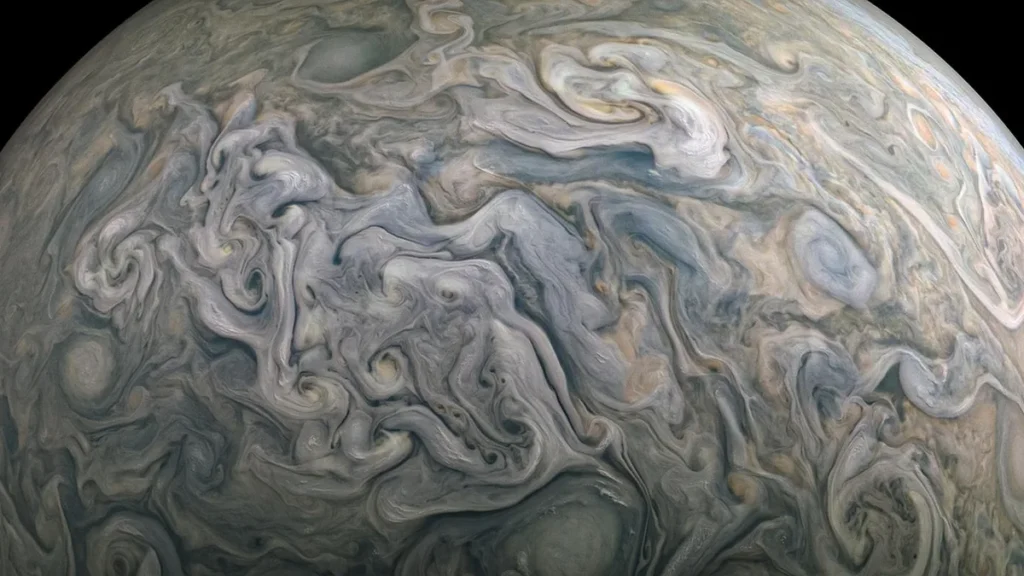
The instability arises when two fluids flow past each other at different speeds. That relative motion creates shear at the interface between them. The shear lets small disturbances grow into waves or swirling vortices. The same process appears in Earth’s oceans and clouds, in Jupiter’s and Saturn’s atmospheres, and in solar wind interactions with planetary magnetospheres.
The vortices sit along solar granule edges. Individual granules span 500 to 2,000 kilometers, while some vortices are just over 20 kilometers across. Moving plasma produces granulation, creating a constantly changing pattern resembling bubbles in a boiling liquid as hot material rises, cools, and sinks.
Nykyri calculated that each vortex holds roughly two septillion ergs of energy after considering velocity shear, density difference, and vertical heights. Across the Sun’s 1.4-million-kilometer surface, countless vortices form and fade within a few minutes. Their energy must go somewhere when they dissipate.
The paper states that five to eight percent of stored vortex mechanical energy must travel upward to the corona to replace heat radiated away. It also says that in darker coronal holes, up to 21 percent of vortex energy could sustain coronal temperatures.
“Eureka!” Katariina Nykyri said. As a Kelvin-Helmholtz vortex spins, it compresses adjacent magnetic field lines into sheets only centimeters to meters wide, which then snap and reconnect. The process turns stored magnetic energy into heat and fast plasma jets, and Nykyri’s model identifies the vortices as the force driving magnetic field reconnection.
When a magnetic line snaps on the Sun’s surface, energy spreads among trillions of neutral atoms and lifts each temperature only slightly. The same energy in the much thinner corona raises individual atom temperatures far more. This particle density difference helps explain why the corona seems so much hotter than the surface despite similar energy release.

The research demonstrates that swirling vortex motion winds up magnetic fields and thins reconnection layers exponentially fast. It erases a scale difference of nearly a million within one vortex lifetime. Using a plasma simulation, she showed that large-scale wave structures collapse into thin current sheets where reconnection starts.
The small whirlpools appear continuously across strong magnetic fields. They offer a persistent way to twist solar magnetic field lines and aid magnetic flux diffusion through the atmosphere fast enough for the eleven-year activity cycle. Current models have difficulty explaining this rapid diffusion, and the vortices could supply part of the answer to what causes field lines to twist in the first place.
Researchers need to track wave transmission and polarization in the chromosphere. They must verify that enough energy reaches it to keep coronal temperatures steady, as Nykyri proposes. If her theory holds, some of the Sun’s high temperatures will stem from small plasma tornadoes floating across its surface.
They intend to apply automated pattern-recognition tools to Inouye data sets. They will track Kelvin-Helmholtz signatures and measure the energy carried into higher atmospheric layers and the effect on magnetic field diffusion over time. They expect the work to improve space-weather forecasting for flares and coronal mass ejections that could affect power grids, satellites, GPS and communications.
Nykyri said understanding coronal heating is essential to predicting solar behavior, since the hot corona drives the solar wind and space weather capable of disrupting power grids, satellites, GPS and radio communications. She has studied the space weather phenomenon for 27 years, drawing on research into powerful surges of energy.
Nykyri said, “Understanding how it is heated is key to understanding and eventually predicting our sun’s behavior.”
Nykyri wrote the paper alone, and she thanked students and colleagues for long-term work on Kelvin-Helmholtz waves and reconnection backed by many NASA and NSF grants. NSF Plasma Physics Program Director Vyacheslav described it as a puzzle that has lasted for decades, with several competing yet incomplete explanations.
Nykyri said understanding the conversion of magnetic energy to heat can aid fusion research. She noted that deuterium in one glass of heavy water contains enough fusion energy for decades of personal energy use. She described the potential prize as large.




Join the discussion