Key facts
- A University of Arkansas study demonstrated that pure lunar regolith simulant can be three-dimensionally printed into interlocking, LEGO-style bricks for construction.
- Cole McCallum was the first author and Wan Shou was the senior author of the paper; McCallum was a University of Arkansas undergraduate at the time and Shou is an assistant professor of mechanical engineering.
- The team used laser powder bed fusion, spreading fine powder across a flat bed and fusing it with a high-powered light source such as a laser through sintering, then lowering the bed and adding another powder layer.
- Lunar regolith contains no organic matter, unlike Earth soil, and consists of loose, jagged particles formed over billions of years by asteroid, micrometeorite and space-debris impacts on the Moon.
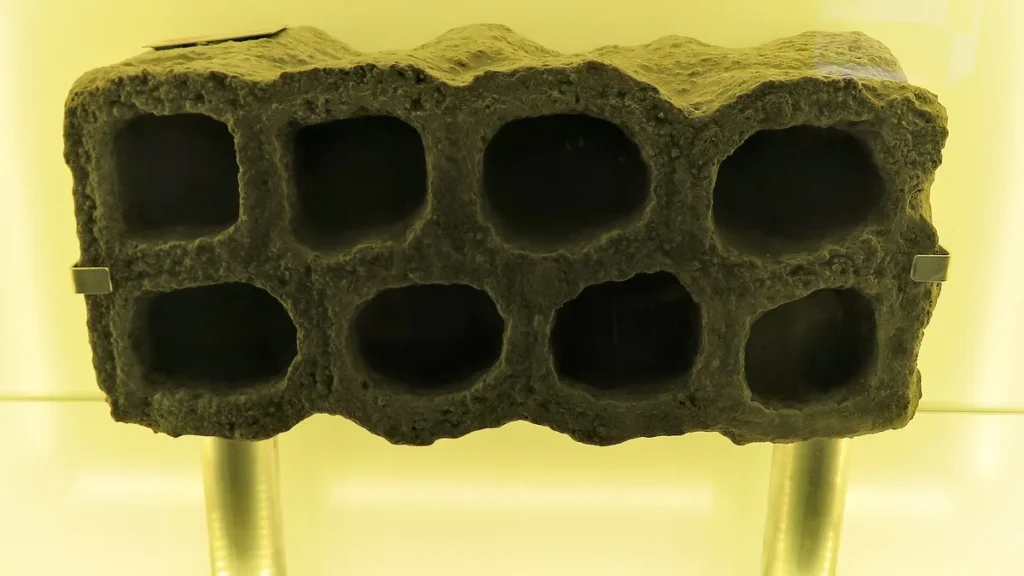
University of Arkansas researchers printed pure lunar regolith simulant (loose, jagged Moon soil) into interlocking LEGO-style bricks, demonstrating a binder-free construction method for future Moon settlements.
The work appeared in npj Advanced Manufacturing on Nov. 10, 2026 under the title Additive manufacturing of lunar regolith for reconfigurable building blocks toward lunar habitation, with DOI 10.1038/s44334-026-00111-x. Cole McCallum served as first author and Wan Shou as senior author; McCallum was a University of Arkansas undergraduate at the time, and Shou is an assistant professor of mechanical engineering there.
McCallum said Shou had a strong belief that undergraduates should get involved more with research. McCallum said research helps refine and overcome problems and that he made many mistakes the first time through. He said it was nice to have a head start on everyone else and make those mistakes early.
A Little Rock native, McCallum began working in Shou’s lab early in his undergraduate studies and graduated in May with degrees in mechanical engineering and physics. He received an inaugural Lafayette Fellowship, one of 30 fellows chosen from more than 3,400 applicants for master’s study in France, a program celebrating the 250th anniversary of the United States.
The team used laser powder bed fusion, spreading fine powder across a flat bed and fusing it with a high-powered light source such as a laser through sintering, then lowering the bed and adding another powder layer. This layer-by-layer additive manufacturing method formed the regolith blocks. Cole McCallum explained the mechanism with the observation: ‘There’s nothing else it’s binding to. The regolith powder is binding to itself.’
Other researchers have used binding agents with lunar regolith for 3D printing, but those binders would have to be transported from Earth to the Moon. The University of Arkansas team was the first to demonstrate that lunar regolith simulant can be sintered directly without a binder into reconfigurable building blocks using a relatively low-power light source.
The printed blocks measure a few centimeters wide and include cross-shaped and H-shaped pieces that fit together like LEGO bricks to form larger structures. McCallum said the structures can be self-supported, but he would be hesitant to claim the process could support other loads at this moment yet.
Objects printed from pure regolith are more porous and structurally weaker than objects printed with binders, according to the researchers. Wan Shou said more research must examine the process in microgravity and vacuum environments, and researchers must optimize mechanical performance for practical use. He is optimistic the method could efficiently create components and structures for a permanent lunar settlement.
Using locally sourced Moon material for construction could reduce what NASA needs to launch from Earth as the agency works toward future lunar settlements. NASA’s Artemis program is among global efforts pursuing long-term human presence on the Moon, alongside China’s lunar base ambitions.
Lunar regolith contains no organic matter, unlike Earth soil, and consists of loose, jagged particles formed over billions of years by asteroid, micrometeorite and space-debris impacts on the Moon. The only actual lunar regolith on Earth consists of handfuls of samples collected from the Apollo missions, Russia’s Luna rovers, and China’s Chang’e-5 probe, at least until Chang’e-6 returns. The only pristine lunar material on Earth is 842 pounds (382 kilograms) of rocks and regolith collected by Apollo astronauts, plus a few handfuls from robotic sample-return missions.
Lunar Highlands Regolith Simulant (LHS-1) supplied the printable material for the experiments. The commercial product imitates samples gathered during Apollo missions in the 1960s and early 1970s, serving as the team’s terrestrial stand-in for real lunar regolith.
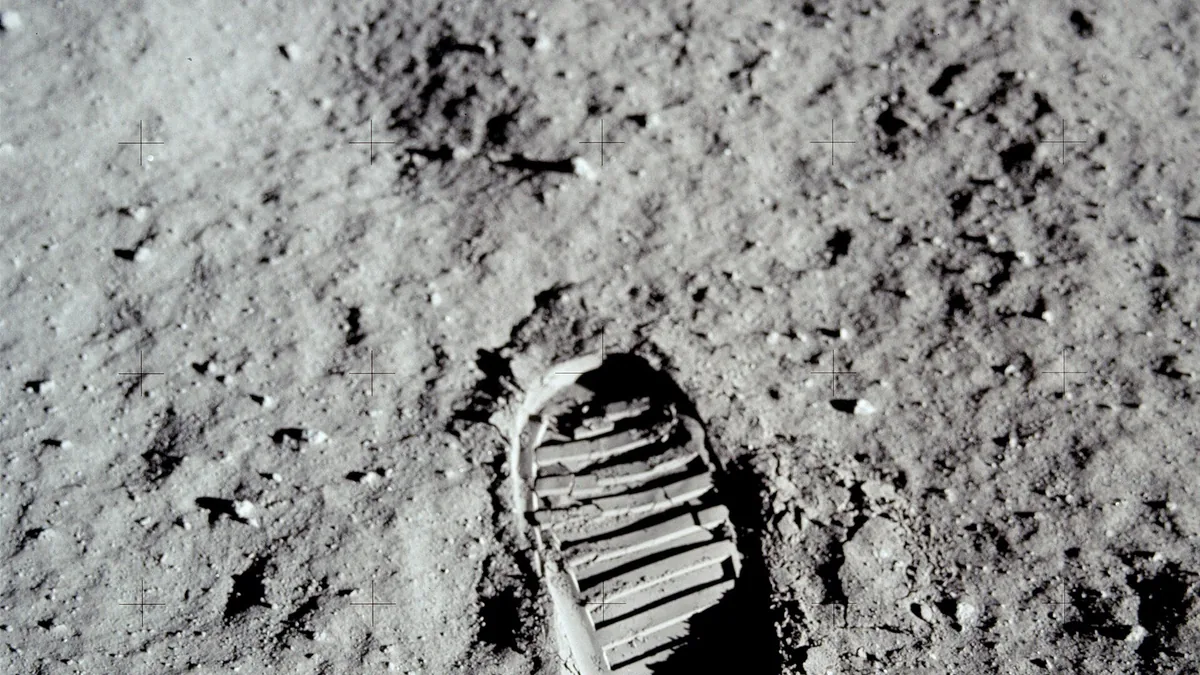
China’s Deep Space Exploration Laboratory in Hefei, Anhui Province developed a solar-powered device that transforms lunar regolith into durable construction bricks, described in Acta Astronautica on Aug. 10, 2025. The device concentrates sunlight through a parabolic reflector and fiber optic bundles to more than 3,000 times Earth-surface strength, producing temperatures above 1,300 degrees Celsius to melt regolith into solid shapes. DSEL engineers spent two years developing the device and created simulated regolith types to handle variable lunar soil compositions; the system uses no additives and relies entirely on in-situ resources.
Tests with basalt-based simulated Moon soil using China’s solar-powered brick device produced flat surfaces, curved structures and complex geometries suitable for lunar construction. The development addressed difficulties in melting variable compositions and transmitting solar energy efficiently.
Simulated lunar bricks were sent to China’s Tiangong space station aboard Tianzhou 8 in November 2024 for a three-year exposure by astronauts to test thermal durability, structural strength and radiation shielding. Results will guide future lunar structure design and scaling of the system for full surface deployment.
Senior engineer Yang Honglun said lunar bricks cannot maintain internal pressure in the Moon’s vacuum but can serve as protective shells around pressurized habitat modules, shielding against radiation, micrometeorites and temperature extremes, and could also build roads and equipment platforms. The bricks would act as outer layers for habitats and other infrastructure in a functioning lunar settlement.
The DSEL team envisions robots mass-producing and assembling bricks into modular structures directly on the Moon, enabling entire lunar facilities without constant Earth resupply. This fully automated construction vision is part of global ambitions for a permanent lunar base and aligns with NASA’s Artemis program and other long-term lunar presence goals.
University of Potsdam researchers fabricated photovoltaic cells from simulated lunar regolith glass combined with halide perovskite. The cells reached 23 percent power-conversion efficiency while cutting Earth-to-Moon transport weight by 99 percent. Optics & Photonics News reported the results on Apr. 9, 2025.
The European Space Agency and LEGO revealed proof-of-concept lunar base blocks that snap together exactly like LEGO toys on June 24, 2024, but the first generation is not made from actual regolith because lunar material on Earth is extremely scarce. ESA researchers made their regolith stand-in from dust of a 4.5-billion-year-old meteorite called NWA 869 found in Northwest Africa in 2000, mixed its metal grains and chondrules with polylactide, and 3D-printed bricks with LEGO’s rectangular design and clickable studs. The meteorite, classed as L3-6, is a brecciated stone with large metal grains, inclusions, chondrules and other elements.
‘According to Lego, the meteoritic bricks do snap and click together like traditional blocks.’ The LEGO Group said 15 ESA Space Bricks would go on display in select LEGO Stores globally and at LEGO House in Billund, Denmark, from June 24 to September 20, 2024. The display included stores in the United States, Canada, Britain, Germany, France, Denmark, Spain, the Netherlands and Australia plus LEGO House in Billund.
ESA science officer Aidan Cowley said no one has ever built a structure on the Moon, so teams must determine how to build and what to build with because materials cannot be transported from Earth. The team wanted to explore whether space dust could make a brick like a LEGO brick to test different building techniques.
Daniel Meehan, Creative Lead at The LEGO Group, said 87 percent of Gen Alpha kids show interest in discovering new planets, stars, and galaxies. The LEGO Group release connects the ESA Space Bricks display to inspiring children to build their own space shelters.





Join the discussion