
Key facts
- NASA will begin live coverage of the Nov. 5, 2026, spacewalk at 5:30 a.m. EST, with the event scheduled to start at 7 a.m. EST and last approximately seven hours.
- As of Oct. 30, 2026, seven of eight roll-out solar arrays (IROSA) have been installed on the ISS, with the final array scheduled for installation on Nov. 5, 2026, completing the power upgrade.
- The upgraded ISS power system, once complete, will support critical operations and the station’s eventual controlled deorbit, ensuring sustained functionality through the end of the decade.
NASA and the Canadian Space Agency (CSA) scheduled a spacewalk for Nov. 5, 2026, to install the eighth and final roll-out solar array on the International Space Station’s starboard truss structure. The outing will complete the final-series power upgrade for the station, and members of Expedition 75 will conduct it.
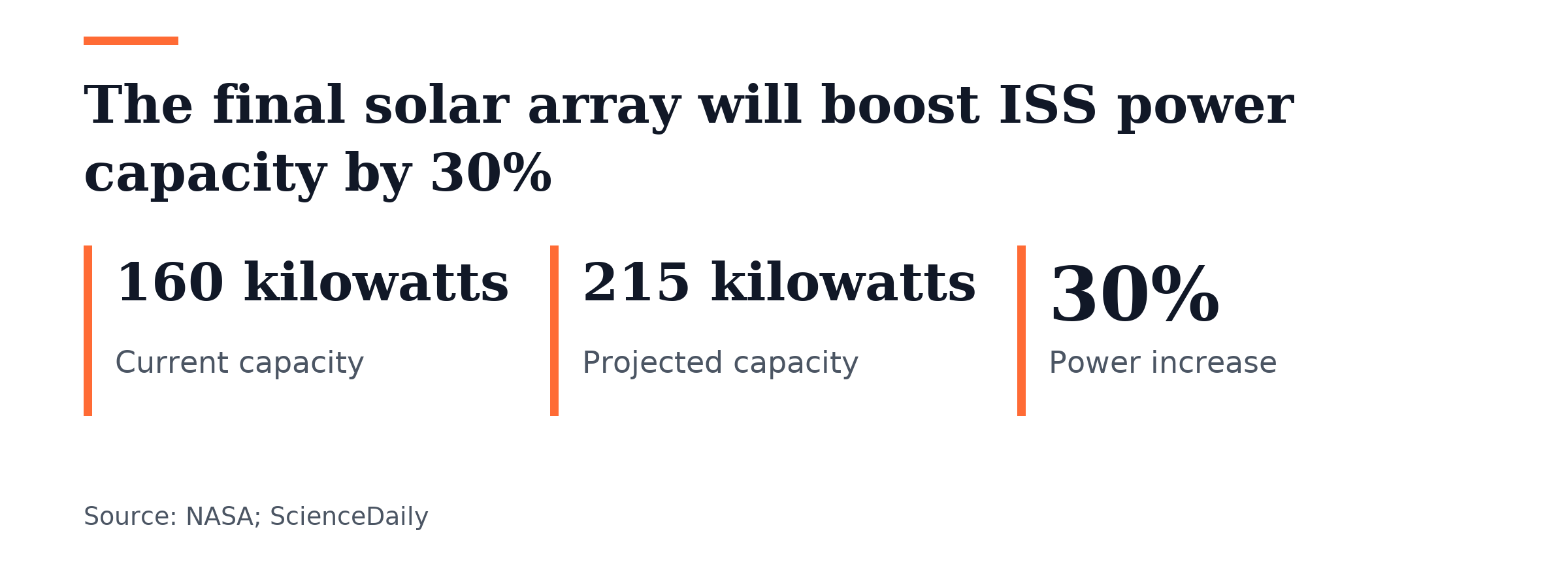
The roll-out solar array, or IROSA, is the last in a series of installations modernizing the ISS power generation system. Once installed, the station’s power capacity will rise by up to 30%, from 160 kilowatts to approximately 215 kilowatts. NASA and CSA say the added electricity will support critical operations. The arrays are designed to provide additional electricity for essential systems and research activities, supporting future missions.
As of Oct. 30, 2026, seven of eight roll-out solar arrays had been installed on the ISS, with the seventh array put in place during a spacewalk that day. The installation marked significant progress toward the final power upgrade. NASA said, “The astronauts finished their work at 3:08 p.m. EDT.” The Nov. 5, 2026, outing will mark the 285th spacewalk conducted to support the assembly, maintenance, and improvement of the International Space Station, and it will be designated U.S. spacewalk 100.
NASA will begin live coverage of the Nov. 5, 2026, spacewalk at 5:30 a.m. EST. The event starts at 7 a.m. EST and lasts approximately seven hours. The agency will stream the coverage on NASA+ and other platforms, allowing the public to follow installation of the final solar array in real time.
On Nov. 1, 2026, Expedition 75 astronauts Joshua Kutryk of the Canadian Space Agency and Anil Menon of NASA reviewed Canadarm2 robotic arm procedures. The pair also took part in pre-spacewalk conferences with mission controllers to discuss readiness and robotic arm concerns. They spoke with spacewalk specialists and consulted robotics engineers about potential issues with the arm. The Canadarm2 robotic arm, operated by astronauts inside the station, plays a key role in the installation and deployment of solar arrays and other external maintenance tasks, and it will assist in the upcoming solar array installation.
On Nov. 1, 2026, Expedition 75 astronauts conducted life science research. Joshua Kutryk used the Bio-Monitor vest and headband for cardiorespiratory studies, Luke Delaney analyzed vascular tissue samples, and Jessica Watkins verified a portable DNA sequencer for genetic sequencing of antibiotic-resistant bacteria. The work used the Destiny laboratory module and the BioFabrication Facility, and the research aims to advance understanding of human health in microgravity, informing future missions to the Moon, Mars, and beyond.
On Nov. 1, 2026, cosmonauts Pyotr Dubrov, Sergey Teteryatnikov, and Anna Kikina conducted research and maintenance tasks in the Roscosmos segment. Dubrov studied high-purity semiconductor crystal production in microgravity, Teteryatnikov monitored his heart activity and blood pressure for 24 hours, and Kikina performed ventilation system maintenance and cargo transfers aboard the Progress 96 cargo spacecraft.
The International Space Station has undergone several power upgrades over its operational lifespan, with the IROSA installations as the latest phase of modernization. The new arrays augment the station’s power system, which sustains critical operations and supports scientific research and operational demands.
The completion of the ISS power upgrade series will ensure the station’s continued functionality for scientific research and operational needs through the end of the decade, supporting critical missions and preparations for its eventual deorbit.


Join the discussion