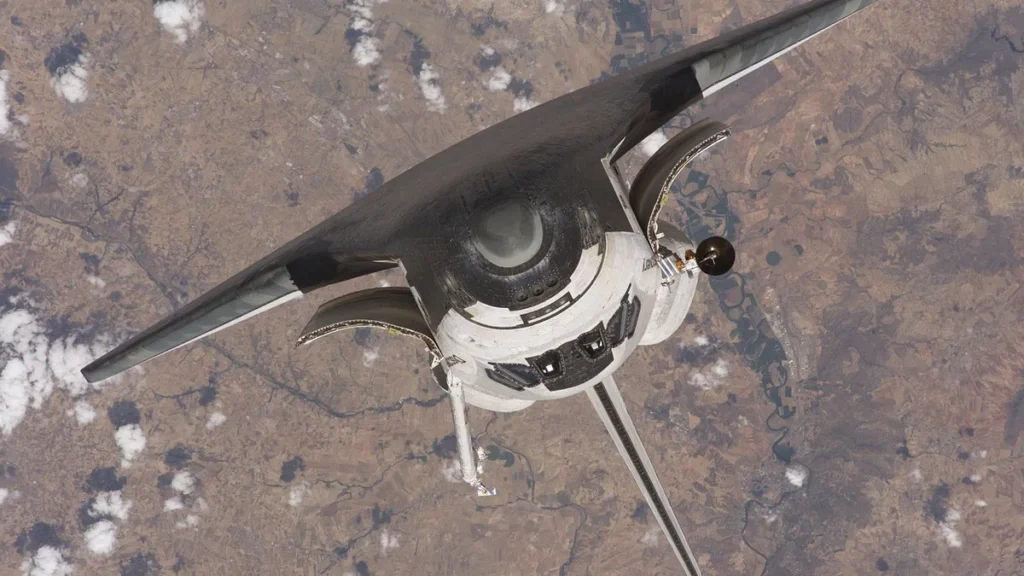
This is a new development in a story we reported earlier: NASA's Swift Observatory set for uncontrolled reentry.
Key facts
- NASA estimates Swift will reenter Earth's atmosphere on November 4, 2026, at 05:31 UTC, plus or minus 12 hours, an estimate moved up by recent active solar weather.
- For viewers in the Americas, the timing would place the event on Tuesday afternoon or evening, November 3, or overnight Wednesday, November 4.
- On August 19, 2026, NASA said the LINK spacecraft would not capture or boost Swift to a higher altitude because of an ongoing commercial spacecraft attitude control issue.
- Katalyst Space launched LINK, a commercial robotic repair vehicle meant to capture Swift and raise its orbit, on July 3, 2026.
NASA estimates the Swift spacecraft will reenter Earth’s atmosphere on November 4, 2026, at 05:31 UTC, plus or minus 12 hours. The agency also says Swift should hit the atmosphere on November 4 at about 3:30 a.m. Eastern Time, inside an 11-hour window during which reentry could occur. For viewers across the Americas, that timing places the event on Tuesday afternoon or evening, November 3, or overnight Wednesday, November 4. Recent active solar weather degraded Swift’s orbit, causing the estimate to move up.
The latest estimate was shifted earlier because solar activity adds drag to spacecraft orbits. EarthSky says this is a reason the spacecraft will likely reenter around Wednesday. The source also points viewers to the Swift Last Light website to check whether the fiery reentry might be visible from a specific location.
Visibility depends on where the observer sits within that track. Swift sometimes shines at visual magnitude +2.0 to +1.5, a brightness scale in which smaller numbers mark brighter objects. That makes the spacecraft visible to the unaided eye under dark sky conditions. Experts expect Swift to burn up upon atmospheric entry, eliminating danger to people on the ground.
The source describes the event as a spectacular, fiery show.
Any fragments that do reach Earth are expected to fall within an equatorial band running from 20.6 degrees south latitude to 20.6 degrees north latitude. NASA estimates the risk of harm to anyone on the planet at approximately 1 in 2,100 and describes that outcome as unlikely. Most of the telescope should burn up in orbit, and only a few pieces are expected to reach the surface.
Where any surviving fragments splash down depends entirely on the timing of Swift’s reentry into the atmosphere. NASA and the Space Force plan to keep watching the re-entry and will issue updated predictions as the date approaches.
NASA ended Swift operations in late October after the telescope made its final observation on October 20, 2026. At that moment the spacecraft flew 171 miles above Earth’s surface. Increased atmospheric drag prevented further science work, and the shutdown was bittersweet for the project team. The observatory had been collecting data right up to the end of operations.
Swift’s orbit had been rapidly decaying after more than 20 years, leaving the spacecraft in need of a boost back in space or a return to Earth. After more than two decades in space, the orbit had fallen low enough that natural drag was bringing the craft down. Swift needed a boost back in space to avoid falling back to Earth. The observatory studies gamma-ray bursts and has flown in orbit since 2004.
Swift launched into orbit on November 20, 2004, and operated for almost 22 years. Swift’s initial mission ended on November 4, 2004, but NASA left the observatory in orbit to continue collecting data because it was performing well. The observatory helped advance understanding of gamma-ray bursts and black holes. Its name changed to honor Neil Gehrels in 2018.
The spacecraft was renamed the Neil Gehrels Swift Observatory on January 10, 2018, in honor of Neil Gehrels. Gehrels led NASA’s Astroparticle Physics Laboratory from 1995 until his death in 2017. He was a pioneering NASA astrophysicist and chief of the laboratory.
According to NASA, Swift scanned over 2,000 gamma-ray bursts, took 1.5 million images with its ultraviolet/optical telescope, and sent home 12 terabytes of data. Those results appear in an estimated 7,000 research papers, which works out to nearly one study each day across 22 years. The mission helped advance understanding of gamma-ray bursts and black holes.
Swift carries three telescopes: the Burst Alert Telescope, the X-Ray Telescope, and the Ultraviolet/Optical Telescope. EarthSky says Swift has three telescopes that watch the night sky. The Burst Alert Telescope continuously monitors the sky for gamma-ray bursts, quickly calculates their positions, and sends coordinates to astronomers worldwide. It also directs Swift to turn rapidly toward detected events.
The X-Ray Telescope observes fading X-ray afterglows, measures brightness changes over time, and can track events for days or weeks. It takes over after Swift slews toward a burst and can pinpoint the location better than the Burst Alert Telescope. The Ultraviolet/Optical Telescope gives precise positions for newly found bursts and records information about brightness, color, and evolution.
Katalyst Space launched LINK, a commercial robotic repair vehicle meant to capture Swift and raise its orbit, on July 3, 2026. Roughly three weeks into the mission, a pair of LINK’s three reaction wheels failed. Reaction wheels are devices that control a spacecraft’s pointing and orientation. The failures sent LINK into an uncontrolled spin and left it able to communicate only intermittently.
EarthSky says the wheel failures happened about three weeks into the mission and caused LINK to spin out of control with intermittent communication. Amateur astronomers with the Sociedad de Astronomía del Caribe captured video of LINK and Swift in similar orbits from Añasco, Puerto Rico, on August 2, 2026, and August 10, 2026. The footage showed the two spacecraft passing near the star Antares in the night sky.
On August 19, 2026, NASA said LINK would not capture or boost Swift because of an ongoing attitude control problem on the commercial spacecraft. Katalyst Space announced the failure alongside NASA. The attitude control issues prevented LINK from capturing the satellite. NASA and Katalyst will still conduct proximity operations with Swift to gather information for future satellite servicing missions.
EarthSky says while the main rescue purpose failed, the two organizations will continue rendezvous and proximity operations to gather information for the future. The lessons will be applied to later missions. NASA Administrator Jared Isaacman said the rescue attempt remained worthwhile because it advanced capabilities the nation will need for future satellite servicing missions.
After the rescue failed, NASA powered the instruments back on and continued gathering data for as long as it could. Over the summer of 2026, NASA tried to rescue Swift but gave up after engineering problems and control issues. The observatory kept collecting science right up to the end of operations.
Shawn Domagal-Goldman, director of the Astrophysics Division at NASA, said the mission gave an incredible lasting return for the nation. “Swift delivered an incredible, lasting return on investment for the nation,” he said. The team planned the mission for two years, but it worked for more than 10 times as long.
Nousek said Swift helped pioneer policies including immediate data access and opportunities for more than 1,000 guest investigators to use the observatory.


Join the discussion