Key facts
- Lunar Outpost said its Pegasus rover passed NASA's preliminary design review under six months after the company received a US$220 million NASA award in May for the Moon vehicle.
- The company said it remains on schedule to hand NASA a flight-ready Pegasus in late 2027.
- NASA's Artemis missions and Moon Base plans are the goals behind Pegasus's planned arrival on the Moon in 2028.
- NASA selected two rovers in May, and the second is Astrolab's CLV-1 with a similar award.
Lunar Outpost said Nov. 19, 2026 that its Pegasus rover passed NASA’s preliminary design review, under six months after the company received a US$220 million NASA award in May for the lunar terrain vehicle. Finishing the review marks a significant move toward the next phase of building the vehicle.
The critical design review is next for Pegasus, and passing it would let Lunar Outpost begin construction and tests on the flight rover. The company said it remains on schedule to hand NASA a flight-ready Pegasus in late 2027. NASA’s Artemis missions and Moon Base plans are the goals behind Pegasus’s planned arrival on the Moon in 2028, with both sources tying the Moon delivery to the agency’s Artemis campaign and Moon Base development near the lunar south pole.
The rover is intended to transport astronauts and cargo across the rugged ground of the lunar south pole, extending mission reach and capacity across the demanding terrain. Before crews arrive, the rover will be driven from Earth to map the surface and collect data for future Moon Base sites, with early robotic operation meant to map the terrain and collect information used to plan future locations.
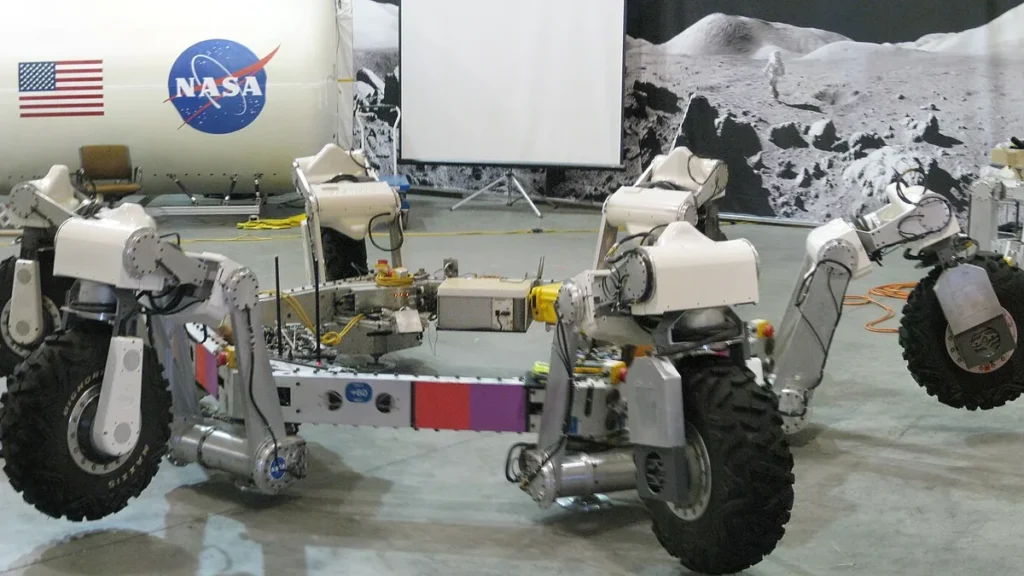
Lunar Outpost built three Pegasus prototypes and had NASA astronauts test them at Johnson Space Center in Houston. The astronauts wore pressurized spacesuits and scored the vehicle’s layout, simplicity and comfort, with evaluating design, usability and crew comfort part of preparing the rover for driving on the Moon. Tests of the Pegasus spring mesh tires checked grip and movement through simulated lunar soil at a NASA Glenn test facility. The tire work at the SLOPE Laboratory examined soil mechanics, traction and mobility.
The team plans to drive a Pegasus prototype with NASA astronauts in a simulated lunar setting, aboard and by remote control. The upcoming test will check how the rover handles with a crew aboard and under telerobotic operation in a simulated lunar environment. Lunar Outpost carried out extensive hands-on tests and iteration with NASA to get Pegasus ready for work on the lunar surface.
Justin Cyrus, Lunar Outpost’s founder and chief executive, said lasting presence in space depends on converting ambitious plans into operational hardware quickly. Cyrus also framed the work as building a permanent lunar presence and providing mobility for NASA astronauts to explore, work and support Moon Base development.
NASA selected two rovers in May, and the May choice covered two commercial lunar terrain vehicles, Lunar Outpost’s Pegasus and Astrolab’s CLV-1, with the second carrying a similar award. Blue Origin will land both rovers using its Blue Moon Mark 1 lander at US$234 million for each mission, with the per-mission price applying to delivery of both selected rovers by the Blue Origin lander.
Canada’s MDA Space belongs to Lunar Outpost’s wider Lunar Dawn team and built a prototype of the MDA Skymaker robotic arm for the group’s rover, with MDA’s arm work part of the broader team effort rather than the pared-down Pegasus vehicle itself. MDA will not supply robotics for the pared-down Pegasus, for which Lunar Outpost lists General Motors, Goodyear and Leidos as partners.
The company plans ten missions to the Moon and cislunar space before 2030, and Lunar Outpost describes itself as having the most lunar rover missions of any company. A 2027 mission will fly a small rover across Reiner Gamma, a bright swirl of lunar soil over magnetized rock seen through telescopes since the 1600s.
Instruments for NASA’s Lunar Vertex investigation will fly on the rover, with the Johns Hopkins University Applied Physics Laboratory leading the work. This is part of the planned 2027 Reiner Gamma mission. A separate small rover will fly on NASA’s Artemis IV mission to study lunar dust and plasma with astronauts, and the rover would operate alongside astronauts during the Artemis IV mission. A consortium co-led by Lunar Outpost is building Roo-ver in Australia, the nation’s first lunar rover, to collect soil for a NASA oxygen-extraction facility.
The company says it ran the first commercial lunar rover and made oxygen on Mars. This background is part of the company’s description of its work on NASA’s Lunar Terrain Vehicle program.



Join the discussion