
Key facts
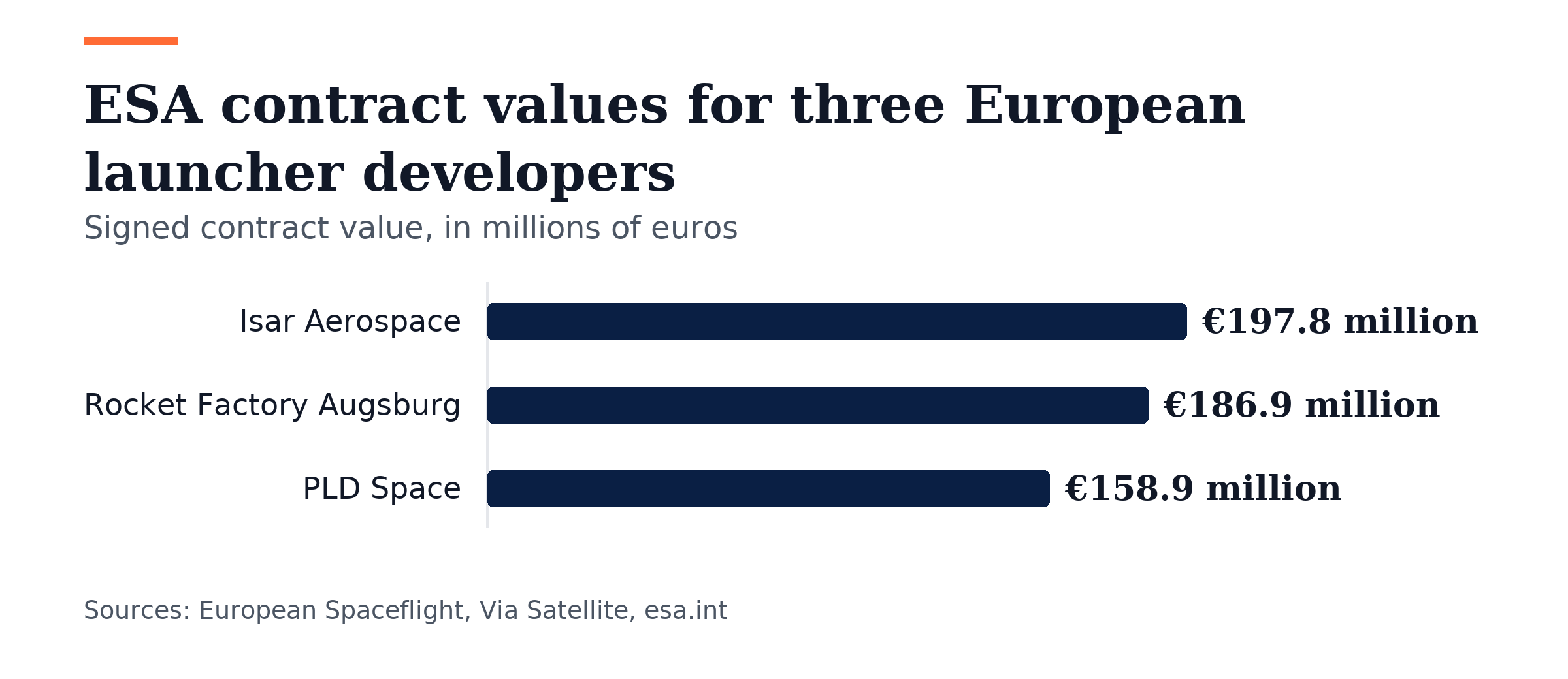
- Isar Aerospace received the largest August 2026 contract at €197.8 million, followed by Rocket Factory Augsburg at €186.9 million and PLD Space at €158.9 million.
- ESA has not yet signed a European Launcher Challenge contract with MaiaSpace because the company chose a funding arrangement different from its competitors, complicating negotiations.
- The other three European Launcher Challenge companies secured most of their funding under Component B: PLD Space received €132.23 million, Isar Aerospace €173.8 million, and Rocket Factory Augsburg €175.21 million.
- Each of the three other challengers secured less than €37 million under Component A, with Rocket Factory Augsburg receiving just €15.3 million under that component.
The European Space Agency said MaiaSpace’s choice of a funding arrangement different from its competitors has left the company’s European Launcher Challenge contract unsigned and complicated negotiations.
On Aug. 27, 2026, the European Space Agency signed deals totaling €543.6 million under the European Launcher Challenge. The recipients were Isar Aerospace, Rocket Factory Augsburg, and PLD Space. Isar Aerospace received the largest award at €197.8 million, with Rocket Factory Augsburg receiving €186.9 million and PLD Space €158.9 million. The August signing covered only the three companies that pursued the standard route, leaving MaiaSpace’s contract pending.
Under the challenge, launch service contracts draw from Component A, while Component B covers co-funding for developing and demonstrating upgraded launch vehicle capabilities. MaiaSpace secured €183.4 million all under Component A, while the other three companies directed most of their funding to Component B, commitments dating to the 2025 Ministerial Council in Bremen. Ezequiel Sánchez said PLD Space views the agreement as more than a standalone milestone.
During ESA’s 2025 Ministerial Council meeting in Bremen, member states committed €902.16 million to the challenge. PLD Space received €132.23 million under Component B, Isar Aerospace €173.8 million, and Rocket Factory Augsburg €175.21 million. Under Component A, each of the three received less than €37 million, and Rocket Factory Augsburg received only €15.3 million.
ESA Director of Space Transportation Géraldine Naja explained the delay during an ESA media briefing on Oct. 22, 2026. She said MaiaSpace was the only challenger to choose launch service contracts rather than technical development funding, and that the other three companies had chosen the standard technical development funding route used by competitors. Negotiations were a little bit more sophisticated because of MaiaSpace’s preference, she said, and the contract’s signing was a question of days.
In August 2026, ESA said the MaiaSpace contract process was nearing completion and expected to restart soon. As of the Nov. 12, 2026 report, ESA had yet to publicly announce the signing of the MaiaSpace contract. Three weeks after Naja described the signing as a question of days, the contract remained unsigned.
ESA described the European Launcher Challenge on Nov. 26, 2025 as an initiative to expand European launch service supply and ensure more robustness in Europe’s access to space. Géraldine Naja said the funding strengthens European competitiveness and broadens launch service choices for institutional and commercial customers. Naja said the milestone kicks off the challenge and encourages competition among European launch providers.
On Nov. 26, 2025, ESA said an evaluation board reviewed each proposal, examining business case, engineering quality, resources, schedule, compliance, financial and technical details, and progress. The award process ended the Challenge’s second stage, which allowed shortlisted companies to submit proposals before April 2026. Awardees unlock funding when they meet milestones, and each must complete an orbital launch before 2028. Lucía Linares said the contracts represent ESA turning ambition into action.
Rocket Factory Augsburg is developing the three-stage RFA One orbital vehicle, about 30 m tall and 2.15 m in diameter, set to launch from a SaxaVord pad in the UK. The vehicle can deploy up to 500 kg to a 500 km sun-synchronous orbit. The company is preparing a SaxaVord Spaceport launch in Scotland for the RFA One rocket, though it recently halted a testing campaign there after running into an issue requiring further investigation.
Isar Aerospace is developing the two-stage Spectrum launcher, 28 m tall and 2 m in diameter with ten engines. It first flew from Andøya Spaceport in Norway in 2025 for 30 seconds, and it is designed to carry as much as 1000 kg to low Earth orbit. The company is preparing a second attempt to validate Spectrum after its March 2025 first flight did not succeed, and it stood down from a June 2025 attempt.
PLD Space flew its Miura 1 technology demonstrator rocket from Spain in 2023, using it as the basis for the Miura 5 launcher. Miura 5 will lift off from Europe’s Spaceport in French Guiana and can deliver as much as 540 kg to a sun-synchronous orbit. The company plans to apply its €158.9 million contract toward establishing commercial orbital launch service and increasing flight cadence through 2030. The company said it is on track for a first Miura 5 launch from the Guiana Space Centre during 2026.
The company manages over 188,000 square meters spread across manufacturing, testing, and operational sites in Elche and Teruel in Spain, Kourou in French Guiana, and Duqm in Oman. The company’s €158.9 million agreement spans Components A and B, with Component A backing commercial flight scaling and infrastructure consolidation for Miura 5 through 2030. For Component B, PLD Space plans to add performance upgrades to the Miura 5 two-stage launcher. The work aims to expand payload mass-to-orbit capability, extend upper-stage orbital reach, and introduce active propulsive recovery systems for stage reusability.



Join the discussion