Key facts
- Vishal Gajjar, an astronomer at the SETI Institute, independently identified two Kepler signals found by Bond, consisting of star KIC 5689121 and star KIC 6691030.
- One of Bond's flagged signals comes from KIC 5689121, a relatively cool star in Lyra that dims every 13.8 days; OpenAI said a planet causing it would be about 2.4 times Earth's diameter.
- Ethan Byrd's initial Astra search produced 49 exoplanet candidates; he has submitted one to researchers working on NASA's TESS mission, two others await submission, and the search is continuing.
- On Nov. 24, 2026, OpenAI said two astronomy enthusiasts had examined public telescope archives with its Codex and Astra tools, producing two promising signals and 49 more preliminary exoplanet candidates.
OpenAI said on Nov. 24, 2026 that two astronomy enthusiasts had searched public telescope archives using its Codex and Astra tools, turning up two promising signals and 49 preliminary exoplanet candidates.
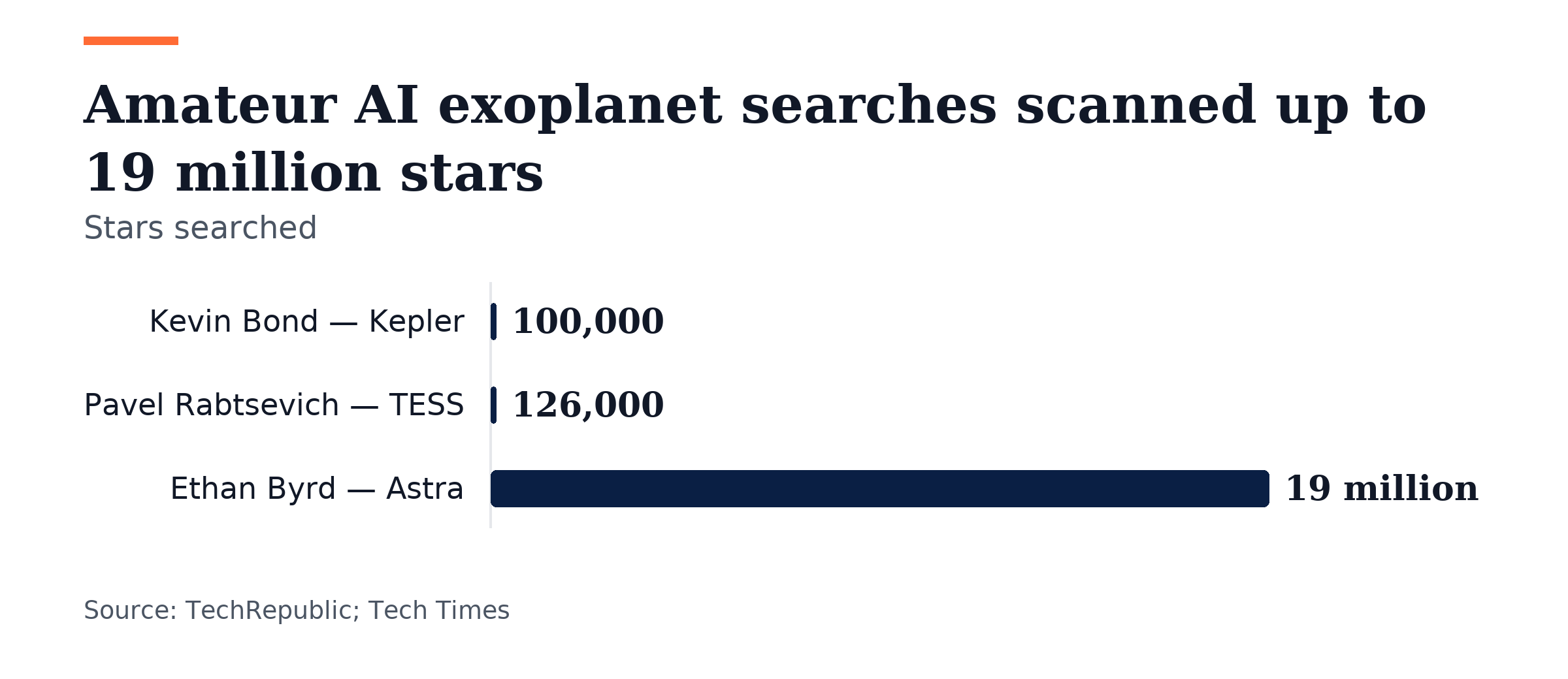
OpenAI engineer and amateur astrophotographer Kevin Bond built the Codex side of that work himself. He merged published detection techniques into a custom search program running two AI agents — one to flag candidate signals and another to review them — and refined the code through testing, and scanned observations of about 100,000 stars from NASA’s Kepler Space Telescope. The program flagged more than 200 signals, and ten of them matched planets already confirmed — a control test showing the code could recognize genuine planetary signatures before hunting for new ones..
Two signals stood out from Bond’s Kepler search. One comes from KIC 5689121, a cool star in Lyra that dims once every 13.8 days; OpenAI said a planet behind the dimming would measure about 2.4 times Earth’s diameter. The second comes from KIC 6691030, which dims every 4.8 days; OpenAI said the dimming pattern matches what a possible planet smaller than Neptune would produce.
The SETI Institute’s Vishal Gajjar independently identified the same two Kepler signals found by Bond. That independent verification gave researchers more confidence that the patterns exist in the archive, though the signals’ planetary origins remain unconfirmed.
Ethan Byrd, founder of startup Primitive, handled the Astra side of the work. He used Astra to study observations of about 19 million stars, running two searches — one broad sweep and another focused on habitable-zone planets, where surface conditions could allow liquid water on the surface. OpenAI said Byrd’s candidates are at an earlier stage than the two Kepler signals: he has submitted one candidate to researchers working on NASA’s TESS mission, two others await submission, and the search continues. Astra also lets amateur astronomers design and run their own searches, often on weaker signals earlier work may have missed.
OpenAI said it could take months or years to confirm whether Bond’s signals are undiscovered planets, especially if a possible planet is hard to observe. The company released no false-positive rate for the signals beyond those already-confirmed recoveries. It also said no new worlds have been confirmed; amateurs now have another way to sort through public data and flag observations that deserve closer examination. Neither Bond nor Byrd launched telescopes or gathered new observations; both relied on existing data open to researchers and the public.
NASA also operates Exoplanet Watch, which lets people analyze existing telescope data without owning a telescope. The program’s free EXOTIC software creates brightness graphs, and participants can submit results through the American Association of Variable Star Observers. People with suitable telescopes can also gather their own observations and take part in coordinated campaigns through the program.
Astronomers have used AI to identify planets for years. A 2017 project used a neural network trained on 15,000 Kepler signals to find an eighth planet around Kepler-90, and NASA’s 2017 announcement of Kepler-90i likewise relied on a neural network trained to identify planetary signals in telescope data. The NASA Exoplanet Archive lists more than 6,400 confirmed exoplanets found since 1992..
Monthly Notices of the Royal Astronomical Society published a 2026 paper on Kepler searches that found local flaws and statistical false alarms may mislead analysts, making earlier candidates look less convincing on closer checks. OpenAI once used nearly 2,000 AI agents to study brain-cell data, an example of faster analysis producing more leads without establishing accuracy; those proposed neurological links still need validation. The company cautioned that AI coding tools can help technically inclined participants build custom search programs, though researchers must still check whether those programs recover known planets, trigger false alarms, or confuse telescope artifacts with real signals.
Pavel Rabtsevich, an amateur astronomer based in Spain, used a custom AI algorithm to study more than 126,000 TESS target stars and identified a repeating signal for TIC 4206066, a star in Orion about 116 light-years from Earth. Its brightness decreased for about two hours every three days, and Rabtsevich logged 22 additional dimming instances in the TESS archives for that star. If genuine, the object might be a super-Earth roughly 1.4 times Earth’s radius, orbiting every three days with surface temperatures near 1,000 degrees Fahrenheit, or 540 degrees Celsius, estimates that hold only if the signal really represents a planet.
He noticed that some dimming dips from 2018 coincided with TESS thruster firings, which can affect measurements; researchers must still establish whether the dimming is genuine or caused by an instrument. He said agreement among AI models alone does not prove a discovery; his method relies on measurable signals, calculations that can be reproduced, control samples, and rules fixed before he examines more data. Several AI agents handled writing code, running analyses, and checking one another’s work, while Rabtsevich defined the question, set the procedure, chose the candidates, and decided what to publish.
An MIT doctoral student and TESS team member said a detection filter flagged the TIC 4206066 signal in 2020 and rejected it as inconclusive; later observations made it detectable again in January 2026. His team’s deep-learning model also flagged the candidate in early 2026, and Michelle Kunimoto’s LEO-Vetter software selected the same candidate in early 2026. Greg Laughlin of Yale University, an AI researcher, called Rabtsevich’s effort human-AI collaboration and said large language models help with searching astronomical literature and spotting overlooked findings.


Join the discussion