Key facts
- When a massive star's core collapses, a shock wave moves outward and trapped light leaks ahead of it near the surface; astronomers call the first escape of this radiation shock breakout.
- Radiation leaks ahead of the physical shock and heats and pushes nearby gas before the shock arrives, creating a radiative precursor that alters gas speeds and produces complicated flows.
- The simulations predict that the flash reaches a peak of roughly 1–3 × 1044 ergs per second and remains near maximum for about 4–35 hours; these figures are model predictions rather than measurements of one supernova.
- Gas around the star can glow with fingerprints of highly ionized atoms, especially the helium line He II at 4686 angstroms, and maintaining this signal for days demands more than a single instantaneous burst.
Wun-Yi 文翊 Chen 陳, Ke-Jung Chen, Keiichi Maeda and Friedrich K. Röpke found that nearby gas changes when a massive star’s first flash of light arrives, how bright it becomes and how long it lasts, in research published in The Astrophysical Journal in 2026 and reported by Phys.org.
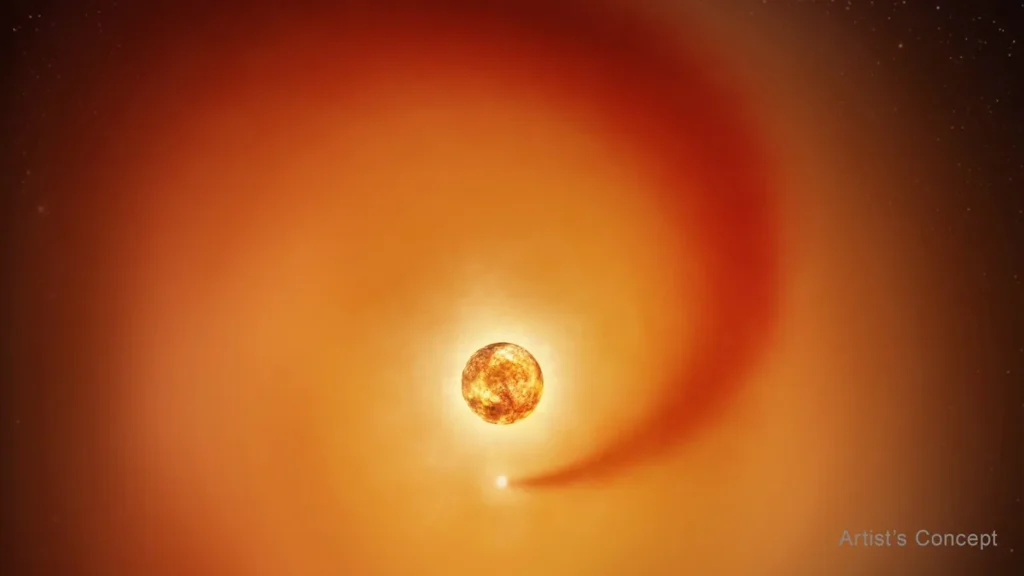
The researchers explain that when a massive star‘s core collapses, a shock wave — a sudden jump in pressure and density driven through the star’s gas — travels outward and trapped radiation leaks out ahead of it near the star’s surface. Astronomers call this first escape shock breakout, the earliest light from the star’s destruction. With no nearby gas the flash is brief, but a dense cloud makes light particles bounce around many times before they get out, like headlights in fog, which alters the flash’s arrival, brightness and length.
The work comes from Wun-Yi 文翊 Chen 陳 and Ke-Jung Chen of the Academia Sinica Institute of Astronomy and Astrophysics, Keiichi Maeda of Kyoto University and Friedrich K. Röpke of Heidelberg University. The researchers note that red supergiants can shed large amounts of material in their final years or decades, with some of it remaining close enough to form a dense cloud around the star. Violent stellar activity or interactions with a companion star may produce the material, and these enormous aging stars have outer layers that could extend far beyond Earth’s orbit.
The paper is titled Observable Signatures of Supernova Shock Breakout in Confined Circumstellar Medium and lists Wun-Yi 文翊 Chen 陳 et al. as its authors. The team treats the cloud around the star — circumstellar means gas around a star — as something that changes how the first radiation escapes rather than as passive scenery.
The researchers used the CASTRO simulation code to build a two-dimensional model of an exploding red supergiant — a model of a flat slice of the star — while following radiation across 16 wavelength groups from infrared light to soft X-rays. Older approaches often forced a choice between tracking the explosion’s turbulent structure and following its many wavelengths.
In the model, exposed hot regions push the spectrum toward higher energies, while expansion and cooling make it redder. Certain soft X-ray signals include an early shoulder or a second peak because separate gas layers release trapped radiation at different times. Because much of the energy escapes as extreme ultraviolet and soft X-ray light rather than visible light, ordinary cameras using visible light could miss most of this early stage.
Radiation moves ahead of the physical shock and warms and pushes nearby gas before the shock arrives, the researchers said. The team calls this a radiative precursor, heating driven by radiation ahead of the shock, and it changes gas speeds and creates complicated flows in the gas around the star. The altered flows shape how the star’s first radiation escapes.
The team’s simulations predict that the flash peaks at roughly 1–3 × 1044 ergs per second — ergs per second being a unit of power — and stays near maximum for about 4–35 hours. The team cautions that these figures are model predictions, not measurements of any single supernova.
In the team’s model, gas around the star can glow with fingerprints of highly ionized atoms, especially the helium line He II at 4686 angstroms — an angstrom is a unit used to measure light wavelengths — and keeping that signal going for days requires more than a single instant of radiation. Highly ionized means atoms stripped of their electrons. In the densest clouds, continued shock-gas interaction supplies powerful extreme-ultraviolet radiation that keeps helium ionized for several days. The same dense material also lengthens ultraviolet output while reducing some X-rays.
The team’s results mean the breakout flash’s timing, brightness and duration encode conditions in the gas at the moment of the star’s destruction. The calculations may explain puzzles seen in the earliest spectra of some supernovae, where surrounding gas briefly glows with the fingerprints of highly ionized atoms. Rapid spectroscopy — spreading light into its component wavelengths to learn what it is made of — could distinguish a compact cloud from a larger one and show whether expelled material formed a spherical wind or an uneven belt. The Einstein Probe looks for rapid X-ray flashes, while ultraviolet missions including ULTRASAT reveal longer-lived ultraviolet signals.
Supernova SN 2023ixf serves as one example in the discussion, with early ultraviolet behavior and uneven gas around the star that resemble parts of the model results. The researchers caution that no single model explains every observation.
The team says the next challenge is to replace simplified gas distributions with material from realistic stellar outbursts combined with binary interactions. Researchers must also calculate turbulent flow across all three dimensions — length, width and depth.
The team says the cause of the dense circumstellar cloud remains uncertain. Violent stellar activity or companion-star interactions might help produce it.

Join the discussion