
Key facts
- A team of researchers from Japan conducted the study using archival data on Comet 2P/Encke, and the work was published in The Astronomical Journal.
- Thermal emission from a comet's nucleus can be recorded directly through mid-infrared observations even if the nucleus is surrounded by a cloud of gas and dust.
- The surface temperature of Comet 2P/Encke's nucleus is estimated at about 328 Kelvin (55 degrees Celsius or 131 degrees Fahrenheit).
- Dr. Takafumi Ootsubo of the University of Occupational and Environmental Health in Japan serves as assistant professor in its Department of Basic Sciences at the School of Medicine and is the study's lead author.
A team of researchers from Japan mapped Comet 2P/Encke’s nucleus using archival mid-infrared data from ground-based telescopes including Subaru, gathered during the comet’s November 2003 close approach, according to the study in The Astronomical Journal.
Mid-infrared observations record thermal emission directly from a comet’s nucleus even when the object is surrounded by a cloud of gas and dust, allowing direct measurement of the nucleus itself. Mid-infrared is a form of thermal radiation that detects heat rather than reflected light. Researchers aimed to separate the nucleus signal from the envelope of ice, gas and dust that expands as solar heat evaporates the comet’s icy material. Dr. Takafumi Ootsubo, assistant professor in the Department of Basic Sciences at the University of Occupational and Environmental Health in Japan’s School of Medicine and the study’s lead author, said the technique lets researchers “directly capture thermal emission from the nucleus itself.”
The nucleus spans roughly seven kilometers by three kilometers, or 4.3 miles by 1.9 miles. Its surface temperature is estimated at about 328 Kelvin, or 55 degrees Celsius and 131 degrees Fahrenheit. The measurement came from archival mid-infrared data gathered during the comet’s November 2003 close approach, when several ground-based telescopes including Subaru observed the object. The temperature estimate derives from the same November 2003 archival observations used to determine the nucleus dimensions.
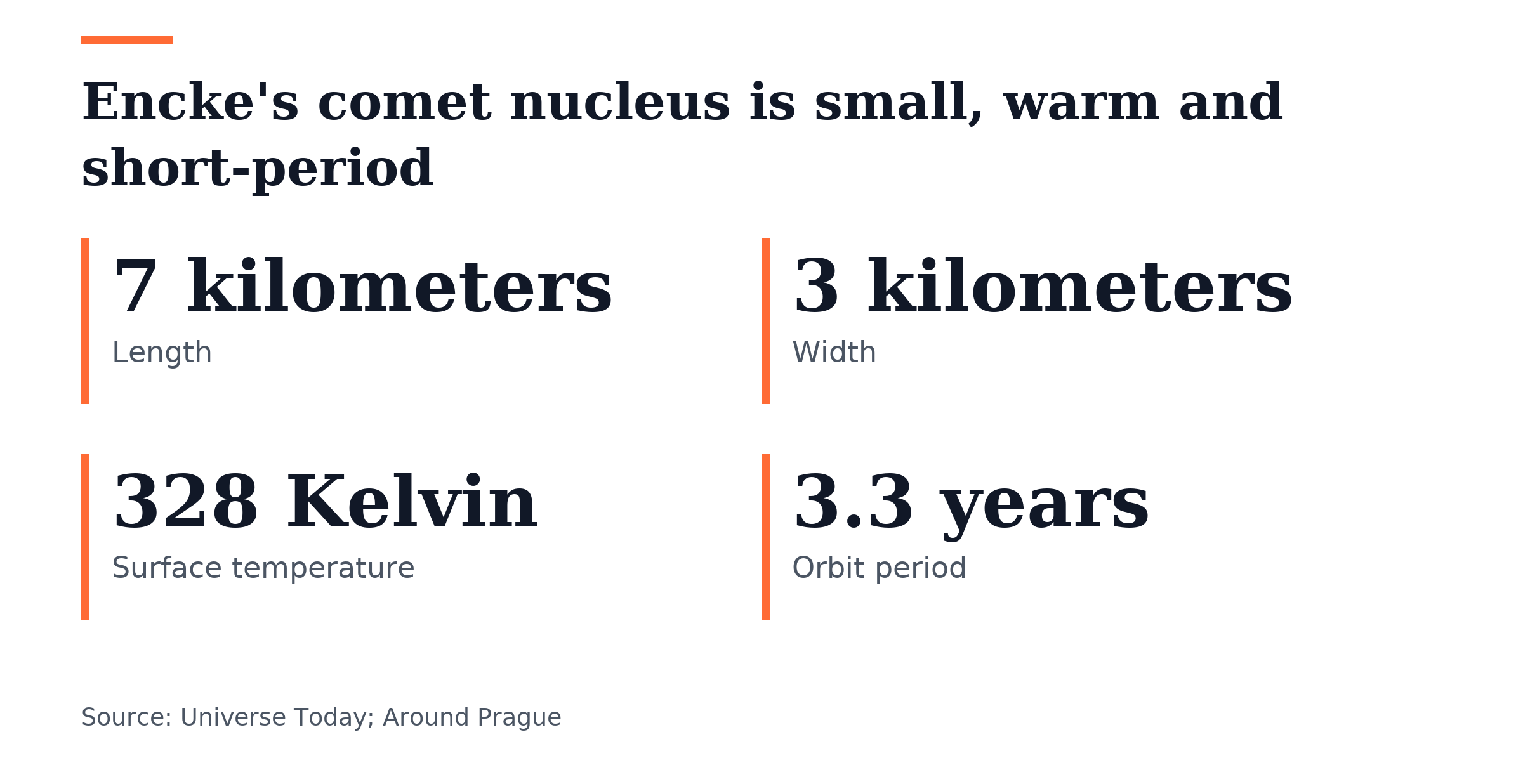
Comet 2P/Encke originated in the Kuiper Belt and became a Jupiter-family comet after Jupiter’s gravity captured and reshaped its orbit. Its orbit lasts only 3.3 years, significantly shorter than traditional comets, which can take from decades to millions of years to journey between the outer solar system and the inner solar system. When a comet nears the Sun, increased heat evaporates its icy material, producing a tail and revealing the rocky nucleus underneath. Comets hold material that has existed for billions of years and are treated as preserved remnants from the formation of the solar system.
During November 2003, Comet 2P/Encke passed within 0.26 astronomical units (AU) of Earth, roughly 37 million kilometers or 26 million miles, while lying about 1.09 astronomical units from the Sun, about 163 million kilometers or 101 million miles. The comet is expected to come within 0.62 AU of Earth in February 2027, a distance of 93 million kilometers or 58 million miles. It came within roughly 0.19 AU of Earth in July 1997 and November 2003, equal to 28.5 million kilometers or 17.7 million miles. The comet’s orbit is constantly reshaping, so Earth encounters have happened only a handful of times in recent decades even though its orbital period is 3.3 years.
In 2020, the COMICS instrument was retired from Subaru, which left the observatory without a mid-infrared instrument and limited its research to archival data from past observations. Dr. Ootsubo is actively working to restart the COMICS program, so the team can study more cometary nuclei. Universe Today did not report a timeline or funding for the restart.
Around Prague notes the result comes from one comet and one set of observations, and describes the temperature as an estimate. The outlet ties comet research to rare close passes and calls the work basic research whose value is scientific because it changes nothing about daily life. Around Prague also adds that Universe Today did not report a timeline or funding for restarting COMICS, underscoring uncertainty around future observations of cometary nuclei.

Join the discussion