Key facts
- C/2026 S1 (Euclid) is the first previously unknown comet found by the European Space Agency's Euclid space telescope.
- Mikko Pöntinen, a PhD student at the University of Helsinki, found the object as part of the Euclid Consortium's Solar System Objects Science Working Group.
- The object showed up in the Euclid Deep Field North area of sky and was imaged across five separate fields of view, using two to four exposures per field for 16 exposures total.
- Pöntinen reported the object to the Minor Planet Center of the International Astronomical Union after catalog searches found no match, and the center confirmed it on October 8, 2026.
The European Space Agency’s Euclid space telescope has found its first previously unknown comet, C/2026 S1 (Euclid), in images taken from Sept. 16 to 24, 2026, roughly 1.3 billion kilometers from Earth.
Mikko Pöntinen, who is a PhD student at the University of Helsinki, spotted the object while working with the Euclid Consortium’s Solar System Objects Science Working Group. His specialized software flagged a streak smeared across multiple images, and he identified the comet in five image sets. A fuzzy cloud around the streak showed an active object shedding dust and gas. Pöntinen said, “I was excited to see my software flag a ‘streak’ smeared across several images”.
The comet appeared in the Euclid Deep Field North across five separate fields of view, with two to four exposures in each field for 16 exposures overall. That repeat imaging was unusual because Euclid normally takes just one picture of each part of the sky under its step-and-stare plan. The object travels outside the flat plane of the planets’ orbits, above the Sun on a path that will take thousands of years to complete. It moves between Jupiter and Saturn, as far from Earth as a point between those planets’ orbits lies from the Sun.
Pöntinen notified the Minor Planet Center of the International Astronomical Union that catalog searches had found no match, and the center confirmed it on Oct. 8, 2026. The center confirmed it as C/2026 S1 (Euclid). Researchers expect to calculate the comet’s orbital period more precisely after additional observations arrive.
Bruno Altieri, a Euclid Archive Scientist on the discovery team, said very few comets are expected from Euclid and described the multiple-image capture as a happy coincidence. The overlap of the comet’s orbit with Euclid’s scanning across those days let the telescope image the moving object repeatedly despite its usual single-pass approach.
Valeria Pettorino, the Euclid Project Scientist, said her team is glad to find a previously unknown comet for the solar-system community to follow up on, and she described it as a real test case for coordinating future work between the Euclid and Comet Interceptor teams. The discovery was reported on behalf of the working group by eight researchers: M. Pöntinen, A. A. Nucita, A. Franco, M. Granvik, B. Altieri, S. Kruk, B. Y. Irureta-Goyena and B. Carry.
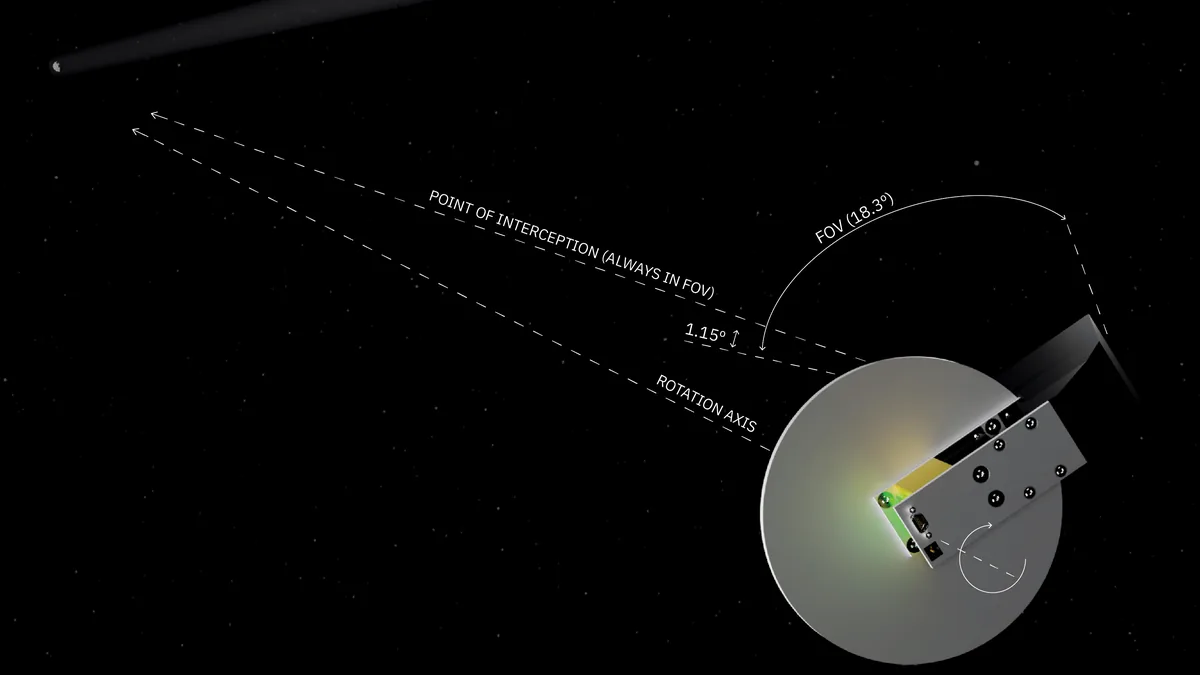
The find gives scientists on ESA’s future Comet Interceptor mission a test case for coordinating how discoveries and alerts are handled, though this particular comet is not a suitable candidate for that spacecraft. Researchers say the rapid identification shows Euclid can detect new comets far from the Sun, a capability that could eventually help choose a target for the planned Comet Interceptor.
The spacecraft will spend six years surveying billions of galaxies at distances up to 10 billion light-years to study how dark matter and dark energy shape the visible universe. It was launched in July 2023 with NASA contributions and now orbits the Sun-Earth Lagrange point 2, roughly 1.5 million kilometers from Earth. From that position it gauges the redshift of roughly 10 billion sources out to redshift 2, equal to about 10 billion years ago or 3.7 billion years after the Big Bang.
Because Euclid was designed to study distant galaxies instead of fast-moving objects, finding a previously unknown comet in its own pictures came as a surprise. Euclid steers clear of the sky around the solar system’s plane because dust there creates stray light that could disrupt sensitive observations of the distant universe. Because it uses a step-and-stare approach, imaging each part of the sky only once, teams cannot easily redirect the spacecraft to a newly found comet for more details. The telescope has imaged comets before, but every one was already known.
The first data release, called DR-1 Foundation and issued Nov. 12, 2026, contains 1.7 million gigabytes covering nearly 5% of the night sky, including 900 million galaxies, 60 million quasars and 15,000 new strong lens candidates. It charted 1,900 square degrees of sky using visible and near-infrared bands and also lists more than 60 million quasar candidates and spectra from over 160 million sources. The full Wide Survey plans to map 14,000 square degrees of sky.
Researchers use the mission to identify objects in our solar system, removing comet trails and stray light so galaxy measurements stay accurate. Imaging such comets far out in the solar neighborhood can also teach scientists to spot cometary trails as noise in the telescope’s view.
Comets are ancient ice and dust left over from the solar system’s formation about 4.6 billion years ago, most coming from the Kuiper Belt and Oort Cloud beyond the outer planets. These objects have remained mostly unchanged since they formed, keeping evidence of the materials and conditions present while the planets took shape, and researchers say studying them could reveal the origins of Earth’s water and the chemicals behind life. As a comet approaches the Sun, heat turns its ice directly into gas, and the escaping gas and dust form a glowing coma and a long tail.

Join the discussion