
Key facts
- Two of NASA's four active Mars missions have halted science work following separate technical problems in recent weeks.
- The affected missions are the Perseverance rover and the Odyssey orbiter.
- The Perseverance fault is in its communications system, which uses two redundant UHF radios for high-rate links through Mars orbiters and a separate X-band system for slower direct contacts with Earth.
- When one Perseverance UHF radio did not respond after being powered on October 30, the system automatically switched to the backup and put the rover into safe mode.
Two of NASA’s four active Mars missions, the Perseverance rover and the Odyssey orbiter, have halted science work after separate technical problems, Ars Technica reported Nov. 24, 2026.
Perseverance is in its sixth year exploring the Martian surface and has collected rock and soil samples intended for eventual return to Earth. The rover is examining the edge of a crater that previously held an ancient lake made of liquid water, though its surface science work is now paused. Perseverance uses two redundant UHF radios for high-rate links through Mars orbiters and a separate X-band system for slower direct contacts with Earth.
After one Perseverance UHF radio failed to respond when powered up on October 30, the spacecraft switched to its backup radio and entered safe mode. Ground teams at NASA’s Jet Propulsion Laboratory in California detected the failure after the rover attempted to power up the radio.
NASA said last week that engineers found the backup UHF radio transmitting at roughly half its expected power output. NASA said the team stopped using both radios while engineers review possible causes and decide whether either unit can safely return to service.
The rover is currently sending signals directly to Earth through X-band, at a much lower data rate than the normal orbiter relay over UHF. Mission managers halted rover science work out of caution while they investigate the radio issue. NASA said the first recovery step is restoring the backup UHF radio before attempting to bring the primary unit back online.
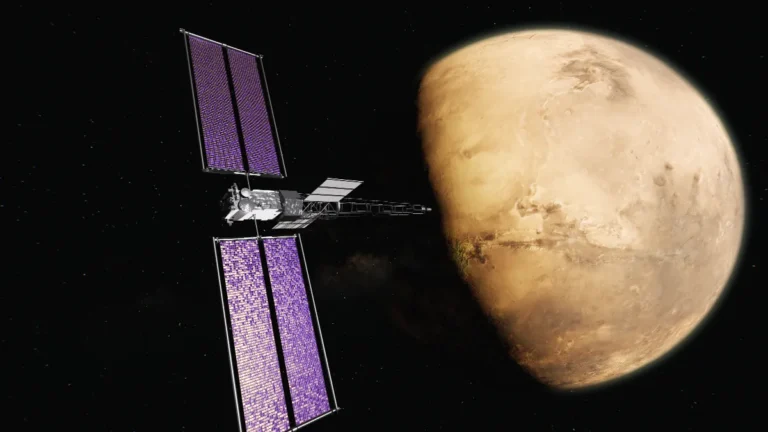
Odyssey reached Mars orbit in 2001 and holds the record as the longest-lived mission to the planet. Each spacecraft has operated longer than its original design lifetime. The simultaneous outages leave half of NASA’s four active Mars missions without science work.
Perseverance has been driving through Jezero Crater since 2021, collecting information about Martian geology and clues to the planet’s past. Near the bottom of Jezero Crater is the Séítah formation, a rock layer almost four billion years old. A 2026 study in Communications Earth & Environment offers an explanation for how the Séítah formation came to be.
Researchers drew geochemistry data from PIXL, an X-ray spectrometer aboard Perseverance that identifies chemical elements in rock and soil. Based on geochemistry data and modeling, the low-viscosity flow spread about 200 kilometers (124 miles) from its magma vent. Interlocking olivine crystals in the Séítah formation point to a low-viscosity lava lake that cooled over hundreds or thousands of years.
Previous work suggested the Séítah formation was made of komatiite, an olivine-rich rock. On early Earth, komatiites formed from runny, low-viscosity lavas that flowed almost like water. Mars’ cooler interior would theoretically make olivine harder to form, which made the discovery of large olivine grains on Mars unusual.

High-viscosity lavas build cone-shaped volcanoes, while low-viscosity lavas form flatter, wider rock layers. Researchers applied a 2008 Earth magma movement model to connect geochemistry readings with lava viscosity. Viscosity measurements allowed scientists to calculate how far a lava flow traveled and pinpoint its probable source. This helps planetary scientists address the problem of explaining very long lava flows present on Mars.
Alternative hypotheses suggest the Séítah lava was an intrusion, with molten rock from inside Mars crystallizing inside existing rock layers. If true, the rock would have needed uplift and exposure, which could imply active plate tectonics on Mars. Current evidence suggests plate tectonics is not active on Mars. A challenge in modeling other planets’ histories is that researchers remain uncertain whether every rocky planet was built from the same elemental proportions.
Lionel Wilson, a planetary scientist at Lancaster University not involved in the study, commented on the research. “Suggests that the long-term evolution of the mantles of Earth and Mars is not enormously different,” Wilson said.
Adrian Brown, a planetary scientist at Plancius Research and the paper’s lead author, said low-viscosity lavas would have required a relatively warm Martian interior, potentially making the planet more hospitable to life. Brown linked interior temperature to potential habitability as part of what knowing Mars’s geological history can reveal.
Perseverance has been studying unusually bright rocks in Idubi, part of the Lac de Charmes region outside Jezero Crater. The rover photographed the Idubi formations on Oct. 29, 2026, during its 2023rd Martian day.
SuperCam readings showed the Idubi rocks contain abundant hydrated silica instead of typical igneous rock. Hydrated silica can form through hydrothermal activity or groundwater, and such deposits can preserve microscopic fossils, making them targets in the search for ancient life. The rover is now conducting a closer examination of the Idubi formations with its instruments to gather detailed chemical and mineralogical data.



Join the discussion