
Key facts
- According to Turyshev's paper, purely optical communication is very unlikely to replace radio for space communication soon, and a hybrid laser-radio partnership is the better approach.
- Cloud cover blocks all optical and near-infrared lasers, making uplinks and downlinks essentially impossible at an affected base station unless another suitable station is available.
- A single optical ground station is expected to be available just over 60% of the time, while two stations paired in the American Southwest can push availability to around 85%.
- A German Aerospace Center study found that eight optical stations spread across Australia and New Zealand cut outage odds to just 0.02%.
Dr. Slava Turyshev argues in an arXiv pre-print that system reliability, not raw data speed, is the binding constraint for infrared optical space-to-ground links, Universe Today reports.
The researcher is known for work on using the Sun’s gravity as a giant telescope, Universe Today notes. His paper is available as an arXiv pre-print. The pre-print pushes back on the idea that optical links can easily outscale regulated radio frequencies. Instead, it frames system reliability, rather than raw data speed, as the binding constraint for infrared optical space-to-ground links.
His paper concludes that purely optical communication is very unlikely to replace radio for space communication soon. A hybrid laser-radio partnership is the better approach, the paper finds. Under that division of labor, lasers should handle heavy data downloads such as video and Earth-observation imagery. Radio should remain the reliable backup for spacecraft steering and emergencies, an arrangement meant to keep astronauts and critical infrastructure connected regardless of weather.
Cloud cover blocks all optical and near-infrared lasers. At an affected base station, uplinks and downlinks become essentially impossible unless another suitable station is available. The atmosphere also distorts laser light through turbulence from warm and cold air pockets. Engineers must correct that turbulence using adaptive optics deformable mirrors or specialized microchips, both costly options, while clouds present the harder problem because they fully block the beam.
A single optical ground station is expected to be available just over 60% of the time. Two stations paired in the American Southwest can push availability to around 85%. Turyshev’s paper pairs stations together to improve availability. Geographic diversity can reduce weather-related outages for optical ground networks, according to the paper.
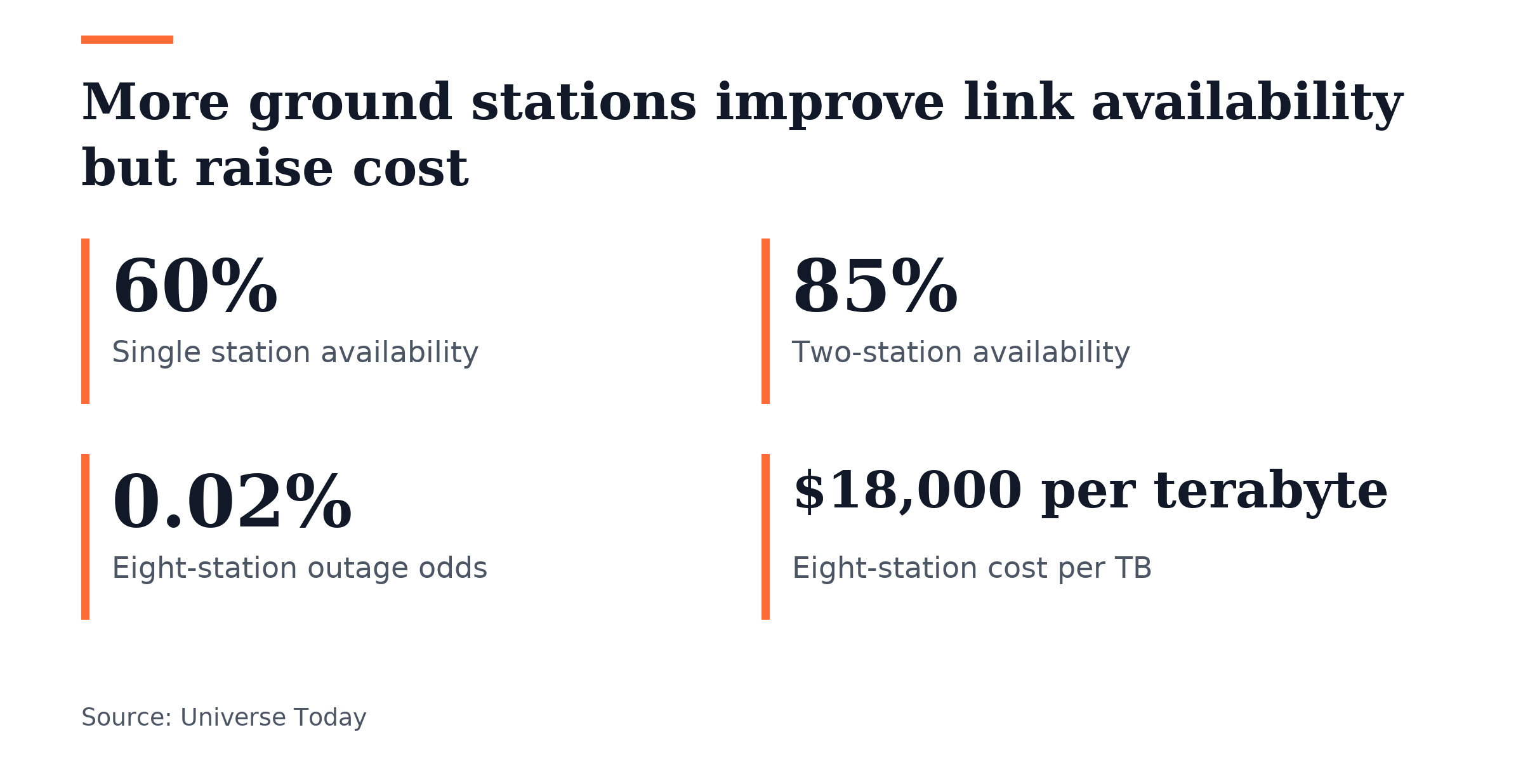
A German Aerospace Center study found that eight optical stations spread across Australia and New Zealand cut outage odds to just 0.02%. A large, spread-out station network can make outages extremely rare, the result illustrates. The source calls an eight-station network for a single mission economically infeasible.
Each optical ground station costs roughly two million dollars per year to build, staff, and operate. The annual cost is why deploying enough stations to guarantee coverage drives the per-terabyte cost into the tens of thousands of dollars.

An eight-station network built to nearly guarantee consistent coverage raises the cost to $18,000 per terabyte of data. The source describes this as the price to almost guarantee consistent coverage. The economics only work with multiple users sharing the network.
NASA’s TBIRD demonstration reached 200 gigabits per second from orbit and moved five terabytes during one five-minute pass under near-perfect atmospheric conditions.
Ground stations must automatically shut off uplink lasers when an airplane passes overhead to avoid blinding pilots or aircraft sensors. The shutdowns cause recurring disruptions that do not affect radio links. Even brief interruptions add up to consistent disruption for laser links.
Radio frequencies face heavy regulation by organizations including the International Telecommunications Union. The regulation restricts network scalability as demand for space-to-ground bandwidth grows. That is why infrared lasers are often proposed as an alternative to radio, the source says.
Making the per-terabyte cost reasonable requires multiple satellite companies to split the same ground network. The stations must stay busy at least half of the time. Sharing stations across multiple satellite operators is necessary to bring costs down.
CCSDS 141.0-B, also known as O3K, is a Consultative Committee for Space Data Systems standard that sets hardware and handshaking rules for high-rate near-Earth links. The US Space Development Agency‘s Optical Communications Terminal Standard requires interoperability across terminals regardless of supplier. It includes requirements for CCSDS communication protocols, so terminals from different suppliers can work together. Standardization efforts are already underway for optical communications hardware and protocols, involving both the Consultative Committee for Space Data Systems and the US Department of Defense.



Join the discussion