Key facts
- The research appeared in The Astrophysical Journal Letters in 2026 as Tea Temim et al 2026 ApJL 1012 L26.
- Researchers used JWST's unprecedented mid-infrared spatial resolution to separate dust emission from individual clumps measured at arcsecond scales in supernova ejecta and circumstellar material.
- The ejecta clumps studied are as large as the Solar System.
- Instead of treating the spectra as one mixed jumble, researchers catalogued distinct dust species for each separate region.
Universe Today reported that researchers used the James Webb Space Telescope’s Mid-Infrared Instrument, or MIRI, and Medium-resolution Spectrometer to determine the chemical makeup of Cassiopeia A, a supernova remnant about 11,000 light years away, in new research published in The Astrophysical Journal Letters in 2026.
The paper appeared as Tea Temim et al 2026 ApJL 1012 L26 in The Astrophysical Journal Letters. Its lead author is Tea Temim, a research scientist from Columbia University. The Medium-resolution Spectrometer, or MRS, gave the team JWST’s mid-infrared spatial resolution to separate dust emission from individual clumps at arcsecond scales in the supernova ejecta and surrounding circumstellar material, the gas and dust around the star.
The ejecta clumps studied—debris blown from the star—are as large as the Solar System. Instead of treating the spectra as one mixed jumble, the researchers catalogued distinct dust species for each separate region. Before turning to JWST, the team used Spitzer images to identify three regions with different dust properties, then examined those regions—called P1, P2, and P3—with MRS; all three show significant warm dust emission with differing spectral shapes.
P1 samples ejecta altered by a reverse shock, a wave driven back into the debris, and is dominated by silica grains and bright argon emissions, helping track the outer layers of the supernova’s ejecta. The silica detection at P1 lends support to the hypothesis that the progenitor, the star that exploded, experienced a carbon–oxygen shell merger. P3 is another reverse-shocked region. Its very bright neon emissions compared to P1 favor a merger between a carbon shell and an oxygen shell.
P2 is centered on Cas A’s Green Monster structure, the bright green structure near the remnant’s center, with emissions attributed to circumstellar matter on the remnant’s near side rather than the progenitor material. P2 is likely made mostly of Mg2SiO4, or magnesium silicate, helping show that the progenitor’s dust and circumstellar dust are distinct from each other.
The research indicates the Cassiopeia A progenitor underwent a shell merger shortly before it exploded as a supernova. Temim gave the example of oxygen- and carbon-burning shells merging, which changes the star’s structure and alters the chemical abundances seen in the remnant’s ejecta. “Material within these shells churns and circulates, which can cause the shells to merge shortly before the supernova explosion,” Temim said in a press release.
Co-author Ilse De Looze, associate professor at Ghent University in Belgium, said identifying dust grain types in chemically distinct layers advances understanding of how much dust supernovae contribute to the galactic interstellar dust reservoir. De Looze said JWST reveals the composition of newly formed supernova dust and gives insights into how well grains survive reverse shocks and how much dust escapes into the interstellar medium, the matter between stars.
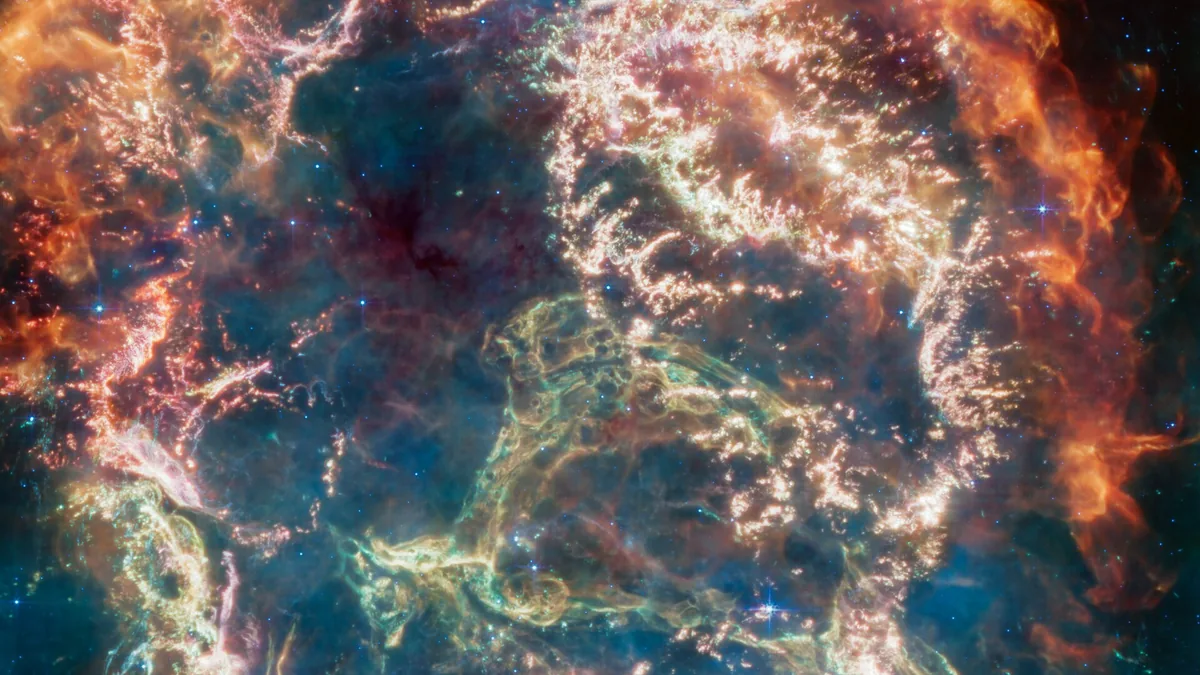
Dan Milisavljevic, associate professor at Purdue University in the United States, said Webb’s improved resolution at the individual clump level enables more sophisticated dust chemistry. This lets researchers tie the explosion back to the progenitor star’s makeup hundreds of years later and learn what happened in the hours before core collapse, the collapse of the star’s core.
Understanding this process is needed to describe the elements a supernova puts into the galaxy and the way those elements help build future stars and planets. The results will help build better models for understanding other supernova remnants. JWST’s observations were added to existing data from JAXA’s XRISM X-ray satellite and NASA’s Chandra X-ray Observatory, demonstrating that mergers of the progenitor’s shells had already started before the explosion, yielding a more complete picture of pre-explosion shell mergers.
Cassiopeia A, one of the best-known supernova remnants, was observed by Earthlings around 1667. Massive stars synthesize astronomical metals, elements heavier than hydrogen and helium needed for rocky planets and living organisms; the stars fuse these elements in layers up to iron in the core, and these layers tell the star’s history before being blown into space, and without them the cosmos would be mostly hydrogen, some helium, and trace lithium.
Astrophysicists cannot see inside stars and must wait until they explode and turn themselves inside out to examine the results. According to the authors, dust compositions mapped across young supernova remnants work well as a probe for uncovering chemical structure and explosion properties connected to core-collapse supernovae.

Join the discussion