Key facts
- HD 158485, an A-type star used as a JWST calibration reference, has been identified as an unresolved binary in which both component stars pulsate.
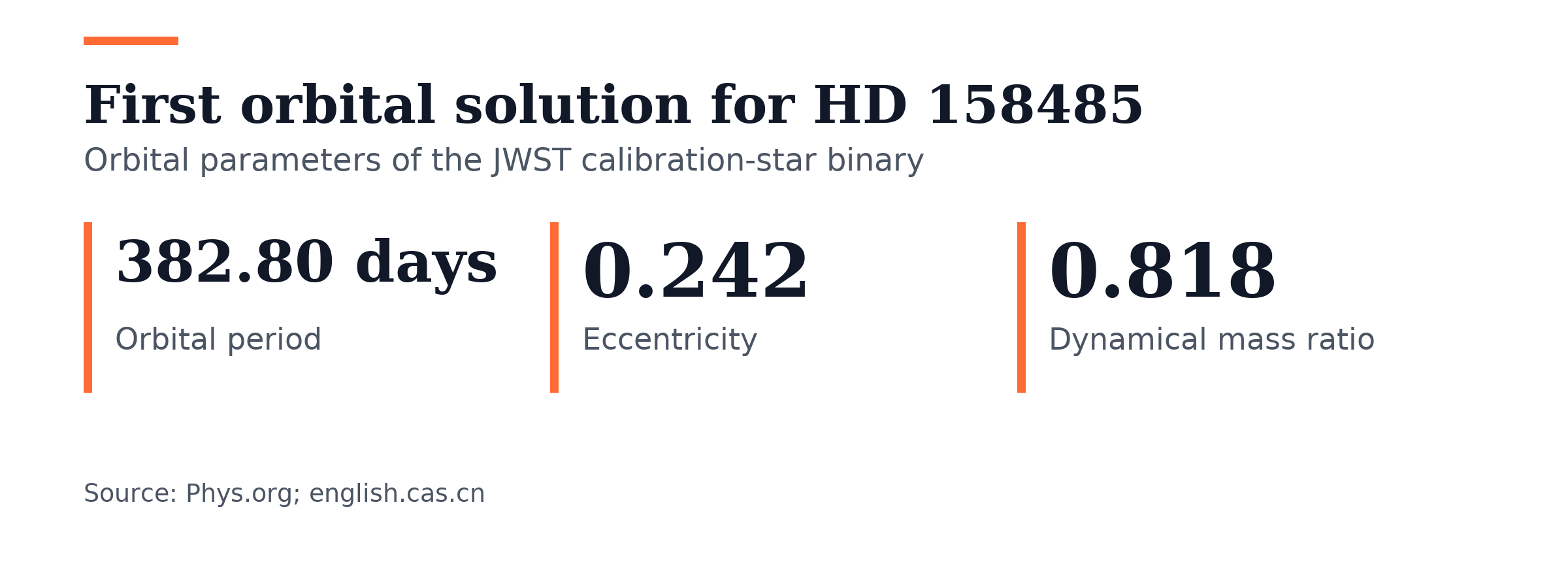
- The orbital solution yields a period of 382.80 days, an eccentricity of 0.242, and a dynamical mass ratio of 0.818, the first measured for the system.
- Using the measured mass ratio, the team compared two-star and single-star atmosphere models and found fluxes differ by about 1.6 percent from one to five micrometers and by 2.5 percent from five to 28 micrometers.
- The paper is titled "TESS Pulsation Timing Reveals the JWST Calibration Star HD 158485 as a Double-pulsator Binary.".
On Nov. 23, 2026, researchers from the Xinjiang Astronomical Observatory of the Chinese Academy of Sciences identified HD 158485, an A-type star used as a JWST calibration reference, as an unresolved binary in which both component stars pulsate, drawing on long-term observations from NASA’s TESS satellite.
The study, authored by Chenglong Lv and colleagues, appeared in The Astrophysical Journal Letters in 2026. It is titled TESS Pulsation Timing Reveals the JWST Calibration Star HD 158485 as a Double-pulsator Binary. A double-pulsator binary is a binary star system in which both component stars pulsate. The publication listing pairs this title with the authors, journal and year to identify the specific paper reporting the HD 158485 discovery.
The Chinese Academy of Sciences release describes the research as delivering both this first orbital solution and the dynamical mass ratio, representing a new orbital characterization of the JWST calibration star. An orbital solution describes how the two stars move around each other. The dynamical mass ratio is the ratio of the two stars’ masses derived from their orbital motion. A binary star system consists of two stars orbiting a common center of mass.
The discovery relied on long-term TESS observations rather than a single snapshot. NASA’s TESS satellite supplied repeated measurements over time. That long record let the team identify pulsation patterns tied to the two stars’ orbital motion.
The team identified six stable delta Scuti pulsation modes. Delta Scuti stars are pulsating variable stars whose surfaces expand and contract in regular cycles. The modes fall into two groups with opposing light-travel-time variations tracing the orbital motion of the two stars. Light-travel-time variations are changes in when the light arrives as the stars move toward and away from the observer.
The opposing variations reveal how each star’s motion changes the arrival time of its pulses. Astronomers measure these shifts in the timing of each pulsation peak. The pattern of opposite shifts is what betrays the presence of two orbiting stars.
The orbital solution yields a period of 382.80 days, an eccentricity of 0.242, and a dynamical mass ratio of 0.818. The period is the time it takes the two stars to complete one orbit. Eccentricity describes how elongated the orbit is. These are the first such measurements for HD 158485.
An orbital model built from earlier TESS data accurately predicted the timing variations of a later observing campaign. The researchers compared the model’s forecast with the new measurements. That agreement provides an independent check of the result. An observing campaign is a coordinated set of observations made over a defined period.
LV Chenglong produced the image of pulsation timing results for HD 158485. It shows the two groups of pulsation modes with opposite time delays. The image accompanies the Chinese Academy of Sciences release and illustrates how the pulsation timing signals reveal the orbital motion of both stars.

Stars used to calibrate JWST must have precisely characterized spectra, so their fluxes can be measured accurately. Stars that appear single may harbor unresolved companions that alter their predicted radiation.
An unresolved binary is a pair of stars too close to be separated as distinct points of light. HD 158485 looks like one star but is actually two pulsating components.
Using the measured mass ratio, the team compared two-star and single-star atmosphere models. Atmosphere models predict how much light a star emits at different wavelengths. The two-star model differs from a single-star model by about 1.6 percent between one and five micrometers and by 2.5 percent between five and 28 micrometers.
These flux differences are not a measured error in JWST calibration. An unseen companion can change infrared flux predictions even though a single-star model matches the visible spectrum well. Infrared fluxes are measurements of infrared light, while the optical spectrum covers visible wavelengths.
The study shows stellar pulsations can expose binaries that conventional observations leave unresolved. Conventional observations are methods that try to detect a companion directly, such as resolving it as a separate point of light. The authors say calibration work for high-precision space astronomy must consider hidden companions.




Join the discussion