Key facts
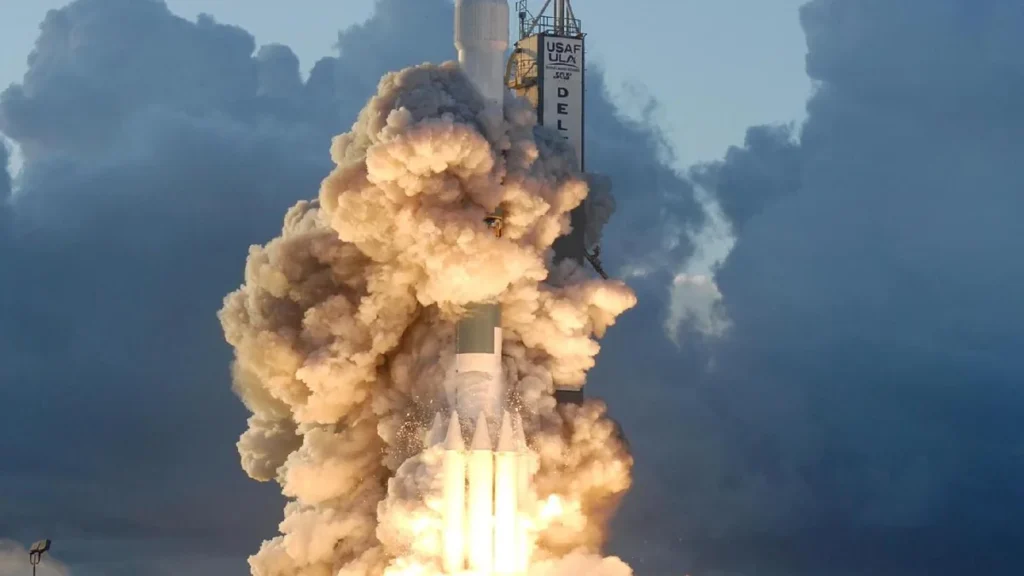
- A United Launch Alliance Vulcan Centaur rocket failed on November 15, 2026, destroying 40 Amazon Leo satellites shortly after liftoff from Cape Canaveral, marking the venture's first total mission failure since 2006.
- ULA said on November 18, 2026, that early findings point to a fuel supply problem with the BE-4 engines, not the engines themselves, as the cause of the first stage's low thrust.
- The Vulcan Centaur first stage underperformed just after liftoff on November 15, 2026, separated too low and too slow to reach orbit, and the Centaur upper stage's RL10 engines worked normally but could not compensate.
- Amazon has reserved launches on 38 Vulcan Centaur rockets, 18 Arianespace Ariane 6 rockets, and 12 to 27 Blue Origin New Glenn rockets, plus older Atlas V missions.
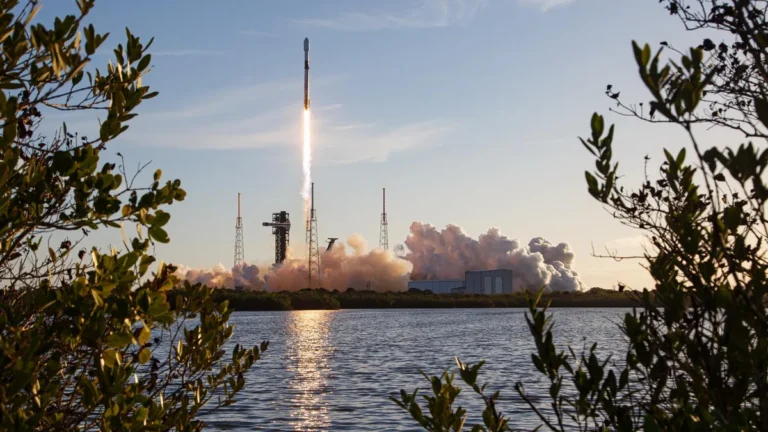
Amazon has scheduled its next Leo satellite launch on an Ariane 6 rocket targeted for Nov. 23, 2026, from Kourou, French Guiana, after a United Launch Alliance Vulcan Centaur failed Nov. 15, 2026, at Cape Canaveral and destroyed 40 Amazon Leo satellites.
On Nov. 18, 2026, ULA said early findings tied the first stage’s low thrust to a fuel supply problem with the BE-4 engines, not the engines themselves. The first stage underperformed just after liftoff and separated at too low an altitude and too slow a speed to reach orbit, while the Centaur upper stage’s RL10 engines worked normally but could not compensate. The company said telemetry and the mission were lost around the 10-minute mark, though the problem started just after liftoff during the first-stage burn.
Prior to the failure, Amazon had put 396 Leo satellites into orbit across 14 successful missions dating back to April 2025, with the most recent flight on an Atlas V in July 2026. Amazon is required to field and run all 3,232 first-generation Leo satellites by July 30, 2029, after the Federal Communications Commission allowed continued deployment despite Amazon missing a July 30 target for roughly half the constellation in service. Satellites not working by that date temporarily lose priority in key spectrum bands.
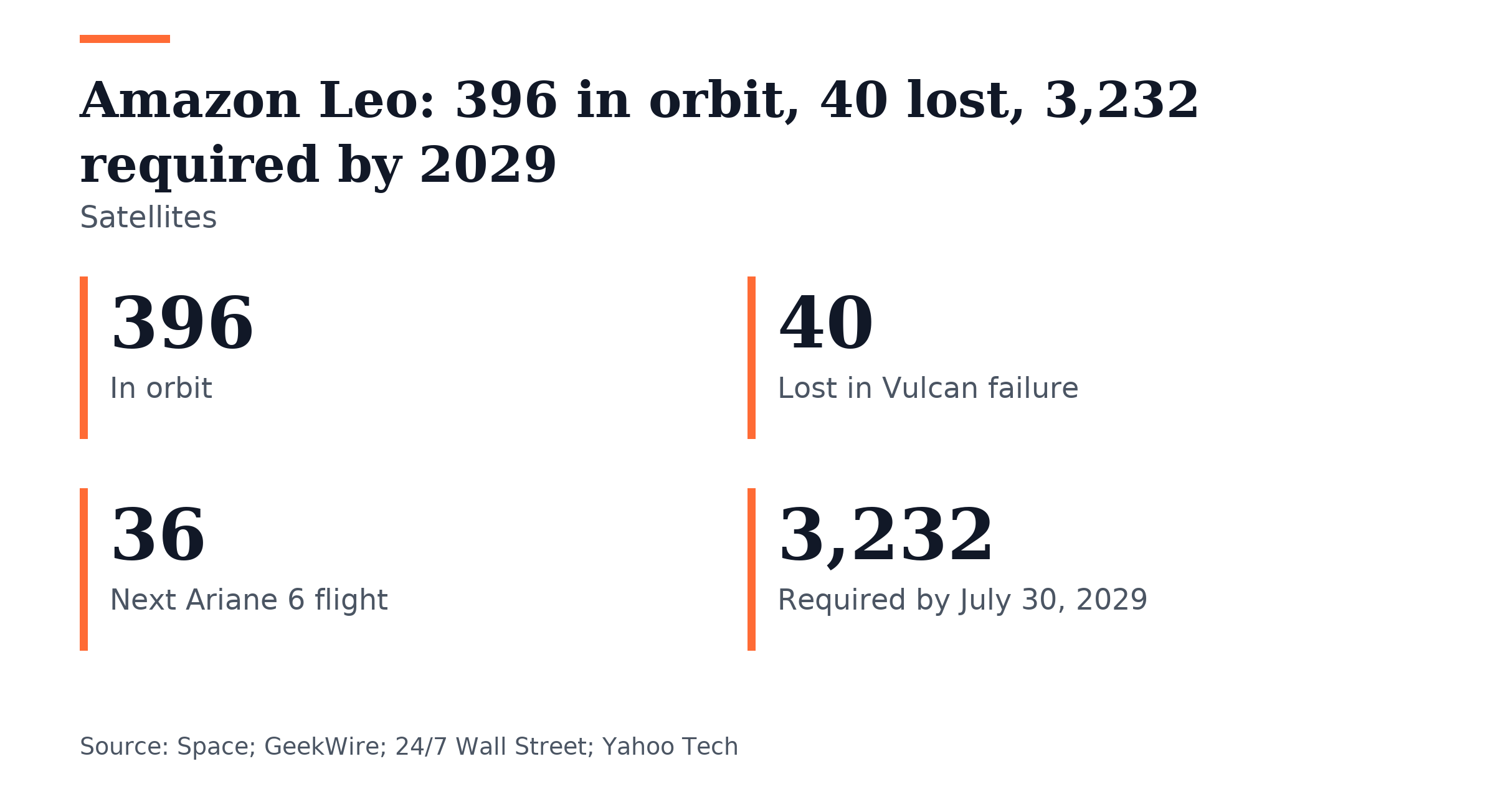
Amazon holds launch reservations for 38 Vulcan Centaur rockets, 18 Arianespace Ariane 6 rockets, and 12 to 27 Blue Origin New Glenn rockets, along with older Atlas V missions. The company spent billions on those reservations. ULA’s Atlas V inventory is nearly depleted, and the company is not building more of them.
Blue Origin’s New Glenn is grounded after an oxygen valve problem triggered an explosion during a May 28, 2026, ground test, and Amazon holds 24 launch reservations on the rocket. New Glenn’s first stage uses seven BE-4 engines. Before the flight, ULA CEO Mark Peller said Blue Origin had retrofitted the November 15 Vulcan’s BE-4 engines with a fix for the May explosion.
Ariane 6, which debuted in July 2024 as Ariane 5’s successor, has flown nine times, with every mission successful except a partial failure on its first flight. This November 23 Ariane 6 mission marks the fourth Amazon Leo flight on the rocket, after earlier flights in February, April and June 2026. It is set to carry 36 satellites during a 29-minute launch window opening at 6:09 a.m. EST (1109 GMT; 8:09 a.m. local time). Space.com plans to carry Arianespace’s live stream, starting roughly half an hour before liftoff.
On Nov. 15, 2026, Amazon Leo posted on X that any launch carries risk, particularly for inaugural missions, and described ULA as a trusted partner. “There is risk with any launch, and that’s especially true for inaugural missions like LV-01,” Amazon Leo said. Amazon said a second Vulcan mission might fly within weeks, though that now depends on ULA’s investigation.
The Federal Aviation Administration will supervise ULA’s investigation of the November 15 failure and must approve the final report and any fixes. ULA said the work was still in its early stages and that it wanted to avoid speculation until the inquiry was complete.
On X, Blue Origin CEO Dave Limp said ULA should provide mission updates and that Blue Origin is supporting ULA with BE-4 data and analysis. “It is ULA’s mission so they should provide the updates,” Limp said.
The Vulcan Centaur follows ULA’s Atlas V as its successor and debuted in January 2024. It had flown four times before the November 15 anomaly, and that launch marked Amazon’s first Vulcan mission. After a February 2026 booster nozzle problem, the U.S. Space Force paused national security launches on Vulcan, whose third and fourth flights were Space Force missions.
In October 2024 and February 2026, Vulcan’s second and fourth flights each saw an SRB nozzle burn-through and separation about 30 seconds after launch, though both still delivered their payloads. On November 15, the six Northrop Grumman solid rocket boosters worked as expected even though they had caused problems on two earlier flights.
Amazon’s third-quarter release said initial Leo internet service would arrive later in 2026. As of early November 16, 2026, Amazon had not revealed the cost of the lost satellites, their insurance status, or a revised deployment timeline, and no Amazon press release had been issued.
Named for its low Earth orbit operation, Amazon Leo will go up against SpaceX’s Starlink internet constellation, which currently includes more than 11,000 operational spacecraft, and Amazon Leo plans to field more than 3,200 satellites. Amazon has secured flights on SpaceX’s Falcon 9 as well as ULA’s Atlas V, Blue Origin’s New Glenn and Ariane 6 for its broadband constellation. Starlink’s operator is one of Amazon’s own launch providers.
In 2025, SpaceX’s Falcon 9 carried more than 80% of all payloads to orbit around the world, and SpaceX has Falcon 9 flights booked through 2028 with no plans to add additional missions.

Join the discussion