Key facts
- NASA's Astronomy Picture of the Day for November 21, 2026 features an image of Neptune captured by the Voyager mission.
- The APOD image is a composited scene built from pictures Voyager 2 recorded during the close encounter and in the days afterward.
- The faintest ring segments in the composited picture are modeled rather than directly imaged.
- The starfield corresponds to how the Neptunian system looked to Voyager on its outbound path.
NASA’s Astronomy Picture of the Day featured an image of Neptune captured by Voyager 2 during its 1989 flyby on November 21, 2026.
The Astronomy Picture of the Day series presents one cosmic image or photograph each day, with an explanation written by a professional astronomer. NASA Science’s page for November 21, 2026 follows that daily format with its Voyager Neptune feature. The page also previews the next selection, titled “Sunday’s Childe,” as the following day’s picture.
NASA’s featured Neptune image is not a single photograph. It is a composited scene assembled from pictures Voyager 2 recorded during the close encounter and in the days afterward. NASA’s explanation describes it as an inspired composition rather than a direct snapshot. The scene covers Neptune, Triton, and Neptune’s faint ring system and identifies Triton as Neptune’s largest moon.
The image looks back toward the Sun from just beyond Neptune’s orbit. From that position, Neptune and Triton appear as thin sunlit crescents against the darkness. NASA describes this as an interplanetary perspective from outside Neptune’s orbit, which also frames the background starfield. The geometry shows the Neptunian system from the vantage of an outbound spacecraft.
The image shows cirrus clouds and a dark band circling Neptune’s south polar region, with a cloudy vortex above the pole. These cloud features are part of what the composited scene shows of the dim outer planet. They appear alongside Triton and the rings in the same assembled view. NASA’s explanation includes them among the visible elements of the Neptune portrait.
NASA’s explanation says Voyager 2 first imaged parts of Neptune’s very faint ring system together with three bright ring arcs during the August 1989 flyby. The faintest ring segments in the composited picture are modeled rather than directly imaged. NASA’s text distinguishes the ring portions Voyager actually recorded from the faintest segments filled in by modeling. The rings belong to Neptune’s faint system, which the composited picture portrays.
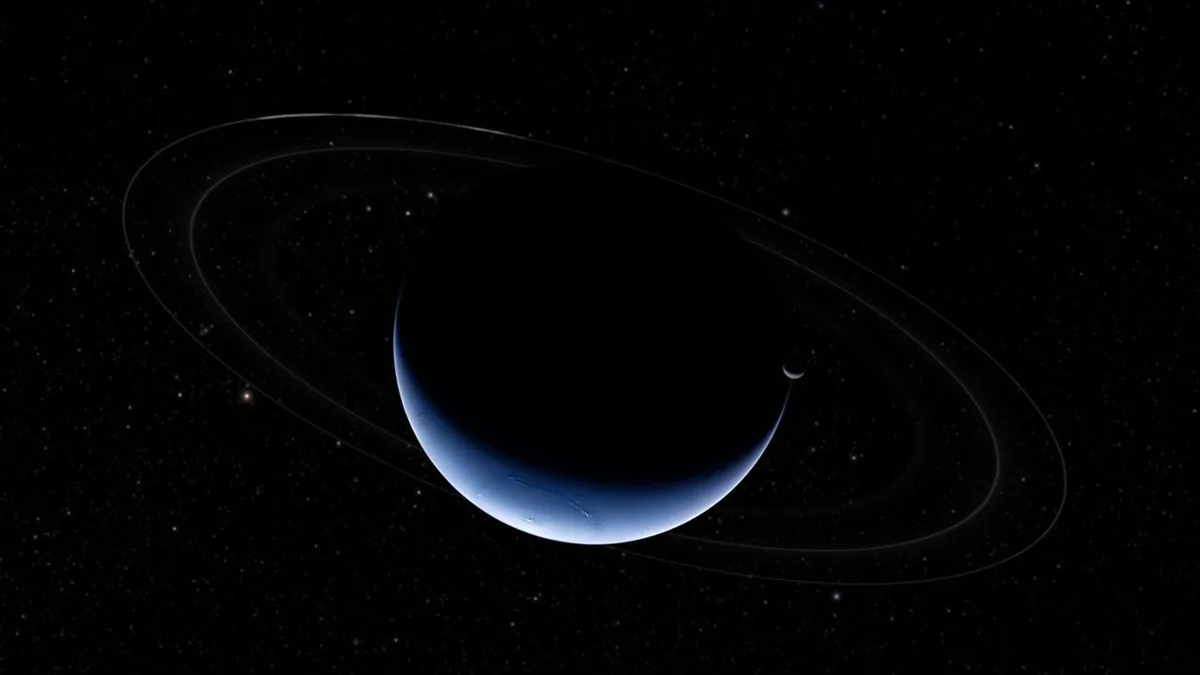
The background starfield spans 7.5 degrees and is built from sky survey data centered on the constellation Camelopardalis, NASA says. NASA says this starfield matches the view of the Neptunian system from the outbound Voyager spacecraft. It corresponds to how the system looked to Voyager on its path away from the planet after the encounter. Sky survey data supplies the stars that appear behind Neptune and Triton in the assembled view.
Voyager 2 made its closest approach to Neptune on August 25, 1989, NASA’s explanation says. The NASA explanation places this encounter during the spacecraft’s cruise through the outer solar system. It calls Neptune the most distant ice giant planet, and Voyager 2 is the only spacecraft ever to visit it. The description of Neptune as the most distant ice giant appears in the same APOD explanation that dates the Neptune flyby.
As of 2026, Voyager 2 is still cruising and is now in interstellar space, the region between stars, NASA says. “Still cruising in 2026, the Voyager 2 spacecraft is now in interstellar space,” the NASA Science APOD explanation says. The spacecraft remains active long after its 1989 Neptune encounter. NASA places this present-day status after recounting the 1989 flyby in the APOD text, linking the encounter to the spacecraft’s current interstellar location.
The APOD feature renews attention to Voyager 2’s historic 1989 Neptune flyby while the spacecraft continues operating in interstellar space decades later. NASA Science published the page that pairs the Neptune image with an astronomer’s explanation. The page also looks ahead to the next selection, titled “Sunday’s Childe.” Together, the feature connects a historic planetary encounter with a mission still operating in interstellar space.

Join the discussion