Key facts
- Astronomers combined measurements from 37 prior studies to build a catalog and analyze why some spiral galaxies are lopsided, posting the paper to arXiv on Nov. 10.
- The study was led by Abbos Omonov of the National University of Uzbekistan.
- The sample includes 442 galaxies with an A1 measurement and 302 galaxies with both A1 and A2 measurements.
- The method follows a galaxy's brightness around a ring centered on the core and splits the uneven pattern into simple waves called Fourier modes, with each wave's height giving the amplitude.
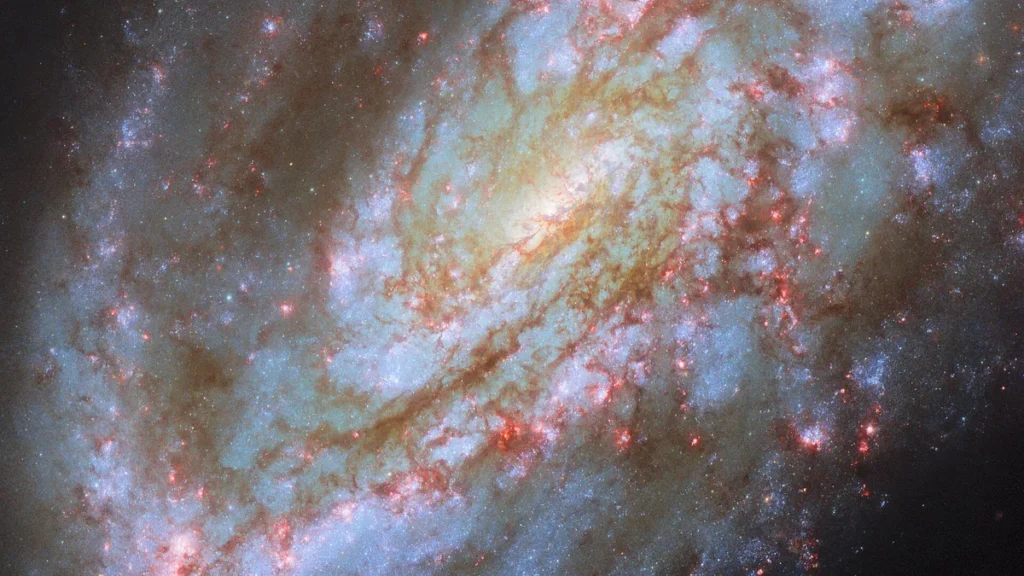
Astronomers led by Abbos Omonov of the National University of Uzbekistan posted a catalog to arXiv on Nov. 10, 2026, that combines 37 prior studies to explain why many spiral galaxies appear heavier or more elongated on one side, Phys.org reported.n
According to Phys.org, the researchers began with an existing collection of 683 catalog entries, removed duplicate records, leaving the team with measurements of 606 galaxies. Abbos Omonov works at the National University of Uzbekistan and led the team that assembled and analyzed the catalog of disk galaxies. Of the 606 galaxies, 442 had an A1 measurement and 302 had both A1 and A2 measurements. The outlet explained that not every galaxy had both Fourier modes measured, so the subset with both is smaller than the full set.
Phys.org described the measurement technique: astronomers follow a galaxy’s brightness around a ring centered on the core and split the uneven pattern into simple waves called Fourier modes, with each wave’s height giving the amplitude. The brightness tracing technique comes from signal analysis, and astronomers use it here to capture asymmetries in how stars and gas spread across the galaxy. By measuring light around the ring, astronomers can see where stars and gas pile up or thin out.
A1 is defined by a single bright side and a single dim side and measures lopsidedness. A2 has two bright regions on opposite sides and points to a central bar or two opposite spiral arms. When A2 equals zero, the galaxy shows no two-sided pattern at that radius from the center, and higher A2 values indicate a stronger bar or two-armed spiral pattern. Zero means the pattern is not present.
The A2 measurement helps the team separate one-sided lopsidedness from symmetrical features such as bars.n
An A1 value of zero indicates a perfectly balanced galaxy, while an A1 of 0.1 indicates that brightness moves by about 10 percent on either side of the average around the circle. The 10 percent swing illustrates how the amplitude translates into a visible imbalance around the galaxy’s core. For the typical galaxy, defined by the median value, A1 is about 0.12 and A2 is 0.11, meaning both patterns appear mildly across the sample. The median values show that mild lopsidedness and mild two-sided patterns are common among the disk galaxies studied.
Phys.org reported that the team found a tendency for galaxies with larger A1 to also show larger A2, which the researchers said suggests a link between the two patterns. The team presented the connection as a hint that the two patterns may relate rather than as a confirmed physical mechanism. The team makes no causal claim from the correlation alone.
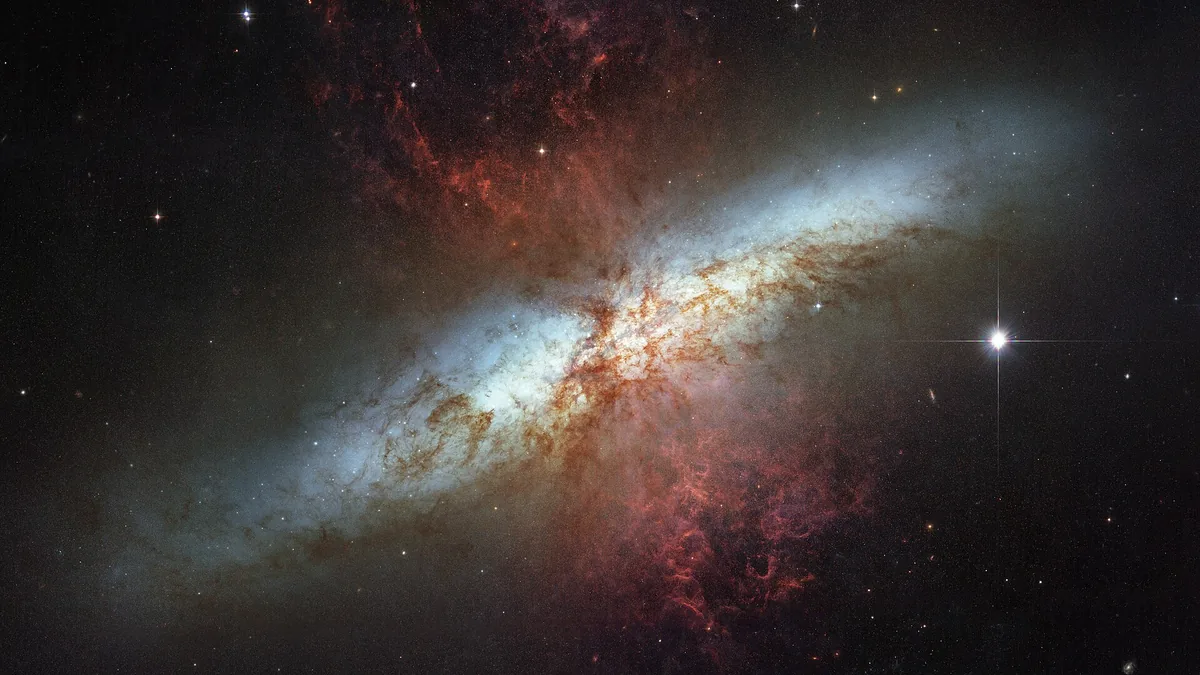
The team found that lopsidedness rises toward smaller, later-type galaxies and falls as stellar mass and gas rotation velocity increase, meaning a faster-spinning galaxy tends to be less lopsided. The TNG50 computer simulation reproduced accurately the trend that more massive galaxies are less lopsided. Phys.org noted that the team compared its observational results with trends seen in the TNG50 simulation. TNG50 is a computer simulation of galaxies, and its match to the mass-lopsidedness trend supports the idea that mass influences asymmetry.
According to the team, if tides alone caused the asymmetry, the pattern would reverse because massive galaxies sit in dense environments where interactions happen often. The team’s paper argues that if collisions and tidal interactions were the main cause, massive galaxies in dense environments should show more lopsidedness, which the data do not show. This reasoning leads the researchers to treat outside interactions as secondary for the population.
The researchers say the galaxy’s internal dynamics are the main regulator of its shape, not only gravitational interactions with neighboring galaxies. External interactions can still matter for individual galaxies, but the picture is better explained by studying the galaxy’s environment together with internal dynamics. The team does not rule out neighbor effects for particular systems.
Although TNG50 matched the trend, it did not match the amplitude, with simulated galaxies about 1.4 times less lopsided than observed. The researchers said this indicates a gap between simulation and observation. They cite three causes for the mismatch: the sample combined studies using different methods, some studies focused on galaxies already known to be lopsided, and measurements came from somewhat different radii. These three compounding effects explain why the observational sample may show higher lopsidedness than the simulation.
The paper is titled A Statistical Analysis of Lopsidedness in Disk Galaxies by Abbos Omonov et al., posted on arXiv in 2026 with DOI 10.48550/arxiv.2611.14435. Phys.org reported that certain spiral galaxies appear heavier or more stretched on one side, and the cause remains unclear. The catalog was built to examine candidate explanations including collisions, gravitational tugs, uneven gas infall, and disk instabilities that pull gas and stars away from the center.n
Phys.org reported that the catalog offers clues to the imbalance without settling which explanation dominates. The measurements show that lopsidedness increases toward smaller, later-type galaxies and falls as stellar mass and gas rotation velocity increase, so faster-spinning galaxies tend to be less lopsided, and that TNG50 matches the mass trend but not the amplitude. What remains uncertain is which physical process drives the asymmetry in any given galaxy. The researchers treat collisions, tides, gas infall, and disk instabilities as candidates rather than settled conclusions.



Join the discussion