Key facts
- Keck Observatory observations indicate Europa's immense, diffuse sodium cloud has stayed steady for over twenty years despite Jupiter's shifting plasma conditions.
- The cloud reaches up to 30 Europa radii and stretches east to west.
- A Sept. 29, 2022 Keck HIRES observation studied Europa during a Juno flyby behind the moon as seen from Earth.
- Researchers observed Europa through Jupiter's shadow so reflected sunlight from the icy surface would not overwhelm faint sodium emission near the moon.
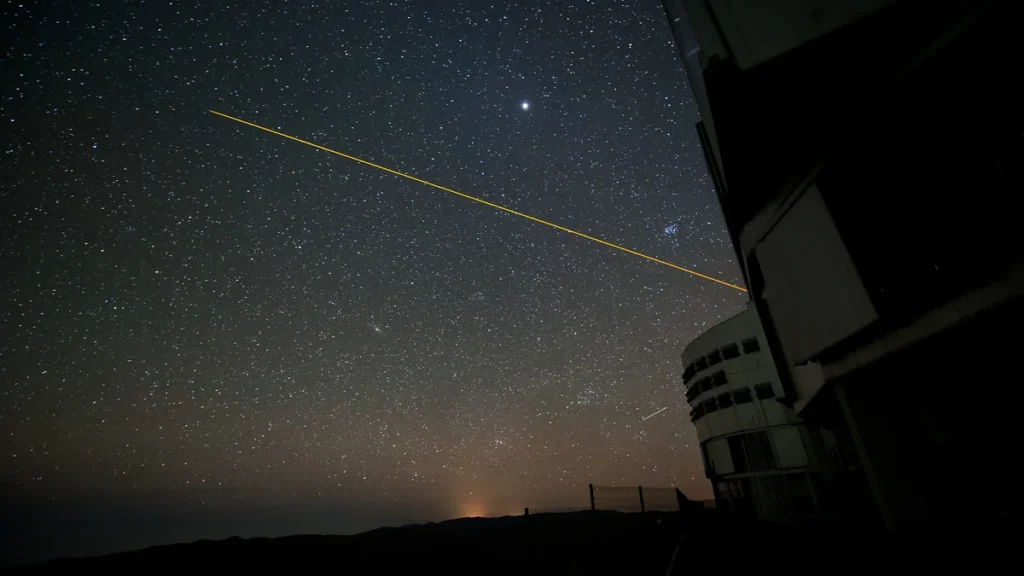
A Boston University-led team reported on Nov. 20, 2026, that W. M. Keck Observatory observations on Maunakea, Hawaiʻi Island, indicate Europa’s vast, spread-out sodium cloud has held steady for longer than twenty years.
The study appeared in 2026 in the Journal of Geophysical Research: Space Physics under the title “Europa’s Neutral Sodium Exosphere Is Quasi-Stable Over Decades.” It links sodium measured high above Europa with sodium near the moon’s visible disk or surface for the first time. Emma Lovett, a Boston University graduate student, led the work, and Carl Schmidt, a researcher at Queen’s University Belfast and Boston University, co-authored it.
Keck’s HIRES instrument, a high-resolution, long-slit spectrograph, captures sodium’s light signature while preserving spatial detail around Europa. Scientists pointed the instrument at positions to map the cloud instead of recording its spectrum from just one spot. They also combined newer Keck readings with archival Keck data from 1999 to extend the record of how the cloud changes. The cloud stretches east to west.
Researchers looked at Europa while it sat in Jupiter’s shadow so bright reflected sunlight from the ice would not drown out the faint sodium glow near the moon. On Sept. 29, 2022, Keck’s HIRES observed Europa during a Juno flyby that placed the spacecraft behind the moon from Earth’s viewpoint. That alignment let scientists compare Europa’s neutral sodium setting with plasma readings around the moon.
Electrons in the space around Europa energize sodium atoms, making them glow and showing where they are. The sodium cloud does not directly measure Europa’s buried ocean, yet it helps researchers assemble a fuller view of the moon’s chemical surroundings.
Sodium is a component of table salt, or sodium chloride, and tracing its origin reveals which materials from Europa’s surface or hidden ocean reach the space surrounding the moon. Io, a volcanically active moon of Jupiter, releases sodium into the space near Jupiter, and scientists have long wondered whether Io coats Europa’s surface. Carl Schmidt said the steady sodium level means Europa does not react to Io’s volcanic activity and that the gas comes from Europa’s salty ocean instead of Io’s volcanoes. “The stable sodium abundance in these Keck data shows that Europa is indifferent to Io’s volcanic activity.”
Emma Lovett said Europa’s atmosphere offers a glimpse of the potentially habitable ocean below and that extraterrestrial life might be closer than earlier believed. She added that the observations help sharpen models of Europa’s atmosphere by testing what releases sodium and how radiation pressure shapes its spread.
Scientists are using the Hubble Space Telescope this November to look for magnesium in Europa’s atmosphere because magnesium may be another part of Europa’s ocean salts. Emma Lovett said magnesium has appeared tentatively on Europa’s surface but has not yet appeared in its atmosphere, and spotting it could add another clue about the salts there.
NASA’s Europa Clipper plans to make dozens of Europa flybys to look for subsurface settings capable of supporting life. If plumes exist and connect to Europa’s ocean, a spacecraft could pass through a plume to collect and examine it from orbit, studying the moon’s ocean. NASA’s Cassini spacecraft did this at Saturn’s moon Enceladus, which has an ocean spraying into space. A 2018 study found that bits of Europa’s ocean might freeze onto the ice shell’s base, and tidal flexing might carry warmer, lighter ice and ocean material to the surface where instruments could study it remotely.
In 2013, Hubble Space Telescope researchers found signs Europa might be actively venting water into space, NASA said. Then, in November 2019, an international team led by NASA spotted water vapor above Europa’s surface for the first time using a Keck instrument that measures infrared light. Galileo did not spot plumes in the 1990s, but Hubble and reanalysis of Galileo data suggest thin water plumes may rise 100 miles (160 kilometers) above Europa’s surface.
Galileo also found disturbances in Jupiter’s magnetic field around Europa, pointing to an induced field from deep, electrically conductive fluid, and researchers think the best candidate is a worldwide salty ocean. The ice shell measures 10 to 15 miles (15 to 25 kilometers) thick and sits atop an ocean 40 to 100 miles (60 to 150 kilometers) deep, according to researchers. Europa is one-fourth Earth’s diameter, and researchers estimate its ocean contains twice as much water as Earth’s worldwide ocean.
Researchers think Europa’s ocean may have persisted for about 4 billion years, the entire span of solar system history, allowing enough time for life to arise. Astrobiologists say Europa has plentiful water and key chemical ingredients like carbon, hydrogen, nitrogen, oxygen, phosphorus and sulfur. If life is present at Europa, it would probably rely on chemical reactions rather than photosynthesis because it would live beneath the ice with no sunlight.
Radiation from Jupiter bombards Europa’s surface, making surface life unlikely, though the radiation could generate fuel for life in the ocean underneath. Europa orbits Jupiter once every 3.5 days and keeps one face turned toward the planet because it is tidally locked. Io, Europa, and Ganymede share a resonance where Ganymede completes one orbit, Europa completes two, and Io completes four; this resonance forces eccentricity.
Tides that pull and relax Europa’s surface arise from its elliptical orbit; tidal flexing likely makes cracks and could power seafloor volcanic or hydrothermal activity, bringing nutrients. In 2011, researchers examining Galileo data proposed that chaos terrain might be places where the surface sank over lens-shaped lakes buried beneath the ice. Europa’s surface is no older than 40 to 90 million years due to the small number of visible craters.
Reddish-brown material along Europa’s cracks probably holds salts and sulfur compounds mixed with water ice and changed by radiation; this surface makeup may offer hints about habitability. Europa spans 1,940 miles (3,100 kilometers) across its equator, roughly 90 percent the size of Earth’s Moon, and its ice reflects 5.5 times more sunlight than our Moon.
Europa travels around Jupiter at roughly 417,000 miles (671,000 kilometers), while Jupiter circles the Sun at about 500 million miles (780 million kilometers) or 5.2 astronomical units. Sunlight needs about 45 minutes to get to Europa, and sunlight at Jupiter and Europa is roughly 25 times weaker than at Earth.
Jupiter takes roughly 4,333 Earth days, or about 12 Earth years, to travel around the Sun; Jupiter’s equator and its moons’ orbital plane tilt only 3 degrees, so Europa does not have Earth-like seasons. NASA’s Pioneer 10 and Pioneer 11 spacecraft flew past Jupiter in the early 1970s. Voyager 1 approached Jupiter most closely on March 4, 1979, and captured a complete global image of Europa from roughly 1.2 million miles (2 million kilometers) away.
Voyager 2’s closest Europa encounter happened on July 9, 1979, and pictures showed a surface brighter than Earth’s moon, crossed with bands and ridges, and without large impact craters, tall cliffs, or mountains. Galileo launched in 1989 and entered orbit around Jupiter in 1995, according to NASA’s Europa facts page. The spacecraft made 12 close Europa flybys altogether.
Galileo studied the Jupiter system during the years 1995 to 2003 and found pits and domes indicating Europa’s ice layer might be slowly turning over. The mission received a two-year follow-on called the Galileo Europa mission. Heat models from 1971 suggested Europa’s inside could hold a layer of liquid water.
In 1972, researchers at Kitt Peak National Observatory used spectroscopy to show Europa’s surface is mostly water ice. The Galilean moons—Io, Europa, Ganymede, and Callisto—probably formed from leftover material after Jupiter condensed from the starting cloud of gas and dust around the sun, early in solar system history, and they are likely about 4.5 billion years old.
Europa has ice and water above a rocky and metallic interior, while Ganymede and Callisto contain more water ice and lower densities. Tidal forces warm Io heavily, so old volcanic activity likely dried up any water it had at formation.

Join the discussion