Key facts
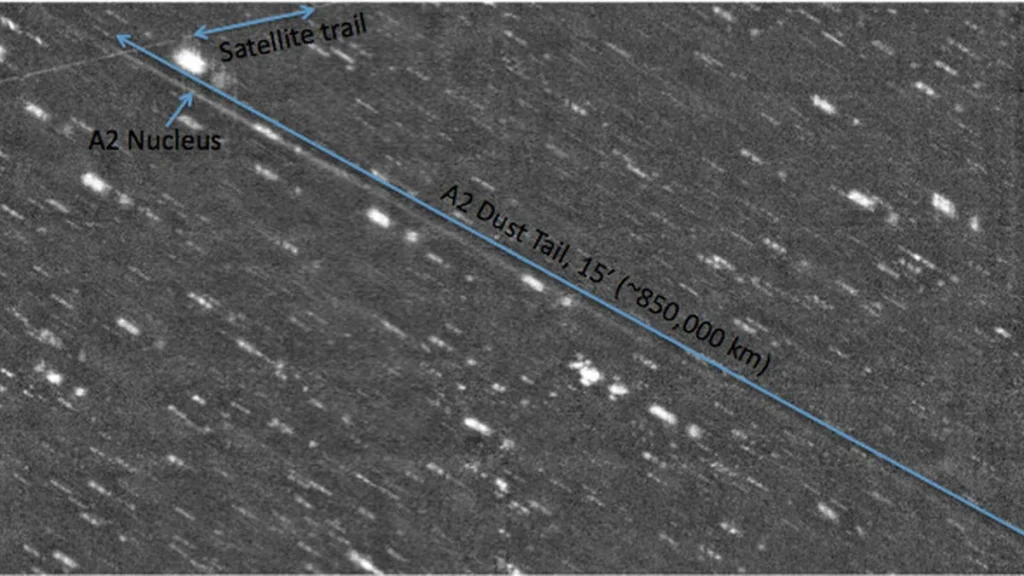
- The tail identifies asteroid 6993 (1995 BJ4) as a candidate for the biggest known comet in the main belt.
- Through 2026, astronomers have seen the tail around asteroid 6993 (1995 BJ4) fade gradually.
- The fading points to debris from a single collision instead of continuous outgassing; astronomers shared the result last month in an Astrophysical Journal Letters paper that has been accepted.
- Astronomers had found only twenty of these objects by 2019, which makes main-belt comets uncommon.
Astronomers spotted a faint tail around main-belt asteroid 6993 (1995 BJ4) in August 2026; the roughly seven-mile (11 kilometers) wide object orbits between Mars and Jupiter, and the tail makes it a candidate for the largest known comet in the main belt.
Dan Bartlett of June Lake, California, took the image for Astronomy Magazine’s Picture of the Day. He exposed two 11-inch f/2.2 Celestron RASA instruments for 4.6 hours using ZWO ASI6200MM Pro and ZWO ASI6200MC Pro cameras. In Bartlett’s image, the tail spans more than 35 arcminutes (a unit of angular width), wider than the Full Moon.
Through 2026, astronomers have watched the tail fade gradually. They say the fading points to debris from a single collision instead of continuous outgassing, and they shared the result last month in a paper accepted by the Astrophysical Journal Letters.
Wonderdome says main-belt comets are a subclass of active asteroids, objects that look like comets but travel on asteroid-like orbits with short-lived comas and tails. Universe Today says they display comae and tails while circling inside Jupiter’s orbit in the main asteroid belt. Wonderdome says astronomers had found only 20 of these objects by 2019, which is why they count as uncommon.
The first active asteroid, 4015 Wilson-Harrington, was found as a comet in 1949, lost, rediscovered decades later as an asteroid, and confirmed in 1992 as one object, Wonderdome says. Universe Today reports that Hsieh and Jewitt introduced main-belt comets as a new class in a 2006 Science paper, volume 312, pages 561-563, after the 2002 outburst at 1996 N2 and other mass-loss discoveries. Another early case, 1979 OW7, was recovered in 1996, renamed 1996 N2, and is now known as 133P/Elst-Pizarro after showing activity in 1996 and again in 2002.
Wonderdome says 7968 Elst-Pizzaro, known since 1979, grew a tail visible for several months in 1996. Later observations in 2001 and 2007 showed tails near perihelion, repeating the display, and the object has a 5.62-year period.
Universe Today says main-belt comets form a third comet reservoir beyond the Oort cloud and the Kuiper belt. That reservoir lets researchers study the proto-planetary disk at three locations and possibly the origins of Earth’s oceans.
Wonderdome says activity that returns near perihelion is usually driven by sublimation of surface volatiles, while volatile-poor asteroids may instead suffer thermal fracture, as with 3200 Phaeton, the parent of the December Geminid meteor shower. Universe Today adds that water-ice sublimation is the leading explanation for mass loss in main-belt comets, based on 133P/Elst-Pizarro, whose activity repeats and peaks near and after perihelion.
Wonderdome says a few active asteroids repeat activity far from the Sun, possibly from rotational breakup, cryovolcanism, or rubbing between parts of a binary asteroid. It also says Main Belt asteroid Gault, first seen in 1988, displayed a comet-like tail in early 2019 after outbursts dating to 2013, shows no link to solar distance, and is suspected of rotating too fast because of the Yarkovsky-Keefe-Radzievskii-Paddack effect.
Wonderdome says scientists suspect a collision with another body knocked off material and created the tail, as with 354P/LINEAR and 596 Scheila. Universe Today says Scheila measures 113 kilometers across and was discovered on February 21, 1906, by A. Kopff at Heidelberg. Its tail and coma were announced on December 12, 2010, after an outburst that began around December 3, 2010.
Steve Larson of the University of Arizona’s Lunar and Planetary Laboratory first reported that images from December 11, 2010, showed an outburst, a comet-like look, and brighter magnitude from 14.5 to 13.4. Universe Today described Scheila as a likely comet masquerading as an asteroid.
Space.com reports that P/2016 J1, found in 2016, is the youngest known solar-system asteroid pair, having split apart around 2010, about six years before discovery. It grew twin comet-like dust tails after activation at perihelion between late 2015 and early 2016 that lasted six to nine months, while the breakup happened near perihelion during an earlier orbit, separate from the activation. The object circles the Sun every 5.65 years on a near-circular path between Mars and Jupiter.
That orbit stays too far from the Sun for heating to explain the tails, Space.com says. Fernando Moreno of the Institute of Astrophysics of Andalusia (IAA-CSIC) says ice exposed by the breakup sublimated from solid to gas and released the dust.
“Both fragments are activated, i.e., they display dust structures similar to comets,” Fernando Moreno of the Institute of Astrophysics of Andalusia (IAA-CSIC) said.

Join the discussion