Key facts
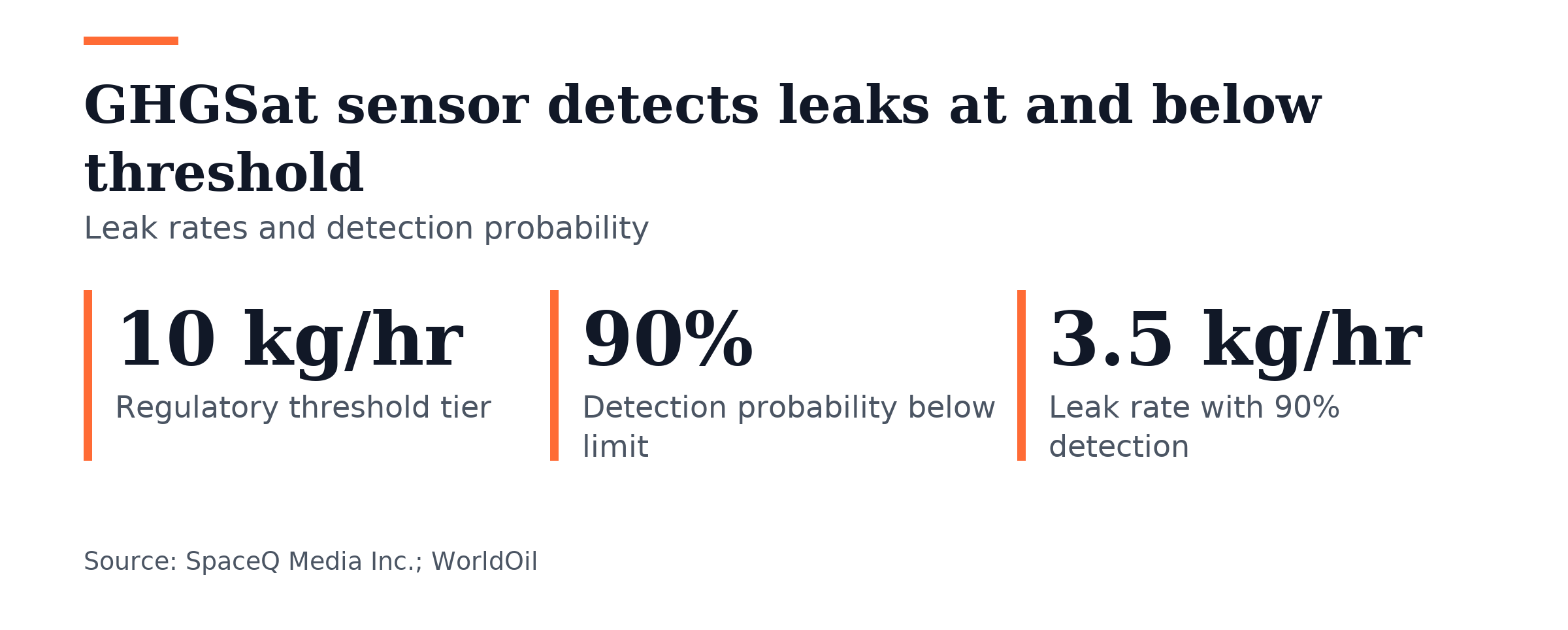
- The clearance covers the 10-kilogram-per-hour leak tier under Subpart OOOOb. Subpart OOOOb is the EPA's 2024 methane standard covering oil and gas facilities that are new or modified.
- The approval lets operators use GHGSat aircraft flights over their sites rather than ground crews to check fugitive methane from valves, connectors, and other equipment.
- GHGSat chief executive Stephane Germain said EPA approval lets operators demonstrate compliance with advanced methane detection technology at a lower cost than traditional methods.
- After the flight, GHGSat analysts study the maps to find and measure emissions at the level of individual equipment.
GHGSat announced on Nov. 19, 2026, that the EPA approved its DATA.AIR Gen2 airborne methane sensor as a compliance option under federal leak-inspection rules for oil and gas operators.
The EPA’s 2024 methane standard applies to new and modified oil and gas facilities, and the approval opens a U.S. federal leak-inspection route for GHGSat’s second-generation airborne monitoring system. Operators may use GHGSat aircraft flights over their sites instead of ground crews to check fugitive methane from valves, connectors and other equipment.
A GHGSat aircraft carries DATA.AIR Gen2, which uses a short-wave infrared spectrometer to map methane concentrations across oil and gas locations. GHGSat describes the system as an aerial methane measurement system for periodic screening under Subpart OOOOb. After the flight, GHGSat analysts study the maps to find and measure emissions at the level of individual equipment. According to GHGSat, one flight can survey numerous facilities daily, reaching remote sites without ground crews at every location, and the company delivers results within hours through its service.
The company said its DATA.AIR Gen2 reliably found leaks below the 10-kilogram-per-hour threshold during a blind test in southern Alberta, where analysts did not know the size or schedule of the controlled methane releases. According to GHGSat, a southern Alberta blinded study with 110 measurements spanning release rates from 2.5 kg/hr to 22.5 kg/hr achieved 90 percent probability of detection below the 10-kg/hr threshold. Colorado State University’s Methane Emissions Technology Evaluation Center detected 3.5-kilogram-per-hour leaks nine times in 10, a result that equals 90 percent probability of detection at that release rate.
Stephane Germain, GHGSat chief executive, said, “EPA approval of DATA.AIR Gen2 means operators can draw on advanced methane detection technology to demonstrate compliance.” GHGSat chief executive Stephane Germain said the approval lets operators demonstrate compliance with advanced methane detection technology at a lower cost than traditional methods.
The EPA cleared the original DATA.AIR system in February 2025 under the less demanding 15-kilogram-per-hour tier. The earlier approval established a precedent for the airborne sensor family before the stricter 10-kilogram-per-hour clearance for Gen2. EPA records on approved alternative test methods list an Oct. 20, 2026, sign-off for DATA.AIR Gen2. The list contains roughly 20 methods that include drones, fixed sensor networks, aircraft, and systems from Qube Technologies in Calgary.

In 2025, the EPA moved many OOOOb compliance deadlines to January 2027. On Oct. 29, 2026, the agency released a proposal to change the standard as part of a broader revision of the methane rule.
The EPA proposal would eliminate the Super Emitter Program that allowed approved third parties to flag large leaks. It would also relax inspection rules at smaller, low-producing well sites, and public comments are due Dec. 16, 2026.
GHGSat combines aircraft operations with its satellite fleet, which monitors larger areas but identifies only larger leaks. The satellites provide broad-area monitoring while the aircraft target smaller leaks, and GHGSat presents the two systems as complementary monitoring layers. According to GHGSat, the airborne system will connect to a second-generation satellite slated for launch in early 2028.
The company made Deloitte’s 2026 Technology Fast 500 list of fast-growing North American technology companies for the fourth consecutive year. The listing matches its run on Deloitte’s Canadian Technology Fast 50 in October. Mitsubishi Electric and MUFG Bank made an investment in GHGSat, according to the company, and the investment appeared in the same announcement as the EPA approval and Deloitte recognitions.



Join the discussion