Key facts
- A new study in Communications Earth and Environment explains how the Séítah rock layer formed, giving insight into Mars's history, geology, and potential to have hosted ancient life.
- Mars has a cooler interior than early Earth, which would theoretically make forming olivine harder.
- Finding large olivine grains on Mars was an unusual discovery.
- Brown and colleagues wanted to see how similar the Séítah formation is to komatiites on Earth.
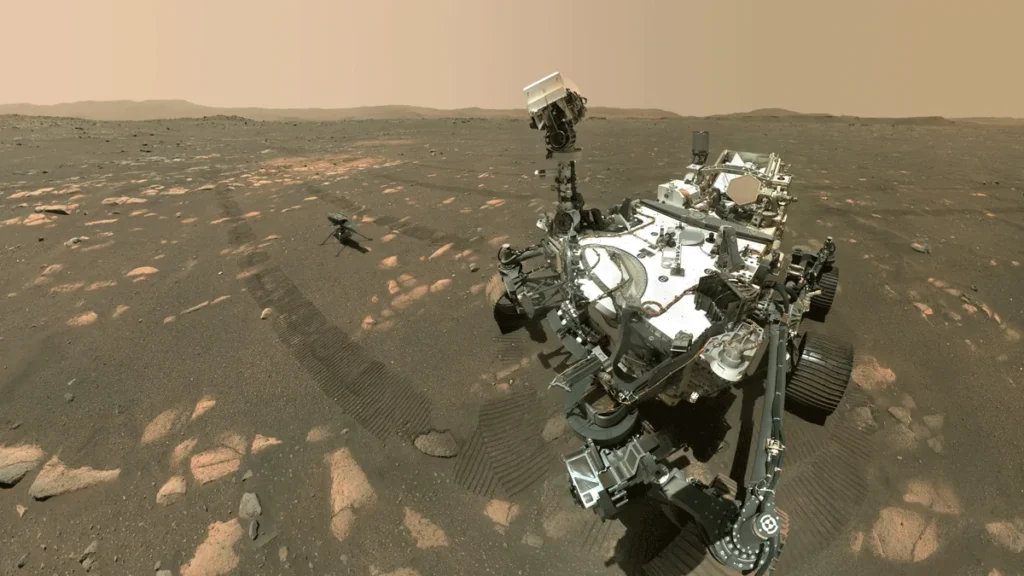
ZME Science reported that a new study in Communications Earth and Environment explains how the Séítah formation, a rock layer nearly 4 billion years old at the base of Jezero Crater, formed as a low-viscosity lava lake using data from NASA’s Perseverance rover.sources
The NASA rover Perseverance has studied Jezero Crater since 2021, collecting geological details and hints about Mars’s past. Perseverance took close-up images of the Séítah formation, a rock layer nearly 4 billion years old sitting at the base of Jezero Crater. Earlier work identified Séítah as komatiite, an olivine-rich rock, and the study gives insight into Mars’s history, geology, and potential to have hosted ancient life. “Since 2021, the Mars Perseverance rover has been roaming Jezero Crater, gathering details about the Red Planet’s geology and hints about its past,” ZME Science reported.sources
Mars has a cooler interior than early Earth, which would theoretically make forming olivine harder. Finding large olivine grains on Mars was an unusual discovery. Researchers needed to check whether the Séítah formation matched Earth komatiites despite the planet’s cooler interior.
Adrian Brown, a planetary scientist at Plancius Research who led the paper, said the team wanted to see how similar the Séítah formation is to komatiites on Earth. He said the team focused on viscosity, which describes how easily lava flows across the ground. He said they wanted to determine where the Séítah lava’s viscosity falls within that range, and that viscosity had received little study because researchers lacked the volume of geochemistry measurements now available.
High-viscosity lavas create landscape features such as classic cone-shaped volcanoes, while low-viscosity lavas form flatter, wider rock layers. Brown and colleagues used a 2008 model of magma movement on Earth that connects chemical data to how easily lava flows. They used rover geochemistry data from PIXL, the Planetary Instrument for X-ray Lithochemistry. PIXL is an X-ray spectrometer on Perseverance that identifies elements in rock and soil.
The geochemistry of the Séítah formation indicates a low-viscosity flow moved across the Martian surface. More PIXL images showed that the large olivine grains in the Séítah formation were interlocking crystals. On Earth, interlocking crystals form in lava lakes such as those in Hawaii as molten rock cools over hundreds or thousands of years.
Brown said the Séítah formation likely came from a low-viscosity lava lake that cooled over a similarly long period. This explanation fits the crystal textures and the low-viscosity geochemistry signature. Lionel Wilson, a planetary scientist at Lancaster University in the United Kingdom who did not take part in the study, said the authors’ suggestion appears to be the right explanation for how Mars accumulated the rocks seen in the Séítah formation.
Wilson said the research indicates the long-term evolution of Earth’s and Mars’s mantles is not different. He said the research offers a strong hint that the evolution of the mantles of Earth and Mars was similar, adding that scientists are seeing the same trends. Some research indicates Mars’s mantle is similar to Earth’s, and the new study supports that view.
Data on viscosity indicates how far a lava flow can travel and where it came from. Explaining long lava flows on Mars is an open problem for planetary scientists. Viscosity can influence lava flow distance, but eruption rate, which depends on subsurface magma storage, can also be a factor. Geochemistry data and modeling indicate the low-viscosity flow moved roughly 200 kilometers (124 miles) from the vent where the magma emerged, showing viscosity was responsible for the flow’s extent.
Wilson said the research sheds light on the bigger picture of Mars’s volcanic history, not just surface activity. Knowing Mars’s geological history can indicate how warm its interior was billions of years ago. Brown said low-viscosity lavas would have required Mars’s interior to be warm, suggesting the planet may have been more hospitable to life. This links the physical properties of ancient lava to the planet’s past habitability.
An alternative hypothesis proposes that the Séítah formation was an intrusion formed by rising molten rock crystallizing within preexisting rock layers. Brown said that if the formation was an intrusion, the rock would have needed uplift and exposure, meaning Mars would need active plate tectonics. He said an intrusion interpretation would change many concepts about Mars. Evidence currently available suggests plate tectonics do not operate on Mars.
The ZME Science article originally appeared in EOS Magazine.



Join the discussion