Key facts
- NASA released four new sonifications of star-forming regions on November 17, 2026, converting telescope data into sound so listeners can hear stellar nurseries where baby stars are born.
- The batch includes sonifications of Rho Ophiuchi, the Orion Nebula, the Carina Nebula, and the starburst galaxy Messier 82 (M82).
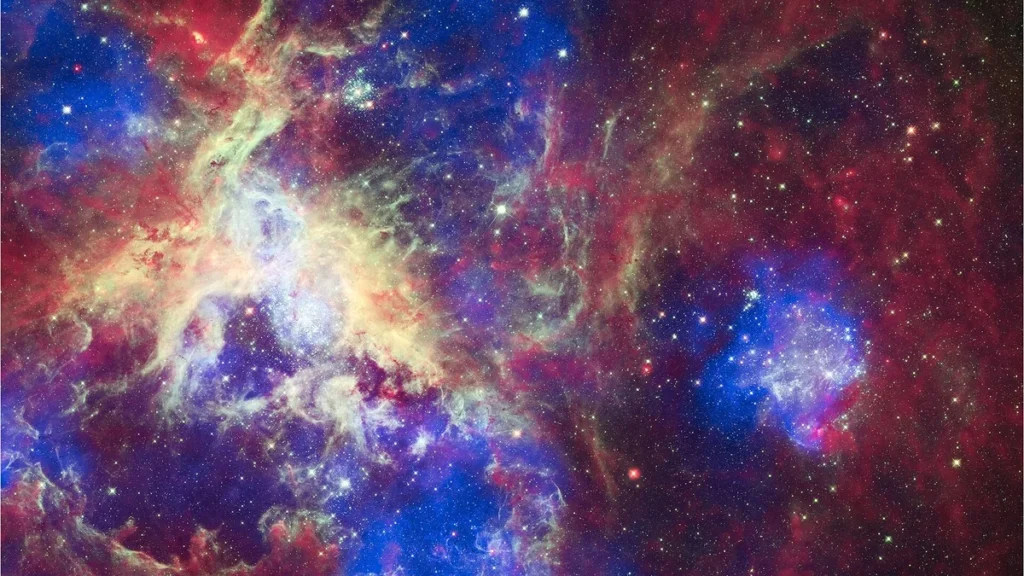
- Rho Ophiuchi is a Milky Way star-forming cloud known for a kaleidoscope of color, where Chandra X-ray data reveals infant stars flaring with X-rays alongside Webb infrared data.
- In the Orion Nebula sonification, newborn stars are twinkling sounds, diffuse X-ray emission is pure high tones, and Webb infrared dust and gas are lower tones, distorted strings, and a digital harp.
NASA released four new sonifications of star-forming regions on November 17, 2026, converting telescope data into sound so listeners can hear stellar nurseries where baby stars form.
Converting digital telescope information into musical notes and sounds, the agency builds sonifications from astronomical data. The source describes this as the basic method behind the new soundscapes, turning digital telescope information into sound instead of only images. Each layer of sound in the videos stands for a particular wavelength of light. The separate audio layers tied to different light wavelengths let people both see and hear distant space objects, making the objects accessible through sight and sound together.
The batch includes sonifications of Rho Ophiuchi, the Orion Nebula, the Carina Nebula, and the starburst galaxy Messier 82, also called M82. One introduction covers the nearby Milky Way stellar factories first and saves the galaxy outside our own for last. EarthSky says the first three are Milky Way stellar factories and M82 comes last. NASA Science lists the same four regions under separate headings.
The source introduces the batch by grouping the nearby Milky Way star-forming regions before turning to M82, which lies far outside our own galaxy.
Rho Ophiuchi is a star-forming cloud in the Milky Way known for its vivid colors. Chandra X-ray observations show infant stars flaring in X-rays at the same time Webb gathers infrared data. NASA explains that Chandra can see through dust to reach these young stars, and researchers combined the X-ray and infrared observations.
For the Rho Ophiuchi track, Chandra X-rays turn into high-pitched glassy tones while Webb infrared clouds become sounds at different pitches. Stars appear as metallic plucks. A gap marks dark dust clouds emitting little light, and bright sources spread across space produce sustained tones.
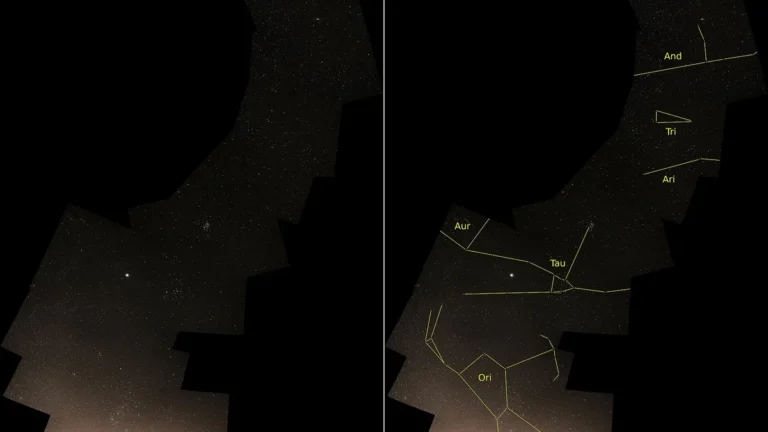
The Orion Nebula is among the closest star-forming regions to Earth at 1,300 light-years and sits just below Orion’s Belt where Orion’s Sword dangles. Chandra sees more than 1,000 newborn stars there. The region is also one of the closest and busiest star-forming areas to Earth. A small telescope under dark skies reveals it.
EarthSky notes the nebula sits just below Orion’s Belt where Orion’s Sword dangles and appears as a misty patch around a star.
Orion’s Belt consists of three stars in a row, and Orion’s Sword dangles just below it where the Orion Nebula appears as a misty patch around a star. EarthSky tells readers to look toward the Orion constellation to find the nebula this way.
For the Orion Nebula, newborn stars become twinkling sounds while diffuse X-ray emission turns into pure high tones. Webb infrared dust and gas show up as lower tones. The infrared dust and gas also appear as strings with distortion, and as a digital harp. NASA says the Webb image reveals dust and gas that builds new stars.
The Carina Nebula is a cloud of gas and dust in Carina the Keel, a Southern Hemisphere constellation. The cloud stretches across a patch of sky three times broader than the full moon and contains Eta Carinae together with the Homunculus Nebula. EarthSky describes Eta Carinae as an exploding star, and the Webb image of the region is known as the Cosmic Cliffs.
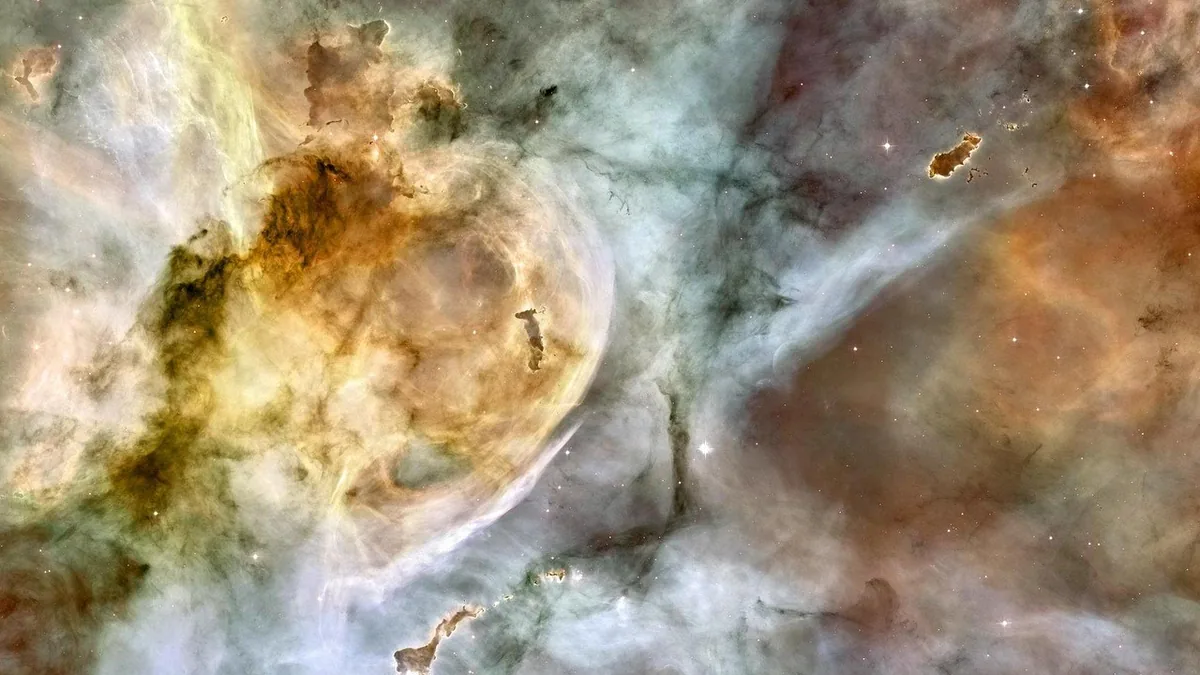
The Cosmic Cliffs track turns baby stars into short string sounds. The diffuse X-ray glow becomes longer string notes, while the nebula itself is a sustained tone broken up by instruments. NASA notes that Chandra can peer through dust and gas to find individual baby stars.
Messier 82, also called M82, is a starburst galaxy 12 million light-years away in Ursa Major where stars form tens or even hundreds of times faster than the Milky Way. EarthSky says the rate is some 100 times more prodigious than the Milky Way. Scientists think the activity might stem from a collision with another galaxy in the past. Chandra now observes giant plumes of hot gas in M82 that come from young, giant stars that quickly explode, together with other star formation activity.
The source connects these plumes to M82’s starburst activity and says the activity may have resulted from a past collision with another galaxy.
The M82 sonification combines Chandra, Webb, Hubble, and Spitzer data in a radar-like scan louder at brighter sources. X-rays sit at the highest frequencies. Infrared appears as a low drone plus plucks, and optical data becomes musical pitches and textures. NASA says the scan is louder where sources are brighter, and EarthSky describes the result as a dripping, clanking, windy soundscape.
Marshall Space Flight Center manages the Chandra program from Huntsville, Alabama. The Smithsonian Astrophysical Observatory’s Chandra X-ray Center runs science operations from Cambridge, Massachusetts and flight operations from Burlington, Massachusetts. NASA Science states these management and operations locations for the Chandra observatory.
CXC leads the sonification program, driven by visualization scientist Kimberly Arcand of CXC, astrophysicist Matt Russo, musician Andrew Santaguida of SYSTEM Sounds, and consultant Christine Malec. NASA Science says CXC leads the program and lists the collaborators by role and affiliation.
More sonifications are available at chandra.si.edu/sound. NASA Science provides the website for more sonifications beyond this batch. Researchers study places where stars form to better understand the lifecycle of stars including the Sun. NASA Science gives this as the reason for studying star-forming regions.


Join the discussion