Key facts
- Long-period radio transients release radio bursts on timescales from minutes to hours.
- Scientists are not certain what causes long-period radio transients, though neutron stars and white dwarfs are possible sources.
- Astronomer Scott Hyman and colleagues detected five mysterious radio bursts near the center of the Milky Way in 2002, spaced roughly 77 minutes apart.
- Hyman's team detected the signals again in 2003 and 2004 before they vanished.
In 2002, Scott Hyman and colleagues found five bursts of radio emission in the Milky Way’s central region, spaced roughly 77 minutes apart.
Hyman’s team picked the signals up once more in 2003 and 2004, and those were the final confirmed detections before the source disappeared. Astronomers have searched for years without detecting any further sign of the source, which lies near our galaxy’s center.
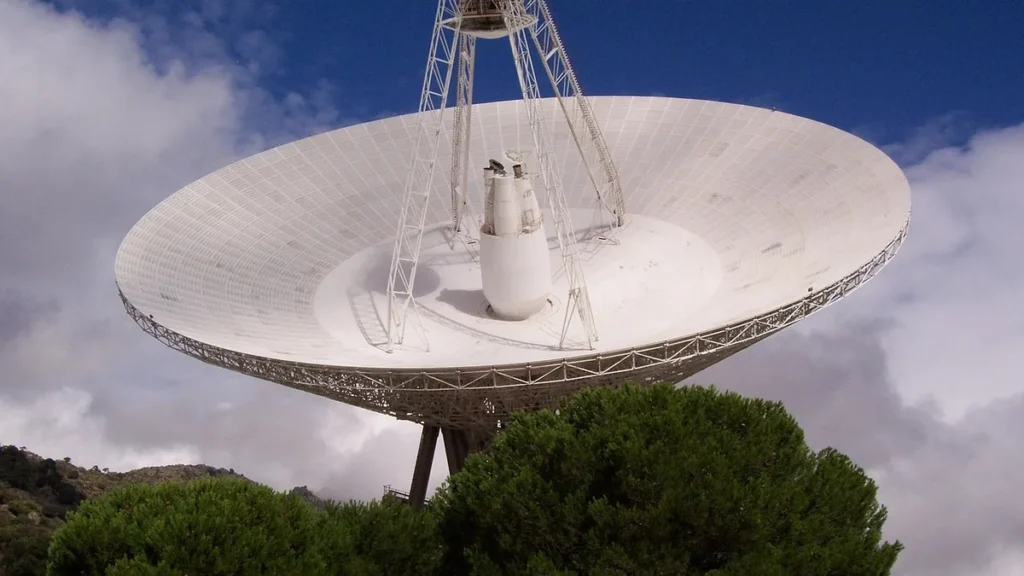
The team found another curious radio source while examining archived MeerKAT observations from May 2022, gathered during a supernova remnant survey in South Africa. The source, later designated LPT J1555-5631 (a long-period radio transient), produced signals that varied over time, and they appeared only across a 15-hour period, with none detected before or after.
The ASKAP radio telescope in Australia also detected the signals after observing the same region of sky, and researchers combined MeerKAT and ASKAP observations to clarify how the signals behaved. Bursts from LPT J1555-5631 arrived at intervals of roughly 62 minutes.
Each cycle included two distinct pulses of similar strength, with one lasting considerably longer than the other. The shorter pulse exhibited almost entirely circular polarization, while the longer pulse displayed both circular and linear polarization. The team proposes the pulses come from opposite magnetic poles on a slowly rotating object.
Team members suggest the object may be a neutron star or white dwarf, though the researchers remain uncertain. Scott D. Hyman and co-authors released Discovery of a 62 minute Long-period Transient with Near-orthogonal Rotator Geometry in The Astrophysical Journal in 2026, with DOI 10.3847/1538-4357/aeb002.
Scientists call these events long-period radio transients, which release bursts across timescales from minutes to hours. Scientists do not know exactly what causes these bursts, but candidate sources include neutron stars and white dwarfs.
Separately, researchers have traced another repeating system, GPM J071507-114153, which lies more than 5,000 light-years from Earth and sends radio signals every eight minutes. GPM J071507-114153 contains a white dwarf and a G-type star like the Sun. The dead star rotates once every eight minutes and circles its companion every 32 hours.
Researchers at Curtin University say the detection has no precedent for radio pulses from a white dwarf paired with a Sun-like star, and the discovery appeared in Nature Astronomy. Dr. Sam McSweeney said, “This is the first time the pulses are clear enough to see the white dwarf moving in its orbit around its companion.”
The team studied over 100 hours of radio data with the Pawsey Supercomputing Research Centre and used Australian and South African radio telescopes along with Hawaii’s Keck Observatory to identify the system. Data suggest the signals come from near the white dwarf, potentially from the star itself. Scientists have not determined exactly what produces the pulses in the GPM J071507-114153 system.
Researchers found stellar flares and a large plasma loop stretching from the Sun-like star. The plasma loop activity resembles what produces Earth’s auroras. Scientists found similar systems with white dwarfs but could not determine which star produced the signals.
A research team spotted the initial long-period transient in 2021, and researchers have found roughly a dozen long-period transients since then. Earlier finds include an unknown 35-year transmitter, a mysterious heartbeat-like radio signal, and radio emissions from a distant planet. Researchers believe next-generation radio telescopes will help discover more unusual stellar pairs, and the finding could aid understanding of mysterious radio signals studied over many years.


Join the discussion