Key facts
- The merged object, a single potentially rejuvenated star, was nicknamed Bao and is formally known as AT 2025abao.
- Before the merger, the two stars spent millennia orbiting as a binary pair; once the smaller star contacted the giant's surface, unification occurred after only seven orbits, about seven years.
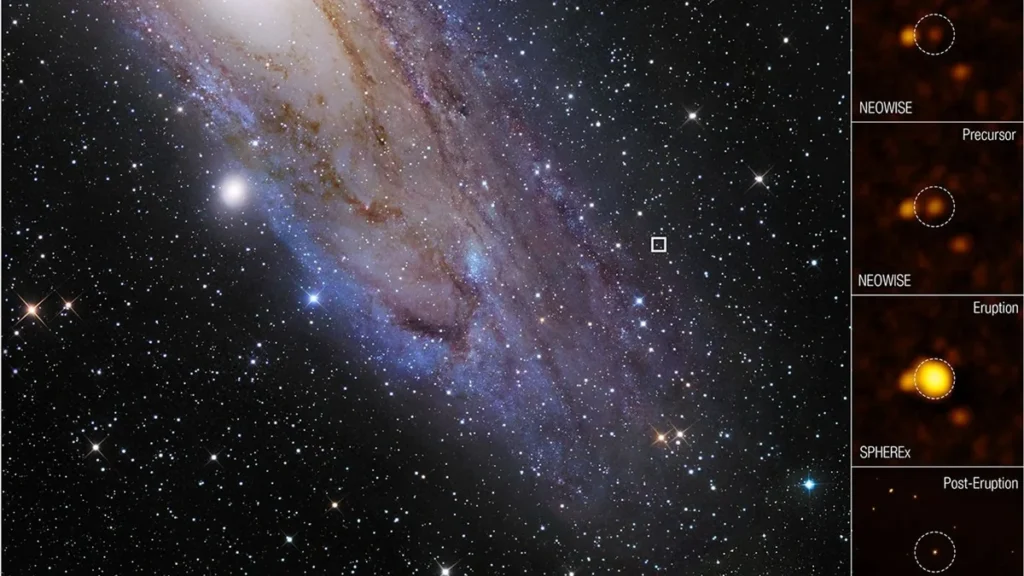
- Bao first attracted attention in February 2023 as an unusual variable star in retired NEOWISE data; before 2018 the object had consistent luminosity.
- WINTER observations in September 2024 showed Bao beginning to brighten and spew dust.
Researchers using NASA-funded data confirmed on Nov. 18, 2026, the first stellar merger of its kind: a star somewhat lighter than the Sun merged with a swollen supergiant on the Andromeda galaxy’s outskirts.
The merged object is a single, potentially rejuvenated star nicknamed Bao and formally tracked as AT 2025abao. The finding appeared in Nature and relied on fast-turn James Webb Space Telescope observations, cross-checked with information from ground-based and space telescopes.
On Oct. 17, 2025, the Zwicky Transient Facility spotted the eruption as the stars quickly brightened and grew much hotter. Webb’s observation of Bao came on Dec. 24, 2025, through a rapid-response Director’s Discretionary Time program, 47 days after the eruption peaked.
“Webb observed Bao only 47 days after the stars’ eruption peaked, the earliest ever follow-up of an event like this,” said Viraj Karambelkar, a NASA Hubble Fellow based at Columbia University in New York. Karambelkar said mergers cannot be predicted, which makes them hard to catch in real time. His team began watching the system after noticing something unusual in 2023, ahead of the eruption in 2025. His team published its first paper on Bao ahead of the 2025 eruption.
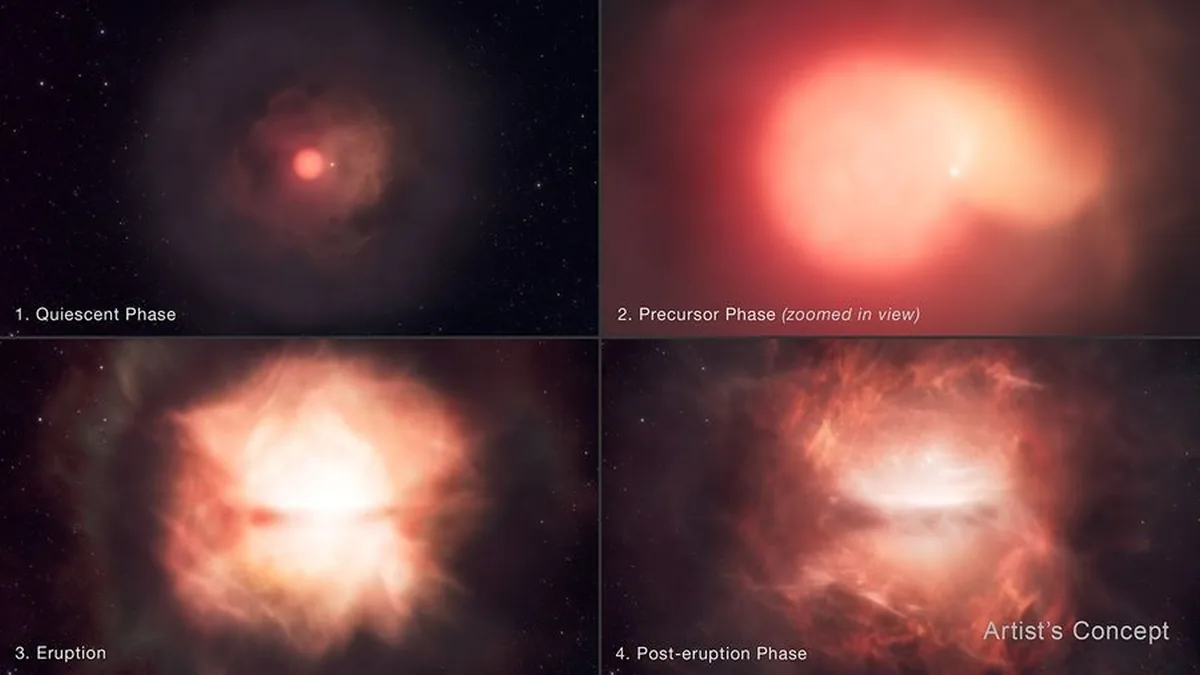
Before contact, the two stars had orbited quietly as a binary pair for millennia. Once the smaller star touched the larger star’s surface, unification took only seven orbits, roughly seven years. Other known mergers of two smaller stars happened after thousands of orbits, making this sequence unusually fast.
Simulations led by Karel Temmink of Radboud University in Nijmegen, Netherlands, estimated the larger star, Big Bao, at seven times the mass of the Sun, 350 times its radius, and 18,000 times its brightness before the eruption. Modeling gave the destroyed companion, Little Bao, a first mass estimate of about 0.7 solar masses, with a somewhat smaller radius and a fainter profile than the Sun.
This event is an example of common envelope evolution: Big Bao engulfed Little Bao, and the smaller star spiraled through the shared gas envelope, with drag removing orbital energy. Analysis showed Big Bao’s core pulled in Little Bao rather than letting it escape, an encounter Kishalay De of Columbia University compared to a bomb going off inside a living star.
In other common-envelope systems, both stars may survive while losing mass and remaining in close orbits, later evolving into neutron stars, black holes, explosive supernovae, gravitational-wave sources, or rapidly spinning pulsars. The real-time analysis of AT 2025abao let the team measure common-envelope efficiency directly rather than working backward from events that unfolded hundreds or millions of years in the past.
Attention on Bao began in February 2023, when retired NEOWISE data identified it as an unusual variable star; before 2018 the object had shone with consistent luminosity. WINTER observations in September 2024 showed the star beginning to brighten and release dust. A routine SPHEREx survey in July 2025 found Bao fading rapidly in visible light while growing brighter in infrared light.
In November 2025 the team received fast-turn observations from NASA’s retired Neil Gehrels Swift Observatory and from the Gemini North telescope in Hawaii operated by NOIRLab. The observations came ahead of the Webb visit later that year.
Nadia Blagorodnova, a co-author and associate professor at the University of Barcelona in Spain, said the team expected an outburst from such an extended star to last years, yet brightness started rising and hit its peak in under a week. Kishalay De said a companion star meeting a primary star’s outer surface produces slow brightening and strips material from the primary’s outer layers during each orbit, letting gas drift away into space.
Mid-infrared measurements from Webb showed centuries of dust loss from the larger primary star. The researchers revised their simulations until the model matched the observations. Temmink, a doctoral candidate at Radboud University in Nijmegen, Netherlands, led the simulations and said Big Bao outshone its companion, dominating the data.
Early models suggested leftover energy might allow Little Bao to escape, but later work found Big Bao’s core pulled in the demolished companion rather than letting it escape. Webb’s data let the researchers calculate how much mass the merger ejected and judge common-envelope efficiency, using views in ultraviolet, visible, and near-infrared light from telescopes to observe events as they happened.
According to Karambelkar, the Nancy Grace Roman Space Telescope will run public surveys such as the Galactic Bulge Time-Domain Survey, which should produce many short-lived brightening events for this kind of study. Only future observations will reveal how the combined star’s mass is ultimately distributed. A NASA Astrophysics Data Analysis Program grant provided partial support for the work.



Join the discussion