Key facts
- Merrison says if there is too much sand, particles are too heavy to lift high into the atmosphere, and without sand, dust particles remain trapped on the ground because storms cannot kick them up.
- Merrison says dust storms must be factored into Mars mission design because some solar-powered rovers and instruments stop working and lose contact once covered in dust and sand.
- Merrison says better prediction of impending major dust storms could allow operators to drive rovers to shelter or stow vulnerable components until the storm passes.
- Opportunity sent its final signal on 10 June 2018; NASA lost contact with the solar-powered rover, and it never responded again after the June 2018 planet-wide dust storm cut off sunlight.
Senior researcher Jonathan P. Merrison of Aarhus University co-authored research published Nov. 18, 2026, in Geophysical Research Letters proposing that the balance between sand and dust on the surface of Mars triggers dust storms that cover the whole planet.
The process, called saltation, happens when wind drives sand grains to roll and bounce. When the grains hit the ground, they knock dust particles loose from the surface. The wind suspends the dust as it rises into the troposphere. Sand grains measure between two and 0.06 mm in diameter, while dust particles measure under 0.05 mm.
Merrison says too much sand makes particles too heavy to lift, while without sand, dust remains trapped on the ground because storms cannot kick it up.
Aarhus University hosts a specialized laboratory run by Merrison, one of only a handful worldwide, with two chambers beneath yellow brick buildings capable of simulating Martian windstorms. For over 25 years, Merrison and colleagues have replicated Mars’s surface inside the chambers. The chamber simulates Mars’s climate by placing sand and dust inside and blowing air through with fans.
Martian climate models rest on experiments by Merrison and his team, but those models have not explained what triggers global dust storms. Demetrius Ramette, a German researcher never met by Merrison, contacted him about unpublished measurements. Ramette built a new model that uses the sand-to-dust ratio. Running the simulation produces planet-wide dust storms naturally.
Merrison says Mars mission design must factor in dust storms because some solar-powered rovers and instruments stop working and lose contact after dust and sand cover them. Better prediction of impending major dust storms could allow operators to drive rovers to shelter or stow vulnerable components until the storm passes.
Reliable weather forecasts are nonnegotiable for humans living on Mars because survival there is difficult and storms make it far more dangerous, Merrison says. “If humans are to live on Mars, reliable weather forecasts are nonnegotiable,” Merrison said. He contrasts losing robots to dust storms with the challenge of human settlements on Mars.
Storms that cover the whole planet break out on Mars every three or four years, block sunlight and plunge the surface into night. A dust storm erupted on Mars in June 2018 and covered the whole planet within weeks before settling in October 2018. The storm ended the mission of NASA’s solar-powered Opportunity rover. The rover sent its last signal on 10 June 2018, and the agency lost contact after the storm cut off sunlight.
The paper is Demetrius Ramette et al., Investigating the Impact of the Spatially Heterogeneous Surface Dust Cover on Martian Global Dust Event Occurrence, Geophysical Research Letters (2026).
A separate study published July 1, 2026, by Chali Idosa Uga, a third-year Ph.D. student at the University of Alabama in Huntsville, suggests global dust storms on Mars can organize the atmosphere into regions favorable for electrical activity. The research appears in The Planetary Science Journal and was advised by Dr. Gary Zank, director of the UAH Center for Space Plasma and Aeronomic Research, and Dr. Dennis Gallagher of NASA’s Marshall Space Flight Center.
Uga studied the Martian Year 34 global dust storm, a planet-encircling event in 2018 that orbiters and rovers observed simultaneously. Uga says Mars does not have terrestrial thunderstorms but does have intense dust storms in a thin carbon dioxide atmosphere. During such events, dust moves through the lower atmosphere after winds lift and transport it, allowing grain collisions to separate electric charge while the weakly conducting atmosphere may let that charge persist. Uga says the lower atmosphere during the Martian Year 34 storm formed localized pockets at different altitudes where charge separation could persist, and modeled electric fields neared breakdown-favorable conditions.
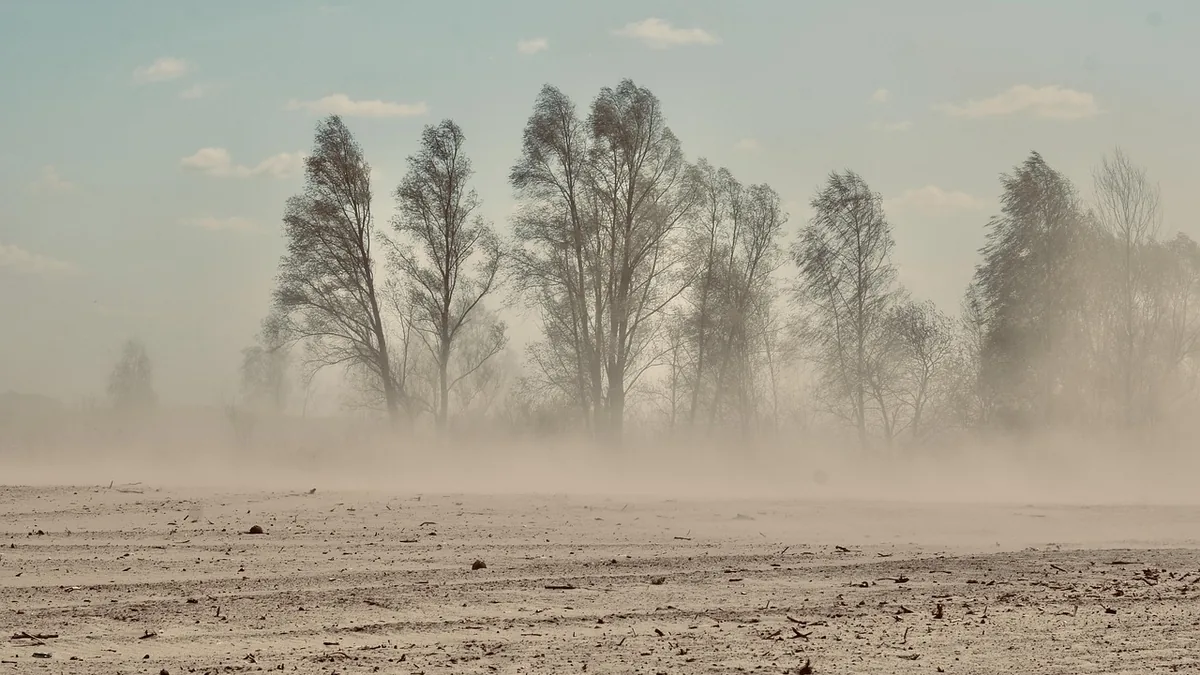
Uga says major dust storms should be evaluated as atmospheric, thermal and visibility hazards and also as structured electrostatic environments. “We do not quantify risk to a specific spacecraft, habitat, instrument or communication system,” Uga said. Uga says electrostatic charging changes how dust interacts with exposed mission systems; under intense storm conditions, charged dust may influence adhesion, deposition on sensitive surfaces, instrument stability and charge accumulation. Uga says the study was not intended to claim lightning detection on Mars but sought to understand when and where a global dust storm creates conditions needed for strong electric fields and possible electrical breakdown.
Electrical breakdown in such regions could alter the local reaction environment of Mars’s dusty carbon-dioxide atmosphere, Uga says. That matters because the chemical state of the near-surface atmosphere affects interpretation of oxidants, perchlorate-related chemistry and preservation of organic molecules – key habitability issues. Uga says researchers must test whether those conditions create measurable electrical effects in the real atmosphere using laboratory experiments, improved modeling and future mission observations. The next step moves from diagnosis to testing.
Research published July 21, 2026, suggests that solar storms may affect Martian weather when they strike alongside major dust storms. Scientists at Lancaster University, the University of Leicester and the Instituto de Astrofisica de Andalucia-CSIC in Granada, Spain looked at five solar energetic particle events at Mars. The team used data from NASA’s MAVEN spacecraft and ESA’s Trace Gas Orbiter and compared observations with the Mars Climate Database.
Solar energetic particle events happen when solar flares and coronal mass ejections release high-energy charged particles, and Mars is especially exposed because it has a thin atmosphere and no strong global magnetic field like Earth.
Of the five solar energetic particle events, four produced no clear effect. The June 2018 event coincided with an expanding global dust storm that ended the mission of NASA’s Opportunity rover. Lana Williams led the study and is a PhD researcher at Lancaster University. She says the team thought energetic particles might affect temperatures in the lower atmosphere.
Williams says no clear heating appeared in four of five events. The single exception took place as a global dust storm expanded across the planet. “The one exception occurred while a global dust storm was expanding across the planet,” Williams said. Williams says finding a dust storm happening at the same time as the heating was unexpected and suggests Mars’s atmosphere and weather may respond to several events acting together rather than each heating source operating independently.
The team says dust storms heat parts of the Martian atmosphere by absorbing sunlight, but the heating pattern during the combined solar-particle and dust-storm event was unusual and the storm alone could not explain it. The team calls the result tentative. Researchers need more observations of solar energetic particle events during Martian dust storms to see whether the combination consistently produces unusual heating or whether another unobserved factor played a role.
The Lancaster-led team says it is not aware of any previous investigation into the interaction between solar energetic particles, dust storms and lower-atmospheric heating. The team says studying combined solar-storm and dust-storm effects could improve models of the Martian atmosphere and help researchers read future temperature observations during intense solar and dust-storm activity.
Merrison remains pessimistic about Mars research, saying interest in the planet has waned following shifts in NASA’s policy direction under the Trump administration. He says the focus is on returning humans to the Moon and establishing a permanent base, with the U.S., China and India racing to get there at the expense of Mars research. Merrison says a mission to bring back samples collected by the Perseverance rover is canceled.
The Moon has virtually no geological activity and no climate, Merrison says. Mars is more Earth-like and may have been more similar in the past. He says researchers can learn only so much from the Moon, and that the shift toward lunar exploration is more about securing access to resources. Merrison says a weather forecast for an uninhabited planet may sound unnecessary, but it serves as an essential tool for continuing to explore Mars.


Join the discussion