Key facts
- SpaceX launched the classified USSF-627 mission from Vandenberg on Wednesday, Nov. 11, at 11:36 p.m. EST after two postponements, and its booster landed on Of Course I Still Love You.
- NASA and Northrop Grumman are targeting 10:47 a.m. EST on Sunday, Nov. 29, to launch the NG-25 Cygnus XL spacecraft on a Falcon 9 from Cape Canaveral Space Force Station.
- SpaceX failed to catch the Super Heavy booster after its guidance aborted, and it exploded over the Gulf of Mexico; the ship reached orbit and released 26 Starlink V3 satellites.
- Rocket Lab flew its Electron rocket for the 100th time just after midnight on Saturday, Nov. 14, at 12:30 a.m. EST on The Mountain God Rises from Launch Complex 1 on New Zealand's Māhia Peninsula.
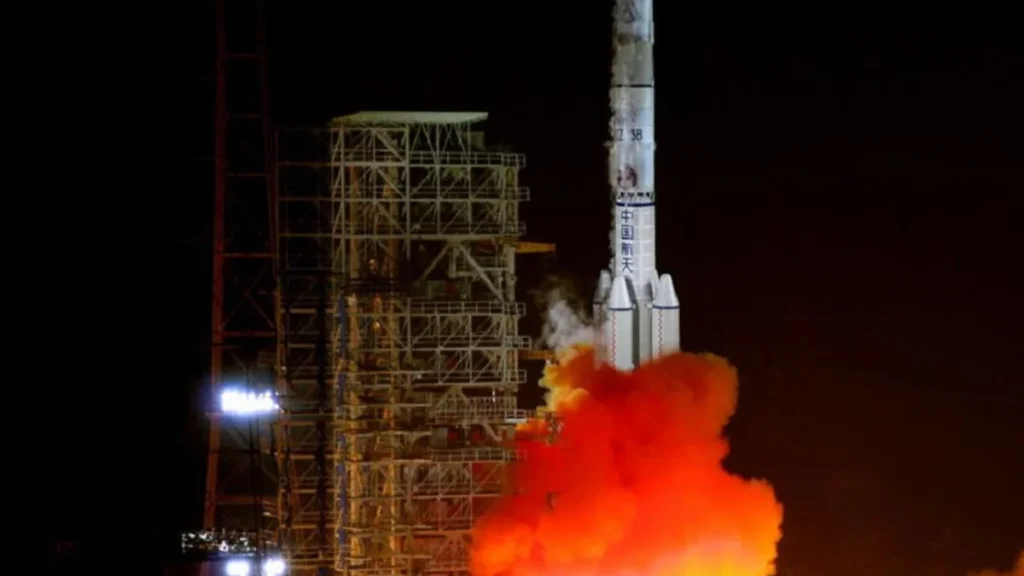
China and SpaceX are scheduled to launch back-to-back missions on Wednesday, Nov. 18, 2026, from Taiyuan Satellite Launch Center in Shanxi province and Vandenberg Space Force Base in California, Astronomy Magazine reported.
The Chinese flight is a Long March 2D set for 5:50 p.m. EST, and its payload has not been announced, according to NextSpaceflight as cited by Astronomy Magazine. The mission opens an evening that also includes a later SpaceX national-security launch from California.
About four hours after the Chinese flight, SpaceX will fly the classified USSF-317 mission for the U.S. Space Force. The launch will occur at 10:00 p.m. EST on Wednesday, Nov. 18, from Space Launch Complex 4E at Vandenberg Space Force Base in California. SpaceX and the U.S. Space Force have not disclosed what the mission carries, and no payload or orbit information beyond its classified status is public. SpaceX plans to land the booster on the droneship Of Course I Still Love You in the Pacific Ocean.
The source pointed to the classified USSF-627 flight from Vandenberg on Wednesday, Nov. 11, at 11:36 p.m. EST as a recent comparison; it lifted off after two postponements and its booster touched down on Of Course I Still Love You.
On Friday, Nov. 20, a Long March 8A is slated to lift off from the Wenchang Space Launch Site on Hainan Island at 6:00 a.m. EST per NextSpaceflight as cited by Astronomy Magazine. Its payload has not been disclosed, though it is suspected to carry SatNet LEO satellites for Guowang, a state-backed broadband megaconstellation intended to rival Starlink. The launch appears in the source’s weekly schedule immediately after the Nov. 18 Taiyuan mission.
The National Reconnaissance Office will launch NROL-136 on a Falcon 9 from SLC-4E at 7:30 a.m. EST on Saturday, Nov. 21, with the booster returning to Landing Zone 4 instead of a droneship. This NRO flight closes out the week’s launches listed by the source and uses a land-based landing rather than a droneship.
Arianespace is targeting 5:12 a.m. EST on Monday, Nov. 23, for an Ariane 64 launch from the Guiana Space Centre in French Guiana carrying 36 more Amazon Leo satellites. Later that day, SpaceX will fly the classified USSF-266 mission for the Space Force from Vandenberg at 11:04 a.m. EST, another national-security Falcon 9 mission from the West Coast pad.
On Tuesday, Nov. 24, China will launch a Long March 12 from the commercial launch site at Wenchang on Hainan Island at 2:00 a.m. EST according to Next Spaceflight as cited by Astronomy Magazine. Its payload remains unconfirmed but is likely another batch of SatNet LEO satellites for Guowang.
NASA and Northrop Grumman are targeting 10:47 a.m. EST on Sunday, Nov. 29, to launch the NG-25 Cygnus XL spacecraft on a Falcon 9 from Cape Canaveral Space Force Station. Named S.S. James A. Lovell after the Apollo 13 commander, the spacecraft will haul tons of supplies to the space station. Astronomy Magazine listed it as the final upcoming launch in its week-ahead schedule.
A Long March 2D carrying CAS Pathfinder-1 lifted off from Jiuquan Satellite Launch Center on Wednesday, Nov. 11, at 6:41 a.m. EST. Astronomy Magazine cited CGTN in reporting that the Chinese Academy of Sciences built the satellite to test technologies for its planned Origins space science program.
SpaceX attempted its first dual-stage tower catch during Starship Flight 15, which lifted off from Starbase, Texas, on Friday, Nov. 13, at 5:47 p.m. EST. Russia launched a Soyuz-2.1b from the Vostochny Cosmodrome at 8:16 p.m. EST the same day, carrying two high-resolution imaging satellites and a dozen smaller payloads.
The Super Heavy booster exploded over the Gulf of Mexico after its guidance aborted and SpaceX failed to catch it; the ship reached orbit and released 26 Starlink V3 satellites. The vessel became the second Starship ever to reach orbit, making the Saturday upper-stage catch a first for SpaceX and spaceflight. After 14 trips around Earth, the stage slowed over Starbase, dropped between the tower’s mechanical chopsticks, and the chopsticks plucked it from the air.
Rocket Lab flew its Electron rocket for the 100th time just after midnight on Saturday, Nov. 14, at 12:30 a.m. EST on The Mountain God Rises from Launch Complex 1 on New Zealand’s Māhia Peninsula. The Electron placed a synthetic aperture radar satellite into orbit for Japanese company iQPS. A synthetic aperture radar sends microwaves toward the ground and reads the reflections to make images, so cloud cover and darkness do not block its view.
United Launch Alliance’s Vulcan rocket lifted off from Cape Canaveral Space Force Station on Sunday, Nov. 15, at 12:40 p.m. EST carrying 40 satellites for Amazon Leo. About 10 minutes into the flight, ULA reported an anomaly, and the satellites never reached orbit. The mission represented a return to flight for Vulcan following the February USSF-87 flight, which suffered a minor booster anomaly but completed its payload delivery, and Amazon has booked dozens of Vulcan launches.
A launch window opens on Thursday, Nov. 26, for the third flight of Isar Aerospace’s Spectrum rocket from Andøya Spaceport in Norway, according to European Spaceflight.


Join the discussion