Key facts
- United Launch Alliance's Vulcan rocket experienced an in-flight anomaly roughly ten minutes after liftoff on Sunday, keeping the vehicle from reaching orbit and destroying 40 Amazon LEO broadband satellites.
- Ars Technica's analysis indicated the problem began in Vulcan's main booster stage, and the rocket's two Blue Origin BE-4 engines kept firing for at least 30 seconds beyond the planned duration.
- ULA has not publicly announced the cause of the failure and stated it lacked immediate specific data to explain what occurred.
- By October 1, the Space Force reassigned six National Security Space Launch missions previously assigned to Vulcan to SpaceX.
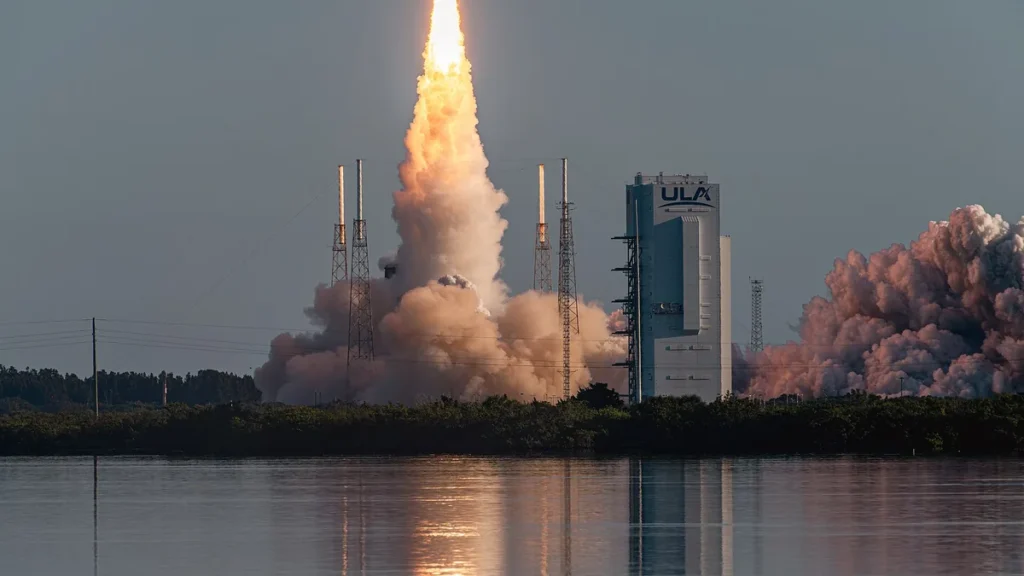
United Launch Alliance’s Vulcan rocket experienced an in-flight anomaly roughly 10 minutes after liftoff from Cape Canaveral Space Force Station, Florida, at 12:40 p.m. ET on Nov. 15, 2026, destroying 40 Amazon Leo broadband satellites and keeping the vehicle from reaching orbit.
Breaking Defense and Gizmodo reported that analysis indicated the problem began in Vulcan’s main booster stage, with the rocket’s two Blue Origin BE-4 engines kept firing for at least 30 seconds beyond the planned duration. The six solid rocket boosters, strap-on motors that provide extra thrust at liftoff, performed well during the first two minutes of flight. The vehicle began spinning shortly after its main engines shut down, and the spinning continued after the Centaur V upper stage separated and its twin RL10 engines ignited. ULA has not publicly announced what caused the failure and said it lacked immediate specific data to explain what occurred.
United Launch Alliance, a joint venture between Boeing and Lockheed Martin, suffered its first complete mission loss since the company’s founding in 2006 on Sunday. Vulcan had completed four launches before the failure, with all four reaching orbit, though two of those flights experienced solid rocket booster problems. The first flight occurred on Jan. 8, 2024, and the second mission, Cert-2 in October 2024, sustained nozzle damage on one of its GEM 63XL solid rocket boosters. The GEM 63XL nozzle, built by Northrop Grumman, failed on two of Vulcan’s four flights even after a design fix was attempted between them.
The U.S. Space Force suspended national security launches with Vulcan in late February 2026 because of persistent problems with the rocket’s solid rocket boosters. The suspension followed the USSF-87 mission on Feb. 12, 2026, Vulcan’s first actual national security flight carrying two Geosynchronous Space Situational Awareness Program satellites and a training payload, when one GEM 63XL booster experienced nozzle burn-through about 20 seconds after liftoff. As of Oct. 29, 2026, the Space Force had not restored military launch authorization for Vulcan Centaur. Only ULA and SpaceX hold certification to fly the military’s most sensitive payloads under Phase 2 of the National Security Space Launch program.
Only SpaceX’s Falcon 9 and Falcon Heavy rockets are currently cleared to carry critical payloads under Phase 3 Lane 2 of the National Security Space Launch program. Blue Origin’s New Glenn remains grounded following a launch pad explosion in May. By Oct. 1, the Space Force reassigned six National Security Space Launch missions from Vulcan to SpaceX. SpaceX’s Falcon 9 and Falcon Heavy took over missions once assigned to Vulcan, including the final GPS III navigation satellite, which launched on Falcon 9 in April 2026.
Vulcan’s contract covers roughly half of the U.S. military’s national security space missions over the next few years. ULA had won 19 national security missions in the Space Force’s newest major launch program versus 28 for SpaceX. On July 29, 2026, the Space Force awarded SpaceX a $1.6 billion task order for 18 Space-Based Sensing and Targeting launch missions under a NSSL Phase 3 Lane 1 arrangement.
The Space Force shifted four Vulcan-manifested missions to SpaceX Falcon 9 and Falcon Heavy, including a Space Development Agency Tranche 1 tracking mission, an Air Force Research Laboratory cislunar pathfinder payload, and the first Next-Generation Overhead Persistent Infrared missile warning and tracking satellite, plus the final GPS III navigation satellite.
The Space Force’s portfolio acquisition executive for space access, Brig. Gen. Eric Zarybnisky, said on Oct. 21 that Leo 1 served as an unofficial national security validation test connected to the military’s clearance decision. “It’ll depend a lot on what we see,” Zarybnisky said. The Space Force is still talking with ULA but has not cleared Vulcan for military missions.
The Space Force is not waiting for a formal re-certification process, new test flights, or a DoD-mandated investigation to finish; it is waiting to see what the commercial customer’s flight data shows. One clean commercial Vulcan flight may not be enough to restore military launch authorization, and the already-assembled Leo 2 could be the real decision point.
Sunday’s flight was the first of 38 Vulcan launches Amazon bought to build a broadband Internet satellite constellation meant to compete with SpaceX’s Starlink. Amazon Leo began as Project Kuiper in April 2019; Amazon rebranded it in November 2025, and Amazon plans it as a 3,236-satellite constellation. As of July 2026, Amazon Leo had approximately 396 production satellites on orbit. The Federal Communications Commission ordered Amazon to place 1,616 satellites, half its approved constellation, in orbit by July 30, 2026, but Amazon missed the deadline.
The FCC granted an extension carrying a spectrum priority penalty that degrades Amazon Leo’s priority until 1,616 satellites are on orbit or until October 30, 2027, whichever comes first. Amazon Leo said on X that risk accompanies any launch, especially inaugural flights such as LV-01, called ULA a trusted partner, and expressed confidence that ULA would learn and deliver on long-term Vulcan plans.
Leo 1 was to be Vulcan’s first flight in the VC6L setup, which pairs all six GEM 63XL boosters with a long payload fairing. The VC6L configuration has a stated low Earth orbit capacity of approximately 27,200 kilograms. The flight introduced the Centaur V LEO-Optimized upper stage, about 1.8 meters shorter than the High-Energy variant and carrying roughly one-third less liquid hydrogen and oxygen propellant. The variant targets Amazon Leo’s approximately 630-kilometer constellation altitude, and the upper stage retains twin RL10 engines with multiple restart capability.
Vulcan’s core stage uses two Blue Origin BE-4 engines, the same design found on Blue Origin’s New Glenn rocket. In August 2026, workers were modifying Vulcan’s BE-4 engines to add the small valve fix that Blue Origin said could be retrofitted to existing engines. Blue Origin’s New Glenn exploded on the pad at Cape Canaveral on May 28, 2026, after a liquid oxygen valve failure in a BE-4 engine that investigators identified as the primary cause.
The failure will likely trigger a lengthy investigation that could ground the rocket for months. The rocket is expected to remain grounded for an indefinite period. Sunday’s flight aimed to show Vulcan was ready to return to regular operations after its grounding. ULA said its purpose is to provide assured access to space, a standard it did not meet on the failed mission.
ULA said its engineers will investigate to find the cause, decide on corrective action, and return to flight as quickly as possible.
On Oct. 28, ULA released its return-to-flight statement, saying its investigation identified several potential contributors to the nozzle burn-through but not one definitive root cause. Testing and analysis will continue alongside Vulcan flights as the company flies the improved nozzle design to gather validating data. Vulcan returned to flight carrying two hardware fixes at once: a redesigned GEM 63XL nozzle and a BE-4 valve modification.
Clayton Swope, deputy director of the Aerospace Security Project at the Center for Strategic and International Studies, called the launch bottleneck real and worsening. “But the launch bottleneck is real and set to get worse,” Swope said. Swope added that a BE-4 engine issue would pose a particularly thorny problem for the Pentagon, NASA, Amazon, and anyone else needing a ride to space. Martin Halliwell of Luxembourg-based New Space Capital said no magic wand exists, and that someone would need to persuade Elon Musk to keep Falcon 9 flying until viable alternatives appear.
SpaceX plans to shift its launch operations to Starship by roughly 2030 and retire its Falcon rockets, while ending commercial Falcon ride orders after 2028. The company has not said whether it will offer Starship launches to commercial or military customers. SpaceX’s plan to phase out Falcon rockets and shift to Starship by around 2030 has raised widespread concerns about a potential multiyear gap between U.S. launch demand and available capacity. On Nov. 14, SpaceX demonstrated for the first time that it could catch the upper stage of its Starship super-heavy launch vehicle during a test flight.

Join the discussion