This is a new development in a story we reported earlier: SpaceX targets Nov. 13 for Starship Flight 15 double landing test.
Key facts
- SpaceX's Starship upper stage reached orbit Friday after the first-stage booster fell into the Gulf of Mexico and exploded, ending the company's bid to catch both stages at the launch pad.
- The first-stage booster was sent to an offshore point in the Gulf of Mexico instead of flying back to the Texas launch pad after liftoff.
- The mission could remain in flight for as long as 22 hours.
- The flight plan calls for Starship to circle the Earth 15 times at about 170 miles (275 kilometers) before returning to the launch site for Saturday's finale.
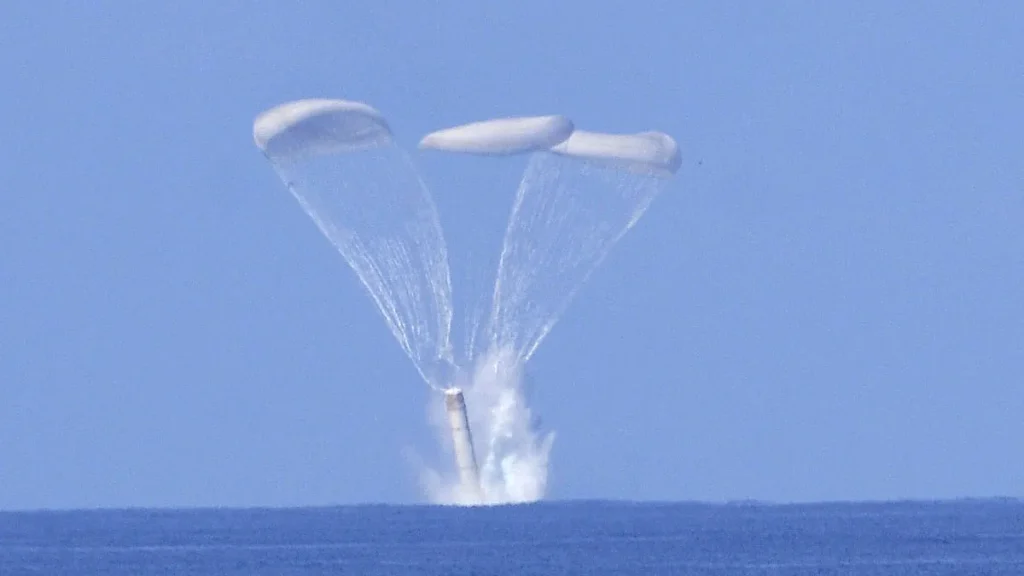
SpaceX’s Starship spacecraft reached orbit Friday, though the booster was lost after falling into the Gulf of Mexico and exploding, ending the company’s attempt to catch both stages at the Texas launch pad. Instead of returning to the pad after liftoff, the booster was sent offshore while the spacecraft continued on its trajectory during a test described as the boldest yet.
The company had caught the booster three times before at Starbase near the U.S.–Mexico border, so Friday’s miss was a surprise. The flight marked the first attempt to catch the upgraded booster, a 236-foot (72-meter) vehicle built as the production model for moon and Mars missions. That also marked the first catch attempt for the spacecraft, which stands 171 feet (52 meters) tall. Combined, the stages form the world’s largest and most powerful rocket at 407 feet (124 meters).
The mission could last as long as 22 hours, with the spacecraft circling Earth 15 times at roughly 170 miles (275 kilometers) before returning to the launch site for Saturday’s finale. Soon after reaching orbit, Starship released 26 of the company’s most advanced Starlink satellites. Barring further trouble, the spacecraft will steer toward the launch pad on Saturday.
Fourteen earlier Starship vehicles had spacecraft sections that ended up in the ocean, either by design or in fiery wreckage. That history includes the first full-scale test flight in 2023, when several engines did not start and the tumbling vehicle destroyed itself. The September test was the first to reach orbit, but SpaceX did not attempt to recover either stage.
Kate Tice, a SpaceX launch commentator, said the loss was not the news the company had hoped for and that it matched safety checks meant to protect the pad. “Well, that certainly isn’t the news that we had hoped to hear for today,” Tice said. The company offered no explanation for what caused the booster to fail.
Before Friday’s launch, Kiko Dontchev, SpaceX’s vice president of launch, said Falcon rockets cannot be fully reusable since they discard their second stage on every flight, unlike Starship, designed to catch both stages. At Kennedy Space Center last week, Dontchev said full reusability might push launch rates from zero to 100,000. SpaceX plans to begin Starship launches from Florida within a few months and from Louisiana within a few years, tied to full reusability and higher launch rates.
Falcon rockets will continue flying from Cape Canaveral to transport NASA astronauts to the International Space Station, and satellites will keep riding Falcon rockets for now. Musk wants Starship to replace Falcon eventually. NASA is paying SpaceX billions of dollars to use Starships for landing Artemis astronauts on the moon, while Jeff Bezos’ Blue Origin is the other major player in the lunar landing effort.
NASA plans to make its decision one year before Artemis IV on whether astronauts reach the lunar surface aboard Starship or Blue Moon, with Artemis IV described as the first astronaut lunar landing in more than five decades. During Artemis III next summer, crew members will practice docking their capsule with Blue Moon and then Starship while in Earth orbit, meant to prepare for a lunar landing as early as 2028. NASA Administrator Jared Isaacman said on X after the spacecraft reached orbit that he anticipates on-orbit Starlink capability for Artemis III.
Musk views rapid reusability as the way to achieve fast, steady launch rates required to construct moon bases and send people to Mars. The company’s founding aim is to retrieve every rocket component for recycling, something no one has accomplished anywhere in the world.
Musk said during a third-quarter earnings call that SpaceX would attempt to catch both the Super Heavy booster and the upper stage on the next test flight, set for no earlier than November 8. He described Flight 15 as the first occasion when an orbital launch vehicle would be completely recovered. That flight would be the first attempt to catch the upper stage following three earlier successful booster recoveries.
A Flight 15 simulation showed one of two Mechazilla launch and catch towers at Starbase in South Texas, towers equipped with chopstick arms for catching returning vehicles. The simulation showed Ship coming back from orbit in a horizontal belly-flop position. Before arriving at Mechazilla, Ship conducts a brief burn to slow down and rotate upright into a vertical catch stance.
The simulation omitted the Super Heavy booster catch, though that maneuver would use the same method at Starbase’s second Mechazilla tower. Musk said he believed the double catch stood a better than even chance of succeeding on the next flight. “I’d say it’s more likely than not that this succeeds next flight,” Musk said.
Recovering the booster should be comparatively straightforward because SpaceX has done it before, but catching Ship is more difficult because it returns from orbital altitude at far greater speed. A successful catch depends on completing the full orbit; an early return means Ship will not reenter over Starbase. Since Flight 14, SpaceX has been working on engine failures that shortened the first orbital flight, and the megarocket has flown with upgraded Raptor 3 engines three times, malfunctioning on each occasion.
Full reusability requires recovering both stages, and flying the same rocket again and again would sharply reduce launch costs. After a successful double catch, the next objectives are to reflight an upper stage and raise Starship’s launch cadence. Gizmodo describes the September test flight as the first to send the megarocket to orbit, a milestone for commercial viability, although the path ahead remains long and difficult and the next test will be more demanding.




Join the discussion