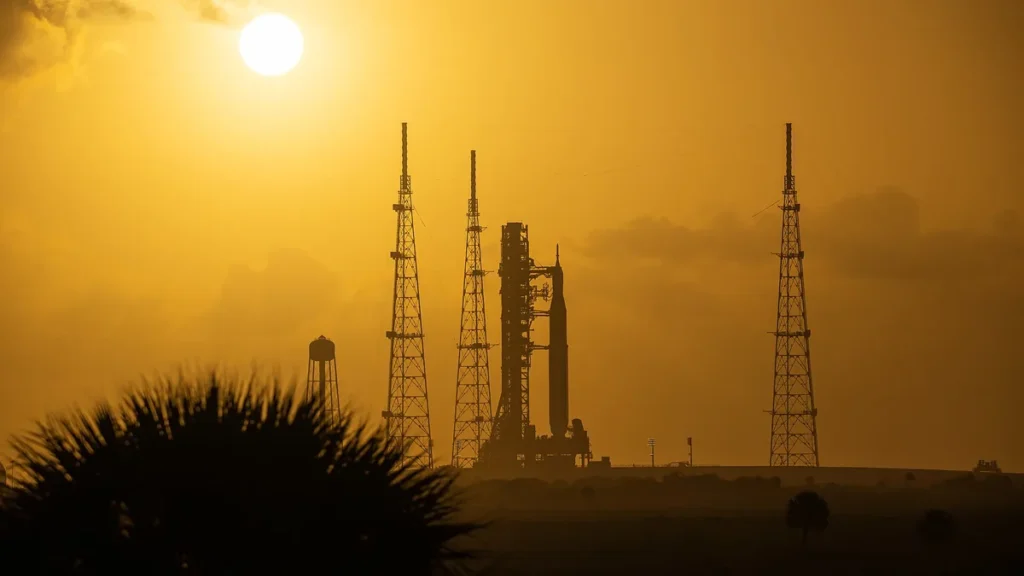
This is a new development in a story we reported earlier: Amazon Leo to launch 40 satellites on ULA Vulcan rocket.
Key facts
- United Launch Alliance postponed its Vulcan launch of 40 Amazon Leo satellites from Friday, November 13, 2026 to Saturday, Nov. 14 at 12:32:30 p.m. EST after a power interruption at an Air Liquide nitrogen plant.
- Amazon Leo's LV-01 mission marks its first Vulcan rocket launch for ULA, carrying 40 satellites to low Earth orbit as the largest Leo payload yet delivered.
- Amazon states its Leo broadband service will start before the end of 2026 across the US, UK, France, Germany and Canada.
- Amazon Leo's LV-01 mission is the first of 38 Vulcan launches Amazon has purchased from United Launch Alliance.
United Launch Alliance postponed its Vulcan launch of 40 Amazon Leo satellites from Friday, November 13, 2026, to Saturday, November 14 at 12:32:30 p.m. EST after a power interruption at an Air Liquide nitrogen plant near Cape Canaveral.
The delay comes as Amazon Leo trails SpaceX’s Starlink in orbit, with roughly 400 Leo satellites deployed compared with more than 11,000 Starlink satellites, according to the Space Foundation and GCN.
United Launch Alliance announced the postponement at 8:41 a.m. EST on November 13, just over four hours before the original liftoff, after liquid oxygen loading had begun on the Centaur 5 upper stage. The company said the rocket and satellites remained healthy.
GCN had listed the Vulcan VC6L for liftoff at 5:54 p.m. UTC on November 13 from Space Launch Complex 41 at Cape Canaveral Space Force Station, with a window from 17:54 to 18:24 UTC.
Saturday’s flight is Amazon Leo’s first Vulcan mission and the largest Leo payload yet delivered, carrying 40 satellites to low Earth orbit. This is the first of 38 Vulcan launches Amazon has purchased from United Launch Alliance.
Vulcan is a 215-foot-tall vehicle returning to flight after solid rocket booster nozzles failed on two of its first four missions.
ULA describes its VC6L Vulcan as carrying more than 50,000 pounds of payload, a company record, using six Northrop Grumman solid rocket boosters. ULA mission diagrams show the Amazon Leo satellites separating roughly 70 minutes after liftoff at about 285 miles altitude, across 16 events spanning roughly 25 minutes.
Vulcan will fly on a northeasterly trajectory after leaving the pad. The U.S. Space Force’s 45th Weather Squadron forecasts zero percent chance of rain and winds of 10 to 15 knots Saturday at the launch site.
This Vulcan flight is the first flight of a BE-4 engine since New Glenn exploded on the pad during a May test; Vulcan uses two BE-4 engines producing more than 1 million pounds of thrust. Blue Origin installed a retrofit kit for Vulcan’s BE-4 engines, which it qualified through hot-fire testing.
New Glenn exploded on the pad during a May static-fire test, heavily damaging Cape Canaveral launch facilities, and Blue Origin CEO Dave Limp said the failure originated at the main oxygen valve on one BE-4 engine, common to Vulcan’s BE-4s. New Glenn remains grounded, and Blue Origin’s FCC filing lists a preflight and launch window from Launch Complex 36 beginning January 15 and extending through April 15.
The launch marks the first flight of a redesigned booster nozzle since the Feb. 12 failure during a Space Force national security mission, with the investigation still open. On February 12 during the USSF-87 mission, one of Vulcan’s four solid rocket boosters suffered a nozzle burn-through about 20 seconds after liftoff, though the payloads reached planned orbit. In October 2024, a nozzle came off one booster on Vulcan’s second certification launch, traced to a manufacturing defect in an internal nozzle part.
The probe into the booster nozzle failures relied on laboratory materials tests and a full-scale engine firing of the Graphite Epoxy Motor 63XL. Investigators found three credible causes and applied fixes through changes to nozzle design and manufacturing, while ULA has kept the causes secret and the inquiry remains open after this flight.
The postponement adds to a nine-month gap following the latest solid rocket booster malfunction that led the U.S. government to suspend Vulcan for national security flights.
ULA President and CEO Mark Peller said every flight generates data and teaches something, and the company will use this flight to assess corrective action effectiveness. “Every flight generates data and every flight teaches us something,” Peller said.
“Every flight generates data and every flight teaches us something”
Amazon Leo, formerly Project Kuiper, is a low Earth orbit broadband constellation managed by Kuiper Systems LLC, a subsidiary of Amazon. The constellation is designed to eventually consist of more than 3,200 satellites, and GCN describes it as a 3,236-satellite system intended to increase global broadband access.
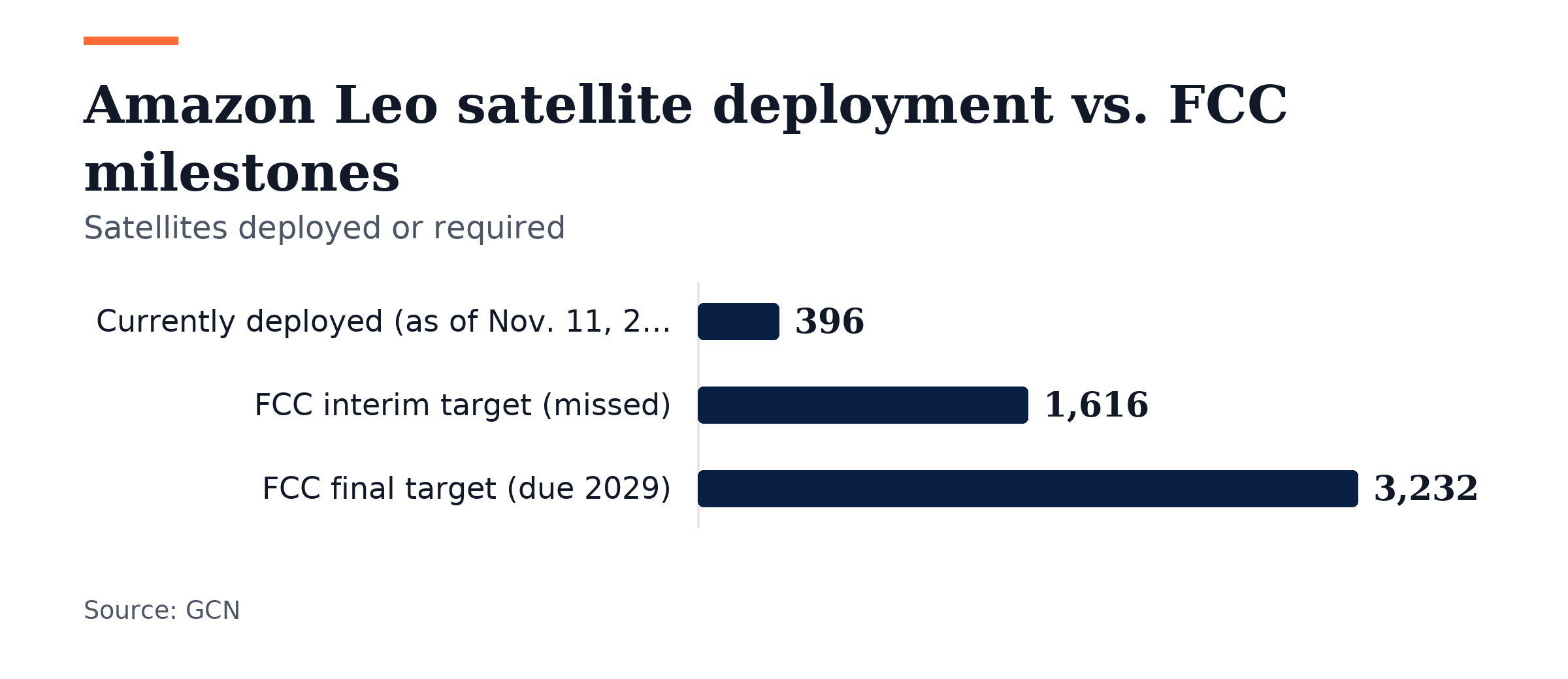
In April 2025, Amazon Leo began full-scale deployment and had launched 396 satellites across 14 production missions as of November 11, 2026, with consumer service still closed. The company has contracted more than 80 launches across five rocket families in what GCN describes as the largest commercial launch procurement in history.
Full-scale deployment began with launches from Arianespace, Blue Origin, SpaceX and United Launch Alliance. Amazon has launched nearly 400 Leo satellites across 14 missions since then using Atlas 5, Falcon 9 and Ariane 6, but none since July.
Amazon Leo missed the FCC interim requirement to deploy 1,616 satellites by July 30, 2026. A conditional waiver granted on June 5, 2026 kept the license in force, but all 3,232 first-generation satellites remain due by July 30, 2029.
Amazon states its Leo broadband service will start before the end of 2026 across the US, UK, France, Germany and Canada. GCN adds that Amazon’s LV-01 mission announcement included a free waitlist at leo.amazon.com.
Melissa Wuerl said Vulcan will launch close to half of Amazon’s first-generation constellation, making it the primary workhorse over the coming years.
The Vulcan set to fly Saturday was assembled in a new Amazon-funded hangar south of the pad enabling ULA to prepare two Vulcans at once, and Amazon says its second Vulcan mission could follow within weeks. ULA dedicated a second Vulcan Launch Platform, 179 feet high, with more than four miles of pneumatic tubing, 24,000 feet of electrical cabling and 44 ordnance devices, customized for Amazon Vulcan missions.
GCN cites recent tracking estimates of roughly 9,900 to 11,200 active Starlink satellites and around 650 OneWeb satellites, and describes Amazon Leo as the third-largest satellite constellation in orbit behind Starlink.
SpaceX launched Starship Flight 15 from Texas on Friday, November 13, 2026, but diverted from the planned booster landing, causing the main booster to splash down off the Texas coast. During Flight 15, the Starship upper stage achieved orbit a second time and released satellites.
The 15th Starship launch placed 26 Starlink V3 satellites into orbit to increase the constellation’s data capacity. SpaceX says each V3 satellite adds one terabit of capacity, and 26 V3 satellites equal the capacity of 10 Falcon 9 launches carrying Starlink V2 Mini.
SpaceX plans to launch tens of thousands more Starlink satellites and potentially one million AI datacenter satellites, a goal the Space Foundation says is enabled by Starship’s increased lift capacity.
Melissa Wuerl, Amazon Leo’s director of launch systems, said larger rockets and more frequent launches are critical to scaling the constellation and getting service to customers. “Larger rockets and more frequent launches are critical to scaling our constellation and getting service to customers,” Wuerl said.


Join the discussion