Key facts
- New research published in Physical Review Letters concludes stupendously large black holes cannot be a significant dark matter component because they would produce isocurvature perturbations exceeding Planck CMB limits.
- Potential dark matter candidates include WIMPs and axions, both hypothetical particles, along with primordial black holes that formed in the early Universe.
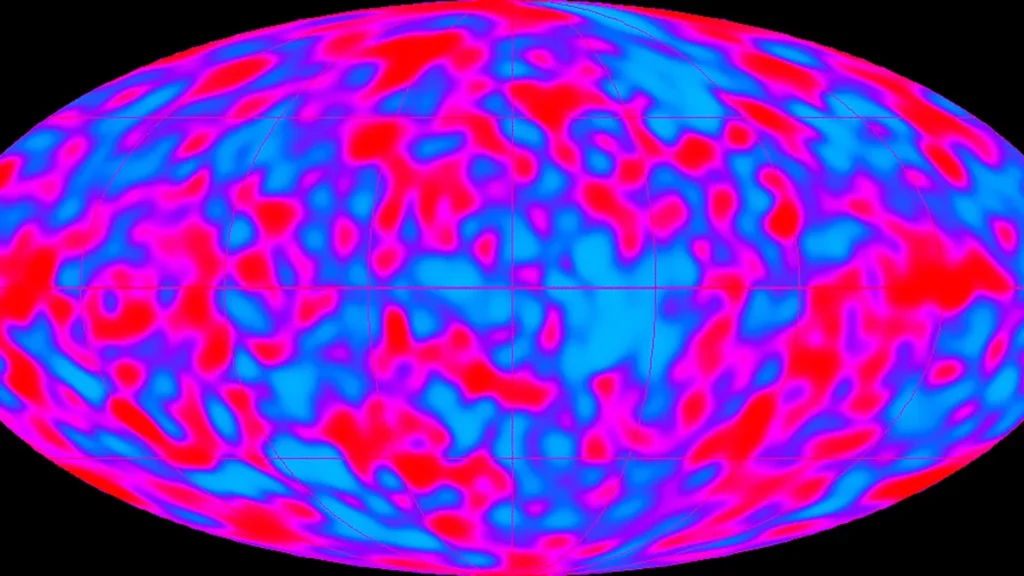
- If stupendously large black holes existed in large numbers with significant dark matter, they would leave a characteristic grainy imprint on the cosmic microwave background through unique perturbations.
- Researchers modeled how stupendously large black holes would affect the cosmic microwave background and compared the results to actual CMB measurements, finding no characteristic graininess.
Research published in Physical Review Letters in 2026 concludes that stupendously large black holes cannot be a significant dark matter component, a result Universe Today describes as eliminating stupendously large black holes from viable dark matter explanations, according to work led by Christopher Gerlach, a theoretical physicist at Johannes Gutenberg University in Mainz, Germany, and its PRISMA++ Cluster of Excellence.
Stupendously large black holes, or SLABs, are hypothetical primordial black holes — black holes that formed in the early Universe — with masses up to 10 billion billion solar masses. If real, they formed from overdensities of matter after the Big Bang and did not need to form massive stars, burn fuel, or explode as supernovae. In large numbers they would leave a characteristic grainy imprint on the cosmic microwave background through unique perturbations.
Dark matter is thought to make up around 85 percent of the matter in the universe, but physicists still do not know what it is made from. Candidates include WIMPs and axions, both hypothetical particles, along with primordial black holes that formed in the early Universe. The substance may also be a collective effect generated by different particles, objects, or phenomena rather than one type of object or particle.
To test the idea, the team modeled how stupendously large black holes would affect the cosmic microwave background and compared the results with actual measurements. They found no characteristic graininess because the background lacks the imprint the holes should have made. The holes would produce isocurvature perturbations — differences in the density of the early Universe from place to place — exceeding the limits set by Planck cosmic microwave background measurements, and the researchers say the holes formed before galaxy clusters and should be the only things leaving such an imprint.
The cosmic microwave background is relic radiation from the Big Bang, released when the Universe was about 380,000 years old. It is the oldest detectable light, appearing mostly smooth and uniform, with minor fluctuations that increasingly powerful detectors can examine.
The analysis relied heavily on data from ESA’s Planck satellite, which ended its mission in 2013. Researchers continue to draw new insights from its data using more computing power, cross-correlation with newer data sets, and better interference filtering. Gerlach has said the Planck satellite remains important to physicists after its shutdown.
Earlier studies had nearly ruled out ordinary primordial black holes as the whole of dark matter. The new findings also challenge scenarios attributing early massive galaxy candidates observed by the James Webb Space Telescope to primordial black hole-induced fluctuations. A 2022 study titled Accelerating Early Massive Galaxy Formation with Primordial Black Holes suggested primordial black holes made up a fraction of dark matter and lay behind those galaxies, and the James Webb Space Telescope has spotted surprisingly massive early galaxies.

Stupendously large black holes had been considered a possible explanation for the gravitational wave background hum sensed by pulsar timing arrays, which monitor pulsars to detect gravitational waves, but the findings make that unlikely. Nicholas Leister, a physicist at Johannes Gutenberg University and the Mainz Institute for Theoretical Physics, says these questions are unlikely to be answered by SLABs because they did not exist in large numbers. The research is based on calculations by Leister at the Mainz Institute for Theoretical Physics and colleagues.
The study does not rule out primordial black holes in the stupendously large mass range altogether. The team assumed all black holes share the same mass, so populations with a wide range of masses still need exploration.
Phys.org reports the researchers’ expectation that new observations will tighten these limits. “With upcoming CMB experiments, including LiteBIRD and the Simons Observatory, the researchers predict that these limits would be tightened even further.”
The paper, Closing the Mass Window for Stupendously Large Black Holes by Christopher Gerlach et al., appeared in Physical Review Letters in 2026 with DOI 10.1103/qlf9-thf4. It is available on arXiv at arxiv.org/abs/2508.08238. The search for dark matter candidates continues, with stupendously large black holes no longer in contention.




Join the discussion