Key facts
- Senate appropriators restored approximately $50 million for the Commerce Department's Office of Space Commerce in a Commerce, Justice and Science spending bill released Thursday by committee Chair Susan Collins, R-Maine.
- House appropriators issued language in May supporting TraCSS and put $50 million in FY27 funds toward the Office of Space Commerce.
- Commercial space monitoring firms have grown increasingly frustrated over the past couple of years with the slow pace of TraCSS development.
- Senate and House appropriators must meet in conference committee to reconcile differences and produce a final agreed-upon bill, with no certainty it will occur before the legislative session ends.
Senate appropriators restored approximately $50 million for the Commerce Department’s Office of Space Commerce on Thursday in a Commerce, Justice and Science spending bill released by committee Chair Susan Collins, R-Maine, Breaking Defense reported.
Collins, a Republican from Maine, chairs the Senate Appropriations Committee, Breaking Defense reported. The Trump administration requested only $11 million for the office, a fraction of the appropriated amount, with just $1 million set aside to effectively shelve past work on the Traffic Coordination System for Space program, or TraCSS. The Trump administration intended the separate $1 million to halt previous TraCSS work, but appropriators rejected that approach in favor of continued development.
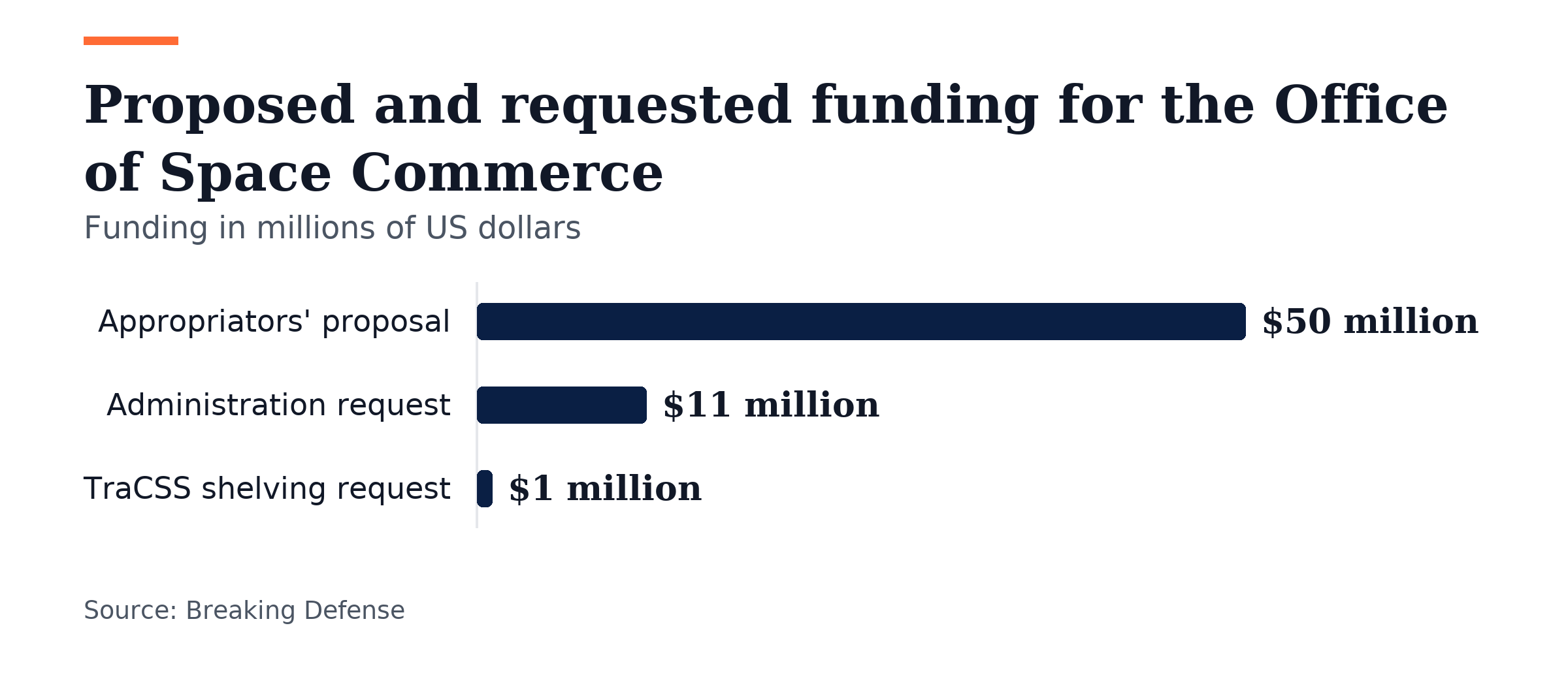
House appropriators issued language in May supporting TraCSS and emphasized the program’s importance, putting $50 million in FY27 funds toward the Office of Space Commerce, Breaking Defense reported. Their version of the bill contained the same figure for the coming fiscal year, and the Senate bill repeats that language and funding level, matching House action from May.
Breaking Defense reported that the Commerce Department launched its space traffic effort nearly a decade ago because the Defense Department was concerned that rapidly increasing commercial space activity was draining military space surveillance resources. The program began under Commerce because the Pentagon faced rising demands on its space monitoring capabilities as commercial satellite traffic increased sharply. The office was created to monitor non-military satellites and reduce the military burden.
Breaking Defense reported that the Defense Department, Space Force and US Space Command were concerned that, for the foreseeable future, the military would remain tasked with alerting nonmilitary satellite operators to possible on-orbit collisions. The military currently must warn civilian operators about possible orbital collisions, and continuing TraCSS would shift some warning responsibility to a civil agency.
Breaking Defense reported that commercial space monitoring firms have grown increasingly frustrated over the past couple of years with the slow pace of TraCSS development. Industry frustration has accumulated because TraCSS has advanced slowly, and the debate over the program’s future has lasted about two years. Appropriators are responding by restoring funding.
Breaking Defense reported that Senate and House appropriators must meet in conference committee to reconcile differences and produce a final agreed-upon bill. A conference committee must merge the House and Senate spending bills, but there is no certainty the committee will finish before the legislative session ends. Until an agreement is reached, the office’s funding remains unresolved.





Join the discussion