
Key facts
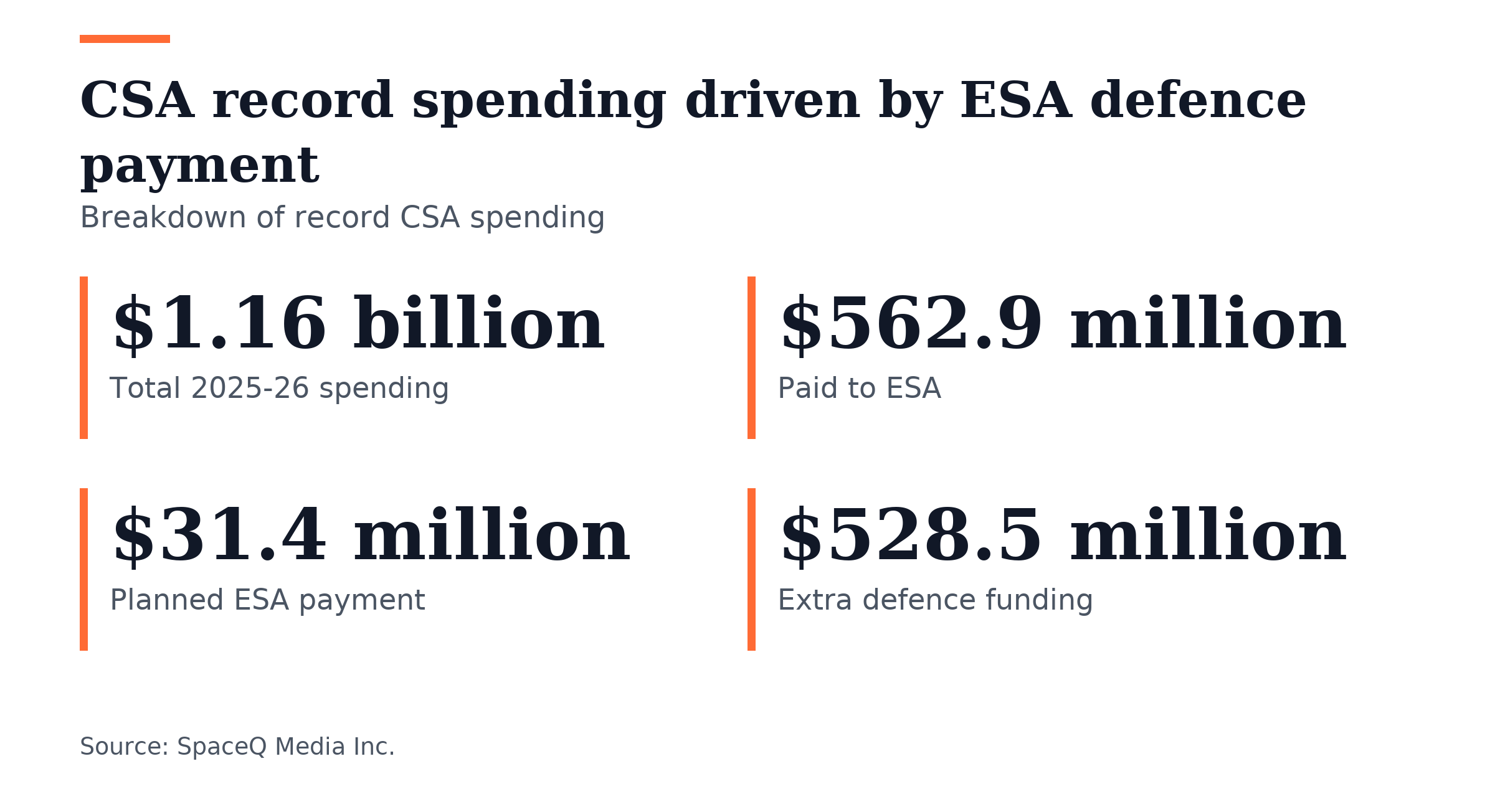
- The Canadian Space Agency spent $1.16 billion in the 2025-26 fiscal year, the highest annual total in its history and nearly twice the previous year.
- The CSA target for its industrial return coefficient is 0.93 by March 2030, just after the current ESA agreement ends on Jan. 1, 2030.
- Canadarm3 is the main asset being built on the CSA's balance sheet, according to the agency's financial statements.
SpaceQ Media Inc. reported that the Canadian Space Agency spent $1.16 billion in the 2025-26 fiscal year, the highest annual total in the agency’s history and nearly twice the previous year’s spending.
Almost half of the record sum went to the European Space Agency, particularly to support defence research and development. The Canadian Space Agency paid $562.9 million under its cooperation agreement with ESA during 2025-26 against an original plan of $31.4 million. Most of the gap between the planned and actual payments was $528.5 million, an amount the government announced in November 2025 as an early measure under the Defence Industrial Strategy. The funds reached the CSA as a transfer from the Department of National Defence to support defence research and development.
The defence transfer formed part of Canada’s $664.6-million commitment at an ESA ministerial council in Bremen, Germany, held in late November 2025. The report describes the Bremen pledge as Canada’s largest-ever commitment to the agency. The November 2025 defence measure was included in that broader pledge.
Canada participates in ESA as a cooperating state, and ESA awards contracts to participating countries roughly in proportion to what each country pays in. The CSA expects about 80 per cent of Canada’s ESA contribution to come back to Canadian industry through contract awards. Canada’s industrial return coefficient reached 0.74 at the end of March, counted cumulatively since 2015-16 and based on Canadian organizations’ ESA contract wins divided by Canada’s payments. A score of 1.0 means Canadian organizations recovered the full value of what Canada contributed.
The agency set a target of 0.93 by March 2030, just after the current ESA agreement ends on Jan. 1, 2030. Access to ESA contracts depends on which programs Canada subscribes to, and those subscriptions are set every three years. The CSA attributes its low coefficient to the significant and sudden increase in funding under the Defence Industrial Strategy. The CSA sees the coefficient climbing toward 1.0 over time as Canadian organizations win ESA contracts.
Sixty-five Canadian organizations were part of ESA-funded projects in 2025-26. In March, Ottawa authorized Canadian companies’ access to four ESA programs Canada had not funded before: Moonlight, FutureNAV, ACCESS and ERS-EO. Moonlight is a lunar communications and navigation service, FutureNAV covers next-generation satellite navigation, ACCESS is a commercialization program, and ERS-EO provides Earth observation for security and resilience.
Canada’s contribution to the Lunar Gateway, NASA’s planned station in orbit around the Moon, is Canadarm3, and the CSA kept building it during 2025-26. In July 2025, the agency advanced Canadarm3’s detailed design and completed the critical review of the Gateway External Robotic Interfaces. On March 24, NASA said it planned to halt Gateway and move toward lunar-surface work instead. The agency plans to redirect Canadarm3 funding toward the next stage of moon exploration.
Jean-Claude Piedboeuf signed the year’s financial statements in August while serving as acting president. Alex MacDonald assumed the CSA presidency on Nov. 4. At an industry conference in May, MacDonald said the agency must “rapidly pivot away from our gateway activities” and focus on lunar surface robotics. The direction matches what the report sets out for Canadarm3.
Assets under construction on the agency’s balance sheet rose by $259 million during the year, reaching $865.8 million at March 31. Canadarm3 is the main asset being built, according to the agency’s financial statements. As of March 31, before the WildFireSat contract was terminated, the agency held $770 million in contractual obligations for building assets across the four fiscal years through 2029-30, mostly for Canadarm3 and WildFireSat. SpaceQ tracked federal Moon program contracts and compared them with Government of Canada open data, finding $1.68 billion committed to Gateway and Canadarm3 since 2019.
The CSA cancelled the Lunar Rover Mission in March after the preliminary design was finished, stopping work on Canadensys Aerospace’s small rover built for a Firefly lander flight in 2029. The robotic mobility know-how from the mission could be used on other missions and for commercialization. In July 2025, contracts worth $14.6 million went to three Canadian companies for the larger Lunar Utility Vehicle, designed to carry cargo and help astronauts on the surface.
The CSA ended its WildFireSat contract with the supplier in April 2026, shortly after the year wrapped up, after a full review showed the project did not match government needs. Spire Global Canada supplied WildFireSat under a contract worth about $72 million. Industry and stakeholders are working with the government to continue developing the wildfire-monitoring mission even after the contract was terminated.
Federal users submitted more than 500,000 imagery requests to Canada’s three RADARSAT radar satellites during 2025-26 for climate research, disaster response and maritime surveillance. The government put $47 million toward building, testing and launching an additional RADARSAT satellite, directing most of it to parts so delivery can happen faster.
SCISAT, Canada’s longest-running satellite and a tracker of the chemistry that controls ozone, will operate through 2028-29 after the CSA extended its mission. MOPITT, the Canadian instrument on NASA’s Terra satellite, gathered 25 years of data before the spacecraft lost power in April 2025, and the agency has archived and validated it.
During 2025-26, the CSA counted 91 services to Canadians relying on space data, missing the 111 target and hitting the lowest point in three years of reporting. The space sector employed 14,622 people in 2024 and added $3.8 billion to gross domestic product, both above the agency’s targets.
An internal 2025-26 review flagged possible compliance issues in procurement and real property, covering long-term contract planning and building reinvestment tracking. The agency says an action plan will be ready by September 2026. The November report does not say whether that plan is in place.
After ending its own operations at Canada’s spacecraft test centre in Ottawa, the CSA licensed the David Florida Laboratory to MDA Space, which began offering testing services there in fall 2025. The report calls the MDA Space licence an interim measure while a longer-term strategy is worked out.
The agency plans to spend $913.9 million in 2026-27, falling to $475.9 million by 2028-29. Planned spending falls as funding for Canadarm3 winds down and cuts from the government’s Comprehensive Expenditure Review take hold. The report says it expects more money for Canadarm3 and WildFireSat in future years.
Capital project money made up nearly all of the $243 million in unspent authority carried into future years by the CSA as the 2025-26 fiscal year ended. Its unspent capital was more than twice the year before.
Jeremy Hansen flew around the Moon on Artemis II in April. Joshua Kutryk launched to the International Space Station on Crew-13 on Oct. 1.



Join the discussion