Key facts
- Astronomers report the universe’s star formation rate has fallen by about 97 percent since Cosmic Noon, because stars need cold dense gas and something happened to that supply.
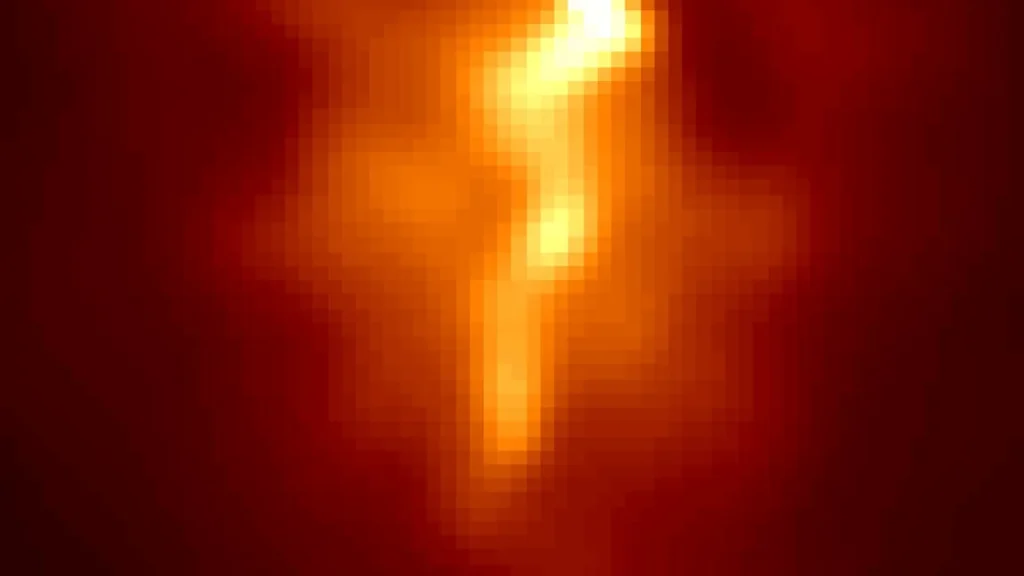
- New research for Astronomy and Astrophysics probes how molecular gas supplies are shaped by environment in dense clusters, focusing on COSMOS-Gr30 at z~0.7.
- ALMA, the world’s most powerful radio antenna array, will observe COSMOS-Gr30 to cut uncertainties using 66 high-precision 12-meter antennas and baselines up to 16 km.
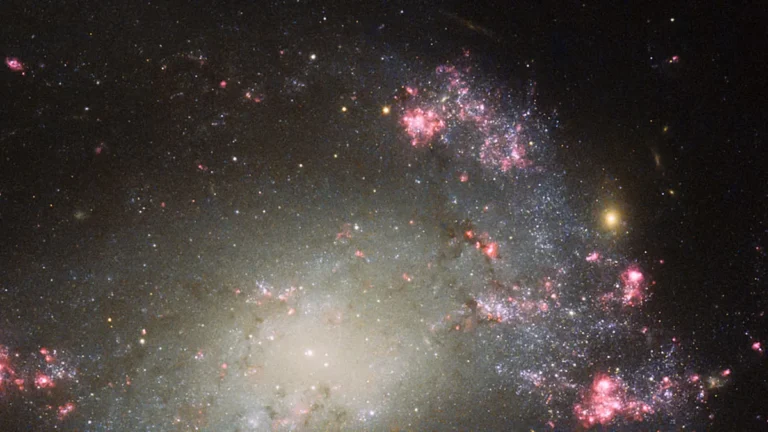
- Bright blue clumps along the jellyfish galaxy’s trailing streams are extremely young stars formed outside the main galaxy body within gas pushed away by ram-pressure stripping.
Astrophysicist Jonathan Freundlich of the University of Strasbourg Astronomical Observatory reported Nov. 13, 2026, in Astronomy and Astrophysics that galaxies in the dense COSMOS-Gr30 group at redshift z~0.7 (light stretched toward redder colors by the expanding universe) contain only 20 percent to 40 percent of the molecular gas found in typical main-sequence galaxies.
The universe now forms stars at a small fraction of its ancient pace. The Milky Way creates 6 or 7 new stars each year, while star formation at Cosmic Noon about 10 billion years ago ran as much as 30 times greater than today. Overall, the universe’s star formation rate has fallen by about 97 percent since that peak because stars need cold dense gas and something happened to that supply.
COSMOS-Gr30 is an exceptionally dense galaxy group where massive cosmic filaments intersect, and it hosts an ionized gas structure about 100 billion square light years in size. Deep MUSE observations, using the Multi-Unit Spectroscopic Explorer, revealed a large massive structure of ionized gas surrounding eight COSMOS-Gr30 galaxies, including one active galactic nucleus host. Less than one-third of the gas displaced from member galaxies into the diffuse surrounding structure is cold enough to form stars.
Astronomers say environmental effects play a leading role in diminishing gas supplies inside galaxies and between them in groups. Stellar winds can blow gas away, and jets from active galactic nuclei can heat gas and disperse it. Galaxy mergers spread star-forming gas into tidal tails, while encounters with the much hotter intergalactic medium can heat or strip a galaxy’s own star-forming gas.
The gas around the eight galaxies was likely expelled through internal processes such as star formation and active galactic nucleus outflows, plus external forces including ram pressure stripping and tidal interactions. Main-sequence galaxies are benchmarks that form stars at a steady, typical rate, and COSMOS-Gr30 members fall far below that level. Together, the low molecular gas content and the diffuse surrounding gas structure give the authors a consistent picture of environmental quenching, in which the cluster environment shuts down star formation.
The same mechanism appears in the distant universe. JWST spotted the most distant jellyfish galaxy ever seen at z = 1.156, showing it as it appeared 8.5 billion years ago while moving through a dense galaxy cluster. Bright blue clumps along its trailing streams are young stars formed outside the main galaxy in gas pushed away by ram-pressure stripping, which occurs when galaxies race through crowded clusters filled with hot gas that acts like a headwind, sweeping gas backward into trailing strands.
Dr. Ian Roberts of the University of Waterloo said cluster environments were already harsh enough to strip galaxies 8.5 billion years ago, earlier than many scientists expected. “This data provides us with rare insight into how galaxies were transformed in the early universe,” Roberts said. Researchers had thought clusters at that distance were still assembling and that ram-pressure stripping was rare, but the observation suggests otherwise, and Roberts links early stripping to the current large population of dead galaxies in clusters.
Earlier X-ray evidence comes from the Centaurus galaxy cluster, 170 million light years away, where core gas sloshes around the gravitational well. Dr. Ming Sun of the University of Alabama in Huntsville described “There is an old problem in galaxy clusters,” referencing the mismatch between bright X-ray cores and few young stars. XRISM’s Resolve instrument revealed hot gas bulk and turbulent motion for the first time on Feb. 12, 2025, showing how sloshing redistributes energy from the central active galactic nucleus and brings in thermal energy from the surrounding intracluster medium.
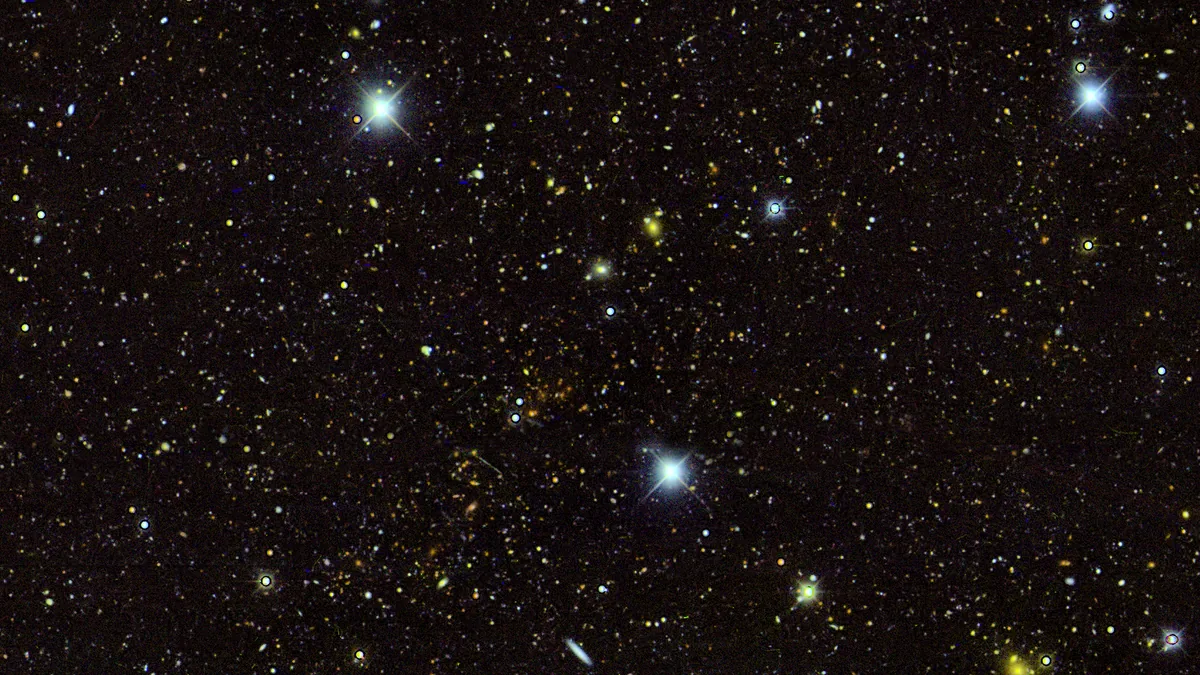
The XRISM mission, a joint NASA, JAXA and ESA X-ray telescope launched in September 2023, worked with MUSE data from the European Southern Observatory’s Very Large Telescope to constrain the motions. Bulk motion means large-scale organized flows, while turbulent motion is chaotic, smaller-scale movement. In Centaurus, sloshing helps explain why hot core gas forms fewer young stars than predicted, addressing the cooling flow problem in which active galactic nucleus feedback reheats gas and prevents rapid cooling.
Researchers identified 26 fast radio bursts associated with galaxy clusters and found an excess at around three sigma, a one-in-a-thousand chance under a random-distribution model. Because cluster gas suppresses star formation, researchers might expect fewer magnetar sources tied to recent star formation in cluster galaxies, though the SETI Institute cautioned the association is marginal and does not prove a physical link. Clusters can magnify faint radio waves, and one candidate burst lies near Abell 2218, a massive cluster known for strong gravitational lensing.
Dr. Mawson W. Sammons of the Laboratoire d’Astrophysique de Marseille plans to develop software that optimizes burst searches toward dense regions to recover bursts broadened by dispersion along dense sightlines. Researchers need more detections to determine whether clusters are magnifying distant bursts, hosting more sources, or both.
Other distant clusters show how quickly dense environments assembled. XLSSC 122, the most distant galaxy cluster displaying strong gravitational lensing, was seen at cosmic noon around 10 billion years ago when star formation ran up to 100 times faster than today. The cluster is undergoing a merger, and its intracluster light—the earliest known—traces concentrated dark matter, supporting the merger story. Kyle Finner of IPAC at Caltech said “It’s still early in the JWST era,” and he noted that wide-area X-ray and radio surveys are needed to spot ultra-distant cluster candidates.
The COSMOS-Z3.1-A supercluster, seen when the universe was only about 2 or 3 billion years old, has about 5,000 times more mass than the Milky Way and contains 10 dense clumps that can each grow into a galaxy cluster. A neighboring system, COSMOS-Z3.1-C, shows about four such clumps. Both should eventually become more massive than the Coma Cluster, and COSMOS-Z3.1-A may be rarer than one object for every 10,000 galaxy clusters.
The authors of the COSMOS-Gr30 work call for better star-formation measurements and larger group samples to assess group-to-group variance, citing uncertainties in star-formation rates and carbon monoxide as a hydrogen proxy. ALMA, the world’s most powerful radio antenna array, will observe COSMOS-Gr30 with 66 high-precision 12-meter antennas and baselines up to 16 km. Measurements of gas supplies in galaxy groups remain rare even though most galaxies live in such systems.



Join the discussion