Key facts
- On Friday, November 13, 2026, Astronomy Magazine's night-sky column directs telescope users toward Mirach's Ghost in the constellation Andromeda, placing the target in the eastern sky by early evening.
- Mirach's Ghost lies just 6.8 arcminutes northwest of the star Mirach, also designated Beta Andromedae.
- By 7 P.M. local time on November 13, 2026, Mirach stands nearly 60 degrees high in the eastern sky.
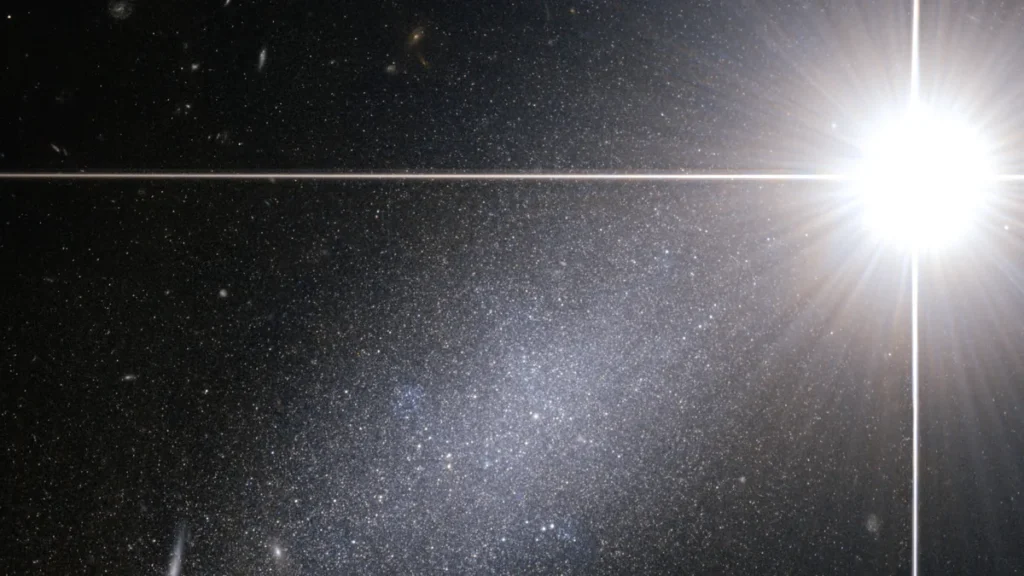
- Mirach's Ghost is the elliptical galaxy NGC 404, glowing at 10th magnitude.
You can look for Mirach’s Ghost with a telescope, a faint galaxy beside the bright star Mirach in Andromeda, in the eastern sky on Friday, November 13, 2026, Astronomy Magazine’s night-sky column says.s1
Astronomy Magazine’s column calls the night a Friday the 13th observing activity and promotes the target as a spooky sight in Andromeda. It names Andromeda as the constellation and frames the galaxy as the actual object of interest rather than the bright star nearby.
The column identifies Mirach’s Ghost as the elliptical galaxy NGC 404, glowing at 10th magnitude. An elliptical galaxy is a smooth, rounded collection of stars, and magnitude measures how bright an object appears in the sky. The column presents the item as a galaxy, not a star or nebula tied to Mirach, so the galaxy is the true observing target.
Astronomy Magazine’s column places the galaxy just 6.8 arcminutes northwest of Mirach, also designated Beta Andromedae. An arcminute is one-sixtieth of a degree. The column sets the bright star apart from the nearby galaxy, identifying the galaxy as the target to watch.
Astronomy Magazine’s column describes the ghost as a faint smudge of light spanning about four arcminutes close to the star. Its faintness and position beside a bright star are why the column urges careful examination of this easy-to-overlook smudge.s1
Astronomy Magazine’s column describes Mirach as a second-magnitude star and a cool reddish M-type giant, one of Andromeda’s brightest stars. An M-type giant is a cool, evolved star of large size. The star lies some 200 light-years away and shines with nearly 2,000 times the Sun’s brightness. A light-year is the distance light travels in one year.s1
The column says NGC 404 is 8 million to 10 million light-years away, beyond the gravitational reach of the Local Group of galaxies. The Local Group is the gathering of galaxies that includes our Milky Way. That distance puts the galaxy well behind Mirach and outside the Local Group, so the star and galaxy are far apart in space even though they appear close together in Earth’s sky.s1
The column explains that the ghost name comes from the sight itself: bright Mirach dominates the view, and the galaxy looks like a ghostly copy of the star. The bright star’s glare creates that visual impression of a spectral copy. That glare is also part of why the column urges careful examination of the region near the star.
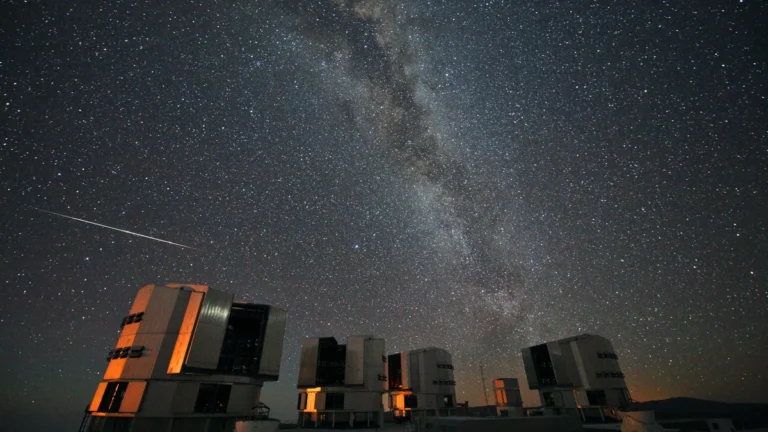
Astronomy Magazine’s column says observers need a large telescope to see Mirach’s Ghost. The column calls the object difficult and urges careful looking. A large telescope collects more light than the naked eye, which helps reveal faint deep-sky objects such as this galaxy.
By 7 P.M. local time on November 13, 2026, Mirach reaches nearly 60 degrees of altitude in the eastern sky, Astronomy Magazine’s column says. Degrees measure altitude above the horizon. That height places the star well above the eastern horizon soon after sunset, good for evening viewing. The column places the viewing in the eastern sky during the early evening.s1
Astronomy Magazine’s column gives sunrise on November 13, 2026, as 6:43 A.M. and sunset as 4:45 P.M. local time from 40 degrees N 90 degrees W. These solar times give observers a reference for judging how dark the sky is at a given hour.s1
Astronomy Magazine’s column lists moonrise at 10:54 A.M. local time from 40 degrees N 90 degrees W, with moonset at 7:55 P.M., on November 13, 2026. The Moon is above the horizon through the afternoon and evening before it sets.s1
At 10 P.M. local time on November 13, 2026, from 40 degrees N 90 degrees W, Astronomy Magazine’s column describes the Moon as a waxing crescent with 21 percent illumination. A waxing crescent is a thin, growing sliver of the Moon’s disk. The faint phase means the Moon will be faint and set early, leaving darker skies.s1
Around Prague, reporting Space.com, suggests skywatchers trace Andromeda along a star line running through Mirach toward Almach. Alpheratz is part of Andromeda despite appearing within the Great Square of Pegasus, so the square can help orient viewers to the constellation. It also urges skywatchers to learn Andromeda as a way of orienting themselves beneath the autumn sky.
The column’s author is Alison Klesman, senior editor of Astronomy magazine, and she holds a Ph.D. in astronomy. She has done research involving minor planets and supermassive black holes. Her astronomy credentials appear in the column’s author bio.
Join the discussion