Key facts
- Amazon’s low Earth orbit internet network is set to add 40 broadband satellites on November 13 when a United Launch Alliance Vulcan rocket departs Cape Canaveral in Florida.
- Liftoff is targeted for 5:54 PM UTC on November 13, 2026, with a window from 17:54 to 18:24 UTC at SLC-41, subject to schedule changes.
- LV-01 will carry 40 production broadband spacecraft as its largest Amazon Leo payload to date and marks the first Amazon Leo flight aboard ULA’s Vulcan rocket.
- Amazon Leo, formerly Project Kuiper, is a mega constellation of 3,236 low Earth orbit satellites that will provide broadband internet access through Kuiper Systems LLC, an Amazon subsidiary.
Amazon’s low Earth orbit internet network is set to add 40 broadband satellites on November 13 when a United Launch Alliance Vulcan rocket departs Cape Canaveral in Florida. Liftoff is targeted for 5:54 PM UTC on November 13, 2026, with a window from 17:54 to 18:24 UTC at Space Launch Complex 41, subject to schedule changes. The flight, designated Leo Vulcan 01 and LV-01, carries 40 production broadband spacecraft as the largest Amazon Leo payload to date and marks the first Amazon Leo flight aboard ULA’s Vulcan rocket.
Once called Project Kuiper, Amazon Leo is a low Earth orbit mega constellation of 3,236 satellites that will deliver broadband internet through Kuiper Systems LLC, an Amazon subsidiary. It ranks behind SpaceX’s Starlink and OneWeb as the third-largest satellite constellation in orbit.
The flight, designated Leo Vulcan 01, is the first Amazon Leo mission on ULA’s heavy-lift rocket and carries the largest payload to date.
Amazon and United Launch Alliance have a multi-launch agreement for 38 Vulcan missions to carry more than 1,500 satellites into orbit for Amazon’s low Earth orbit internet network, a partnership intended to speed deployment by securing dedicated heavy-lift capacity. Amazon paid for Cape Canaveral site enhancements that expand ULA integration and processing abilities, letting ground teams prepare rockets in parallel and streamline turnaround operations between missions. These upgrades support a high-cadence manifest of 38 flights, and after the Nov. 13 liftoff of Leo Vulcan 01, Amazon and ULA will transition to executing the remaining missions to deliver the balance of contracted satellites. Upgraded Cape Canaveral processing facilities will support dual-vehicle operations so Vulcan flights can systematically deploy the remaining satellites into low Earth orbit.
Tracking data indicates Amazon Leo deployed 396 satellites over 14 production missions by November 11, 2026, while consumer service remains closed. The cumulative launch figure and service status come from tracking data cited by GCN as of November 11, 2026, shortly before the Vulcan flight.
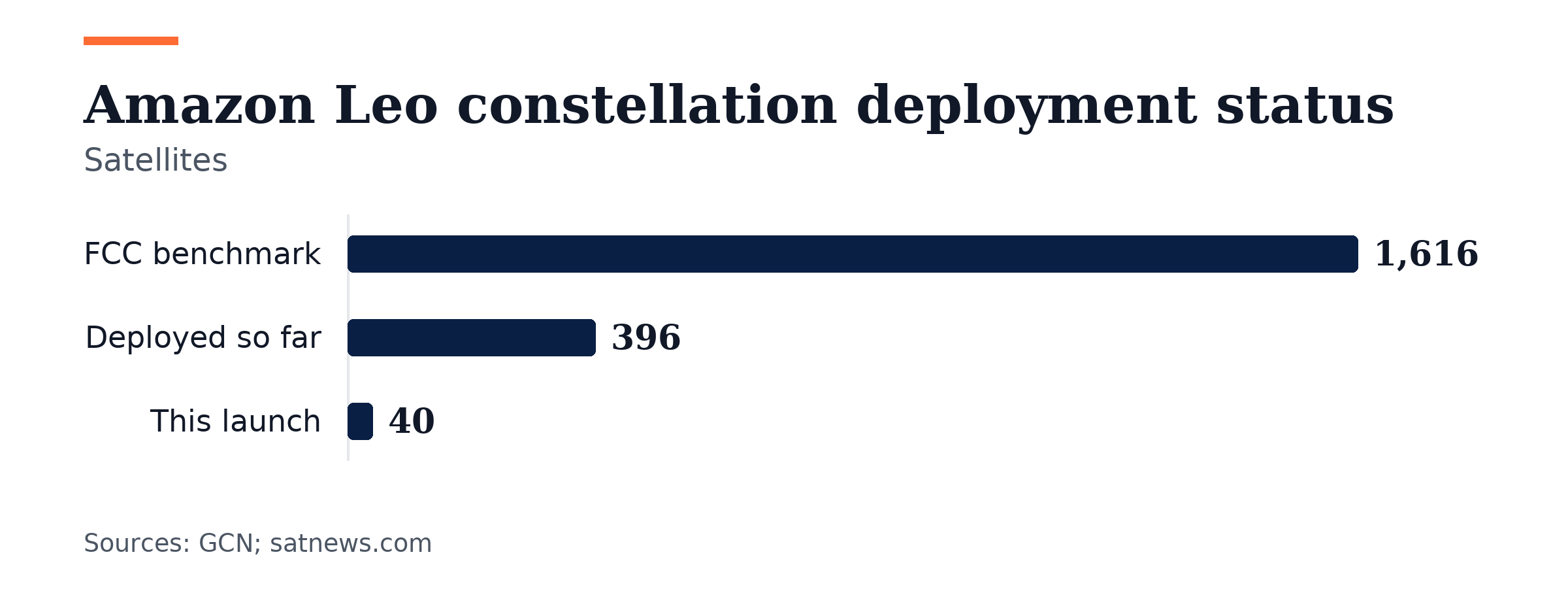
The Federal Communications Commission set an interim deployment benchmark of 1,616 satellites for Amazon Leo by July 30, 2026, which the company missed. A conditional waiver granted on June 5, 2026, kept Amazon Leo’s license in force after it missed the FCC interim benchmark, while all 3,232 first-generation satellites remain due by July 30, 2029. GCN ties Amazon’s deployment schedule directly to conditions set by the Federal Communications Commission and describes the remaining scale as considerable. Amazon Leo began full-scale deployment in April 2025 with the first of more than 80 launches contracted across Arianespace, Blue Origin, SpaceX, and United Launch Alliance, a procurement described as the largest in commercial launch history.
GCN says the Vulcan launch measures Amazon’s ability to speed up deployment and narrow Starlink’s lead in low Earth orbit broadband, framing the flight as being about launch cadence rather than manufacturing alone and tying it to Amazon’s FCC-mandated timeline. Amazon still requires thousands more satellites to reach licensed capacity even after the Vulcan flight adds 40, assuming the launch proceeds as scheduled. Amazon says its broadband service will start before 2026 ends in the US, UK, France, Germany and Canada, based on the company’s LV-01 mission announcement, and a free waitlist is available at leo.amazon.com. GCN describes the Vulcan launch as among the final steps before Amazon opens its broadband service to the public in the five initial countries.

ULA’s Vulcan rocket is returning to flight on this mission carrying 40 Amazon Leo satellites, in the same week that SpaceX attempts to catch both stages of Starship for the first time, according to Astronomy.com as reported by GCN.
- Key times:
- November 13, 2026, 17:54 to 18:24 UTC: Launch window for Leo Vulcan 01 from Space Launch Complex 41 at Cape Canaveral Space Force Station.
- July 30, 2026: FCC interim benchmark of 1,616 satellites missed by Amazon Leo.
- Before the end of 2026: Amazon Leo broadband service expected to start in the United States, United Kingdom, France, Germany, and Canada.
- July 30, 2029: Deadline for all 3,232 first-generation Amazon Leo satellites.


Join the discussion