Key facts
- In observations of Herbig-Haro 168, researchers identified 26 distinct spectral lines matching forbidden rotational transitions of trihydrogen cation, with the strongest line reaching 72 sigma statistical confidence.
- The trihydrogen emission closely tracked ordinary molecular hydrogen (H2) in HH 168, suggesting both molecules responded to the same violent shock conditions from a newborn star's jets.
- Archival JWST observations of Herbig-Haro 211 showed the same telltale trihydrogen emission.
- Trihydrogen's three hydrogen nuclei share two electrons in an equilateral triangle with no permanent dipole moment, so ordinary rotation produces no shifting charge imbalance to generate electromagnetic radiation.
David Neufeld of Johns Hopkins University led a JWST team that detected the faint rotational radiation of trihydrogen cation in gas thousands of light-years away, ScienceAlert reported Nov. 12, 2026. The detection confirms a prediction from 1986 that had never been observed in the universe or recreated in a laboratory.
ScienceAlert said researchers found 26 separate spectral lines in Herbig-Haro 168, also called HH 168, that match forbidden rotational transitions of trihydrogen cation. The strongest line reached 72 sigma statistical confidence. The lines sat within infrared emission from hot, shocked gas, and their wavelengths matched a calculation from Fu-Shih Pan and Takeshi Oka published in 1986, giving the team high confidence. Neufeld’s team detected the radiation while examining shocked gas near a young star, and the paper has been accepted by The Astrophysical Journal Letters with a preprint posted on arXiv.
ScienceAlert describes trihydrogen cation as three hydrogen nuclei and two electrons arranged in an equilateral triangle carrying no permanent dipole moment, meaning no built-in separation of charge. Because the molecule spins without a charge imbalance, ordinary rotation creates no shifting charge imbalance to produce electromagnetic radiation. Standard theory therefore allows no pure rotational spectrum, so the radiation stayed hidden until JWST observed it amid shocked gas.
ScienceAlert calls trihydrogen foundational to gas-phase interstellar chemistry and an ingredient for complex organic molecules tied to life, describing it as the molecule that made the Universe, one of the most important molecules anywhere in the cosmos. The molecule has previously been found in interstellar clouds, and it is partially responsible for Jupiter’s auroral glow. Those earlier detections give trihydrogen an observational history that is well established but separate from the new rotational line.
In 1986, Fu-Shih Pan and Takeshi Oka at the University of Chicago calculated that spinning distorts the molecule’s equilateral triangle enough to create a tiny electric dipole moment, a slight separation of charge that permits otherwise forbidden faint rotational radiation. ScienceAlert notes that Pan and Oka found a loophole in the standard selection rules, and the prediction went unconfirmed for forty years because the expected radiation was too faint to detect in a laboratory.
ScienceAlert explains that these transitions are called forbidden since they break the usual molecular radiation rules rather than the laws of physics. No search had found the signal for forty years, laboratory attempts included, because the transitions are extraordinarily weak.
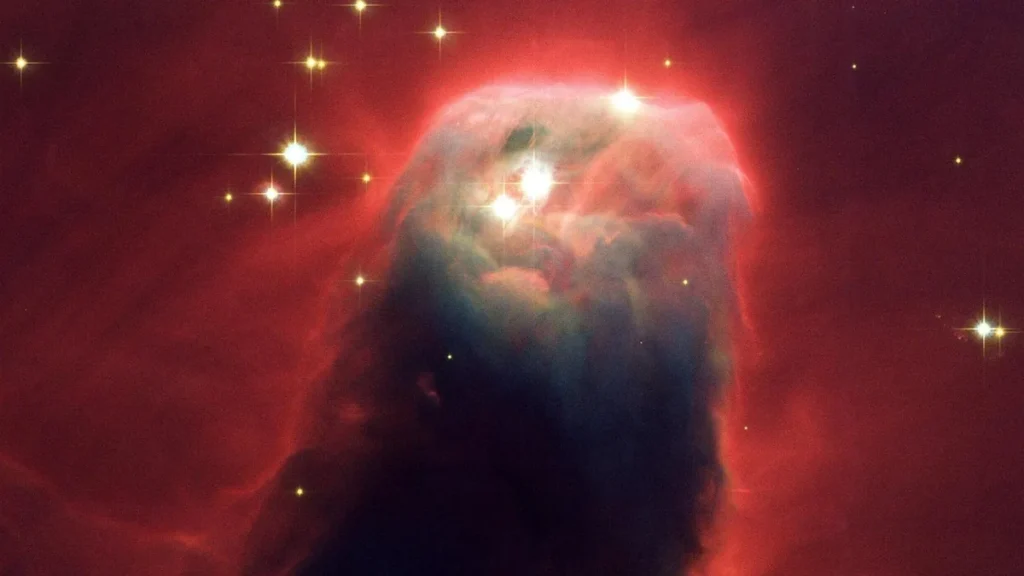
ScienceAlert explains that Herbig-Haro objects arise when magnetic fields blast material from a young star in jets moving at hundreds of kilometers per second into a molecular cloud, and the shock waves heat gas to thousands of degrees. They are short-lived yet important phases in a star’s life, often taking shape within the dense nebula where the star formed and staying hard to observe. Researchers want to learn more about these objects.
ScienceAlert reports that JWST’s infrared vision sees through obscuring dust better than visible light does, which suits the telescope for observing Herbig-Haro objects hidden inside thick stellar nurseries. In Herbig-Haro 168, researchers found that trihydrogen emission closely followed ordinary molecular hydrogen, suggesting the two molecules reacted to the same violent shock conditions produced by a newborn star’s jets.
ScienceAlert says shock models could not completely account for how bright the trihydrogen emission was. One model reproduced molecular hydrogen output but underestimated trihydrogen’s brightness by a factor of five or six; a second model matched trihydrogen more closely under conditions beyond the model’s validated range. Neither model reproduced both emissions well. The H2 correlation pointed researchers toward shock-driven chemistry, though converting that link into a numerical model proved difficult.
ScienceAlert reported that Neufeld’s team said the finding could aid understanding of newborn-star shock waves and of how this critical molecule behaves in violent conditions. The team said more work remains to determine why the HH 168 glow was so bright.
ScienceAlert said archival JWST observations of Herbig-Haro 211 also showed telltale trihydrogen emission. The finding suggested the phenomenon is not limited to Herbig-Haro 168 and that the universe can produce this kind of signal without much difficulty in shocked gas around young stars.
ScienceAlert says the detection could aid understanding of the physics behind giant shock waves from newborn stars and of how this critical molecule behaves amid extreme conditions. Scientists could use trihydrogen as a tool to better understand the chemistry that turns the simplest element into complex cosmic material, including complex organic molecules that serve as ingredients for life.


Join the discussion