Key facts
- A modeling study in the International Journal of Astrobiology models spore dispersal from a single Mars landing that injects 100 viable spores to 100 meters altitude, then follows plume settling with or without wind.
- The authors assume all spores stay viable during dispersal, surface residence, and regolith or rock sample collection.
- Under no wind, the greatest chance of finding one viable spore lies within a 10-meter radius, with probability approaching no more than 1 × 10⁻³.
- At 1 meter per second wind, the chance of recovering one spore falls between 1 × 10⁻⁵ at 20 meters and 5 × 10⁻⁸ at 500 meters downwind.
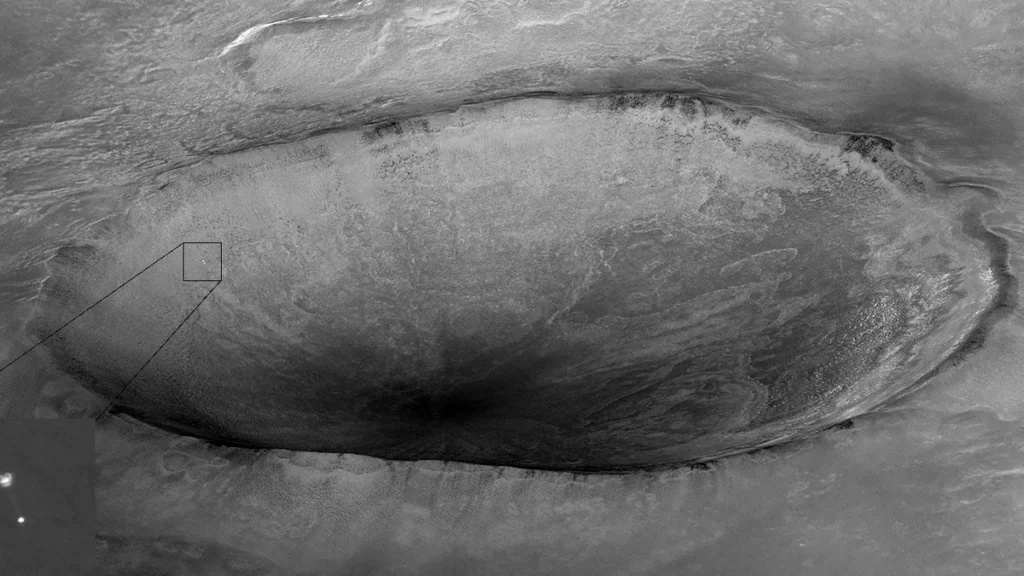
A modeling study published Nov. 11, 2026, in the International Journal of Astrobiology found that bacterial spores released from a Mars lander are unlikely to disperse far enough to compromise nearby life-detection samples on the Martian surface.
The model released 100 viable spores to an altitude of 100 meters and tracked plume settling with and without wind. The authors assumed every spore remained viable during dispersal, surface residence, and the collection of regolith or rock samples, which removes spore die-off from the calculations.
In still air, the greatest chance of recovering one viable spore lay within a 10-meter radius of the lander, with a likelihood of no more than 1 × 10⁻³. This defines the peak contamination zone close to the spacecraft when winds are calm.
With wind at 1 meter per second, the odds of recovering one spore fell to 1 × 10⁻⁵ at 20 meters and 5 × 10⁻⁸ at 500 meters downwind, showing the risk declines steeply with distance in light wind.
At 10 meters per second, dispersal cones reached beyond 7000 meters downwind and grew much narrower, while the chance of finding one viable spore at 7000 meters neared no more than 1 × 10⁻⁹. Even at the maximum modeled distance, the chance of spore recovery remained small.
A rover crossing the downwind plume at a right angle faced zero chance of spore recovery unless vibrations from its arm caused secondary dispersal, according to the model. Crossing the plume at a right angle avoids the primary risk, though rover operations could redistribute spores locally.
The authors concluded that dispersed spores are unlikely to create false positives in nearby life-detection tests, and they noted that keeping forward contamination low near a landed vehicle matters greatly for upcoming life-detection work. The paper is open access.
The result arrives amid other recent work testing how Earth microbes withstand Mars-like conditions. A study published April 25, 2026, in Applied and Environmental Microbiology found that conidia (asexual fungal spores) of Aspergillus calidoustus, a fungus collected from NASA cleanrooms, endured simulated spacecraft decontamination, radiation, Mars-like air pressure, and intense ultraviolet light.
Researchers examined 29 microbial isolates, including 27 fungal strains from NASA Mars 2020 mission assembly facilities and two known radiation-tolerant organisms. The authors called it the first end-to-end evaluation of multiple spaceflight-associated stressors on microbial species from spacecraft assembly facilities. Twenty-three fungal strains survived a strong dose of UVC radiation during initial testing, and Aspergillus calidoustus conidia survived simulated Martian solar radiation for 1,440 minutes, or 24 hours, though their numbers dropped sharply.
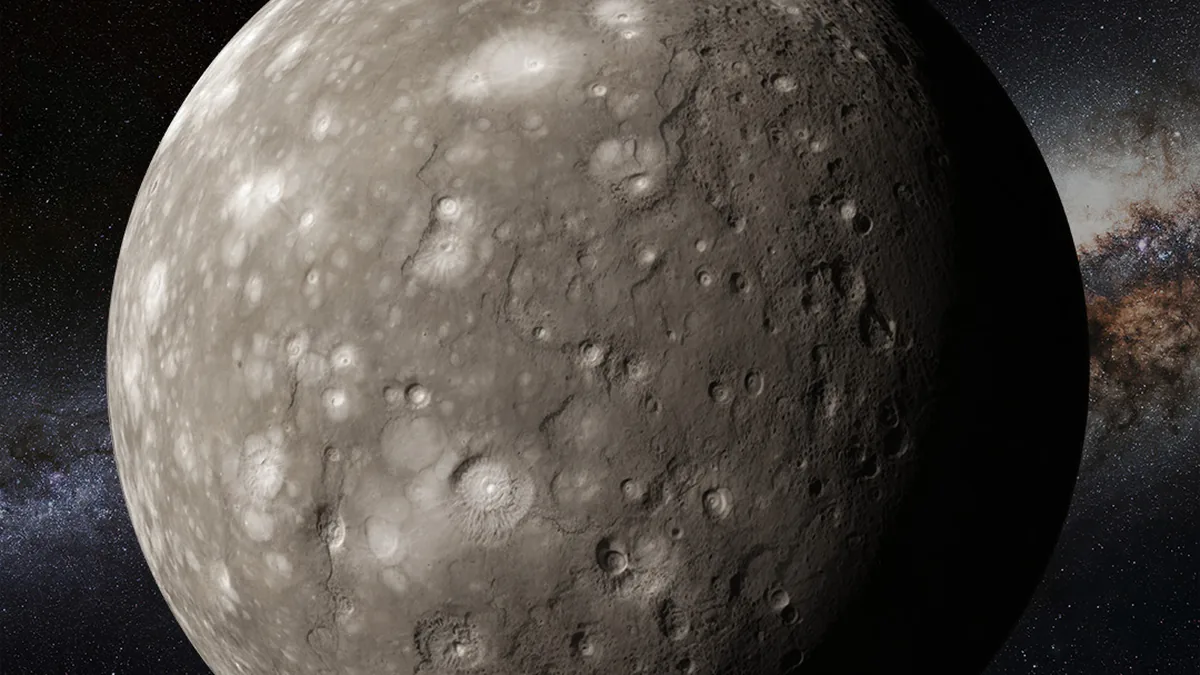
The simulated Mars chamber recreated a thin carbon-dioxide-rich atmosphere at about six millibars, intense UV-visible radiation, and temperatures near the mean Martian surface temperature of about minus 60 degrees Celsius. After one month of neutron radiation exposure, viable conidia dropped by 35 percent compared with controls; after six months, the reduction reached 57 percent, leaving more than 40 percent viability. At 125 degrees Celsius, the fungus survived longer than Aspergillus fumigatus and showed greater late-stage resistance than Bacillus pumilus during dry-heat testing.
“This does not mean contamination of Mars is likely, but it helps us better quantify potential microbial survival risks,” said microbiologist Kasthuri Venkateswaran, Ph.D., study leader and former senior scientist in the Biotechnology and Planetary Protection Group at NASA’s Jet Propulsion Laboratory. Current guidelines cited in the research say spacecraft headed for Mars should carry no more than 300 spores per square meter, and the authors said NASA’s microbial risk models may need to account for fungi more directly, especially for missions where life detection is a scientific goal.
Separate research reported Nov. 6, 2026, showed a salt-loving archaeon growing in conditions meant to simulate Martian subsurface brine. The paper on Haloferax volcanii appeared online Nov. 5, 2026, in Applied and Environmental Microbiology, with Dr. Adam Robinson of the University of Florida and colleagues as authors.
The team kept cultures in a vacuum chamber at 24 millibars, about two percent of Earth’s sea-level pressure, filled with carbon dioxide and scrubbed of oxygen, at 21 degrees Celsius. The microbes sat in salty liquid containing either nitrate or perchlorate, chemicals found on Mars that the organisms can use in place of oxygen. Nitrate fell by about 15 percent to 29 percent and perchlorate by about 16 percent to 29 percent in the Mars-pressure cultures, while no drops occurred in cell-free controls. Liquid loss stayed below 4 percent over 160 days.
Under electron microscope examination, dense biofilm-like structures appeared in actively growing low-pressure cultures, while Earth-pressure controls and non-growing low-pressure cultures showed none. Growth was lower at 24 millibars than in identical cultures at Earth pressure. Intense surface radiation and low atmospheric pressure, together with global desiccation and oxidizing chemistry rising since the Late Noachian, lead researchers to view today’s Martian surface as inhospitable to life. “We are adding to the growing body of evidence suggesting that we should consider the possibility of life on Mars today,” Dr. Robinson concluded.
Earlier work published Feb. 14, 2024, in the journal Astrobiology found four types of human-infectious bacteria capable of surviving exposure to hostile Mars conditions. The international team, led by Tommaso Zaccaria, exposed Serratia marcescens, Pseudomonas aeruginosa, Klebsiella pneumoniae, and Burkholderia cepacia to a lab box containing regolith stand-in, cold temperatures, a no-oxygen atmosphere, and radiation exposure.
All four bacteria survived to some extent when exposed to all Mars conditions at once; three survived for 21 days, and Pseudomonas aeruginosa seemed to multiply and thrive. The research team said bacteria accidentally carried to Mars might harm astronaut health, especially if the organisms mutated to survive the harsh setting more effectively.


Join the discussion