Key facts
- Majorca and Menorca marked the final land locations from which the eclipse could be seen before the Sun set and the shadow vanished.
- Totality at Talatí de Dalt lasted about 73 seconds as the eclipsed Sun sat at the horizon.
- The eclipse was Talatí de Dalt’s first total solar eclipse since 1539.
- The foreground exposure used was 1/30 second at f/2 and ISO 160.
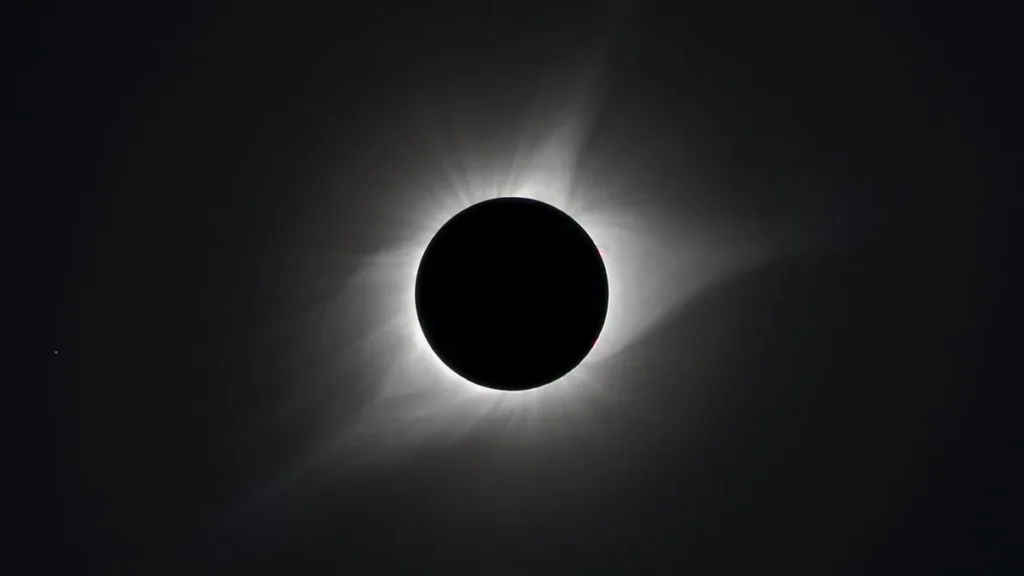
Josh Dury photographed the total solar eclipse as it set over Talatí de Dalt, a late Bronze Age site on the Spanish island of Menorca, on Aug. 12, 2026.G
He assembled the picture from frames taken using a Sony mirrorless camera paired with a 35mm lens. Astronomy Magazine’s image traces the partial phases down to the horizon ahead of totality. The eclipsed Sun stayed at the horizon for roughly 73 seconds. The foreground exposure was 1/30 second at f/2, with an ISO of 160.G
It marked the first total solar eclipse at Talatí de Dalt since 1539. It also marked the continent’s first total solar eclipse since 1999 and mainland Spain’s first in more than a century. National Geographic and BBC News traced the path from northern Russia across Greenland, Iceland and the Atlantic to Spain and a small corner of Portugal, with BBC News describing a track from Siberia’s tip around the Arctic Ocean and ending over the Mediterranean.G
In Spain, the eclipsed Sun hung low over the western horizon during totality, letting photographers frame the darkened star against the landscape. Majorca and Menorca stood as the last land locations where the eclipse could be viewed before sunset ended the shadow’s path. BBC News advised viewers that totality would last only a couple of minutes.G
About 15 million people lived within the track where the Sun was completely blocked, while far more people across Europe, North America and northwestern Africa viewed at least a partial eclipse. The eclipse started in Spain at about 5:30 p.m. UTC, which was 7:30 p.m. local time, with totality crossing the country roughly an hour later. Near Iceland, totality continued for as long as two minutes and 18 seconds.G
National Geographic said viewers needed certified eclipse glasses or a proper solar filter while any part of the Sun remained visible, and unprotected direct viewing was safe only during totality. The shadow moved across northern latitudes, leaving the eclipsed Sun close to the horizon along most of the track. Over far northern Greenland, darkness fell briefly on places that had seen nearly constant daylight during the summer.G
Later that same night, the Perseid meteor shower reached its peak. Because solar eclipses occur only during a new moon, little moonlight was available to wash out the meteors.G
PhotoPills ran a seven-day photography trip to Menorca from Aug. 9 through Aug. 15, 2026, aimed to photograph the setting total solar eclipse on Aug. 12. The trip was led by Antoni Cladera, a PhotoPills Master, and Rafael Pons of the PhotoPills Team, and it recruited 12 photographers and two PhotoPills Masters.G
The group planned to photograph the solar corona, the Sun’s outer atmosphere; the diamond ring; Baily’s beads, flashes of light between lunar mountains; the chromosphere, a thin colored layer of the Sun; earthshine, sunlight reflected from Earth onto the Moon; and the partial phases of the setting eclipse. They also planned night-sky images of the Milky Way and the Perseid meteor shower over Menorca’s rock formations, lighthouses and beaches. According to PhotoPills, the island is home to more than 1,500 archaeological sites, including Talayotic ruins.G
PhotoPills said the total solar eclipse would take place at sunset in Menorca. The expedition included an Aug. 11 classroom session on planning and photographing a total solar eclipse, covering gear, composition, timing, creativity and safety. PhotoPills offered a €500 discount off the regular price for the last spot on the Menorca trip, which had to be booked before Sunday, March 1, 2026, and was sold first come, first served.G
National Geographic posted photographers from Iceland to Spain to document the eclipse. Reuben Wu photographed from Picos de Urbión, Spain, using artificial light to light up the darkened landscape and foreground while looking for a glacial lake and dramatic ridgelines.G
Rüdiger Ortiz-Álvarez, a National Geographic Explorer watching from Burgos, Spain near the center of the path, noticed birds abruptly flying toward shelter as daylight faded. “It felt like a surreal moment – it went by so fast,” Ortiz-Álvarez said.G
Researchers used the Spanish citizen-science project Ecoeclipse to study how the eclipse affected the acoustic behavior of birds and bats. Wayra Ficapal, a Catalan photographer and National Geographic Explorer, made the decision a year earlier to watch from Spain’s Ebro Delta, selecting the Illa de Gràcia bridge in Sant Jaume d’Enveja a week ahead of time.G
At the Ebro Delta, birds called and then went quiet, the temperature fell sharply, and mosquitoes came out in force when daylight returned after totality. Babak Tafreshi, who has photographed 15 eclipses since the 1990s, teamed up with Amirreza Kamkar and Tarragona’s city council to place eight cameras around the UNESCO World Heritage city.G
Jonas Bendiksen photographed the eclipse from a sailboat near A Coruña with his wife and three daughters during a voyage from Norway across the Atlantic. He called the timing a lucky omen.G
In Norwich, England, the Sun was about 91 percent covered, herring gulls flew down to nearby rooftops clucking in confusion, and temperatures fell as daylight faded. Italy was outside the path of totality, so viewers there saw only a partial eclipse at a viewing event held at Santuario di Soviore in Monterosso, Liguria.G
Mark Griffiths made a two-day drive from Cheshire to Galicia, bringing two high-spec cameras, a specialist telescope and a drone to record the eclipse. “I’ll be honest, it’s like an addiction now,” Griffiths said, comparing mainland Europe’s first total solar eclipse in more than 25 years to what the World Cup means to football fans.G
Samantha Phillips-Brown and Gregory traveled to Iceland and rented a camper van for their second solar eclipse; their first was near upstate New York in 2023. They booked their flights and van more than a year ahead. They also planned to reach Iceland’s Westfjords peninsula a couple of days early after hearing rumors of road closures meant to keep the area from being overwhelmed by too many people.G
Andrew Wills reserved a villa near Andraitx in western Majorca and picked a viewing spot across the sea, expecting the eclipse to sit low on the horizon because Majorca is in the path of totality. He said he would pack camping chairs for his father if they arrived about an hour before the eclipse.G
Join the discussion