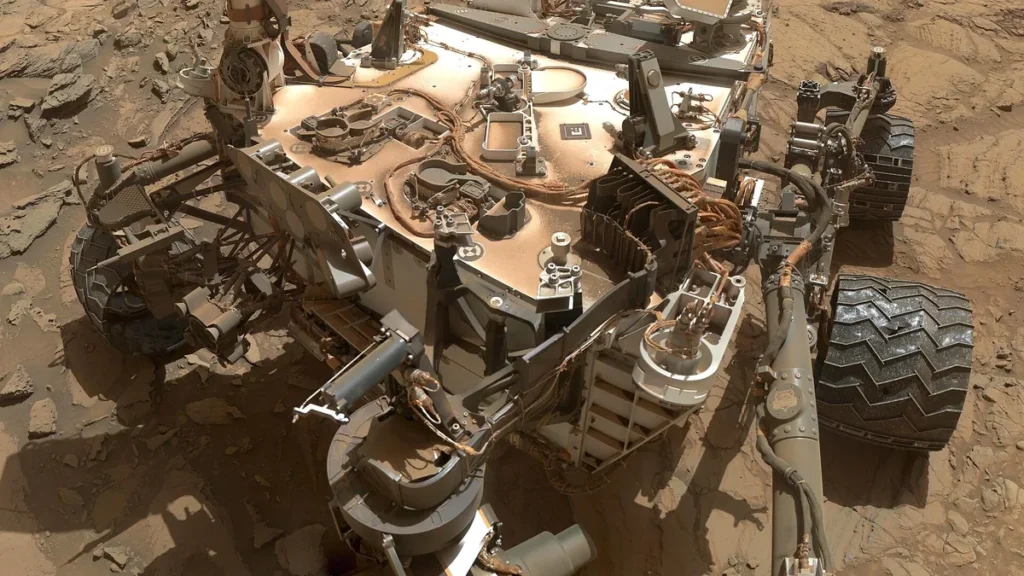
Key facts
- A leading hypothesis holds that the disc- and needle-shaped lumps at Nazca and Chiu Chiu originally formed as crystals grew.
- NASA's Curiosity rover completed its 49th drill hole on Mars at a site nicknamed Nazca during Earth-side planning on Friday, Oct. 23, 2026.
- The Nazca drill target was chosen because the block contains abundant potential crystals visible as disc-shaped rock inclusions.
- Before extending its arm, Curiosity passed a stability test confirming all wheels were on solid ground.
NASA’s Curiosity rover completed its 49th drill hole on Mars at the Nazca site on Friday, Oct. 23, 2026, during Earth-side planning for sols 5050-5055. The mission blog covering the campaign was published on NASA Science on November 10, 2026, and was written by Susanne P. Schwenzer, professor of planetary mineralogy at The Open University, UK.
The team chose Nazca because the block contains abundant disc-shaped inclusions they interpret as potential crystals. Schwenzer says a good drill block primarily contains abundant potential crystals, and the team was eager to find one. If the inclusions are crystals, comparing them to Earth examples could show ancient environmental conditions.
Before extending its arm, Curiosity passed a stability test confirming all wheels were on solid ground, then passed a preload test that checks rock stability and the forces on the arm when the drill bit presses into the rock.
Earlier, during planning on Friday, Oct. 16, the rover had returned to the area after the Basque Lakes drill campaign and moved to a spot a few meters from the Chiu Chiu block. Lucy Lim, a planetary scientist at NASA’s Goddard Space Flight Center, authored the sols 5043-5049 blog entry describing that preparation.
Chiu Chiu itself was a poor drilling candidate, but the block just beyond it looked more promising and became the drive target during Monday’s planning. Close-up views after the drive showed the neighbor block was jam-packed with disc- and needle-shaped lumps like Chiu Chiu, and the team quickly gave the science go-ahead to prepare for drilling at the newly named Nazca site.
Before the preload test, LIBS, DRT and APXS were applied to the Nazca spot to characterize its surface composition thoroughly. LIBS uses laser pulses to analyze rock chemistry, APXS measures elemental composition, and DRT brushes dust off the surface. The team also planned MAHLI observations, including a Quantitative Relief Model built from five overlapping images, to create detailed three-dimensional relief models of the crystal forms.
MAHLI planned to double its focus mechanism steps to add extra frames, increasing the resolution of the three-dimensional models of the crystal forms. ChemCam LIBS planned a depth profile on the crystal-form-rich target Toucan by concentrating all 150 laser shots on one spot instead of spreading them across five points.
A normal LIBS observation uses 30 shots per point across a five-point raster, so the focused 150-shot profile should penetrate about five times deeper than a standard point observation. LIBS vaporizes a small amount of rock to form a plasma for analysis. The experiment intended to reveal whether the composition inside a crystal form differs from its surface composition, differences that could reflect exposure to the modern Martian environment or the original circumstances in which the crystal form developed.
The third LIBS observation in the preparation plan targeted Condor, a nearby block with a finely layered texture. As twilight cloud season began, the rover planned nighttime imaging of Phobos, the larger and brighter of Mars’ two satellites, expected to capture high-altitude carbon dioxide clouds.
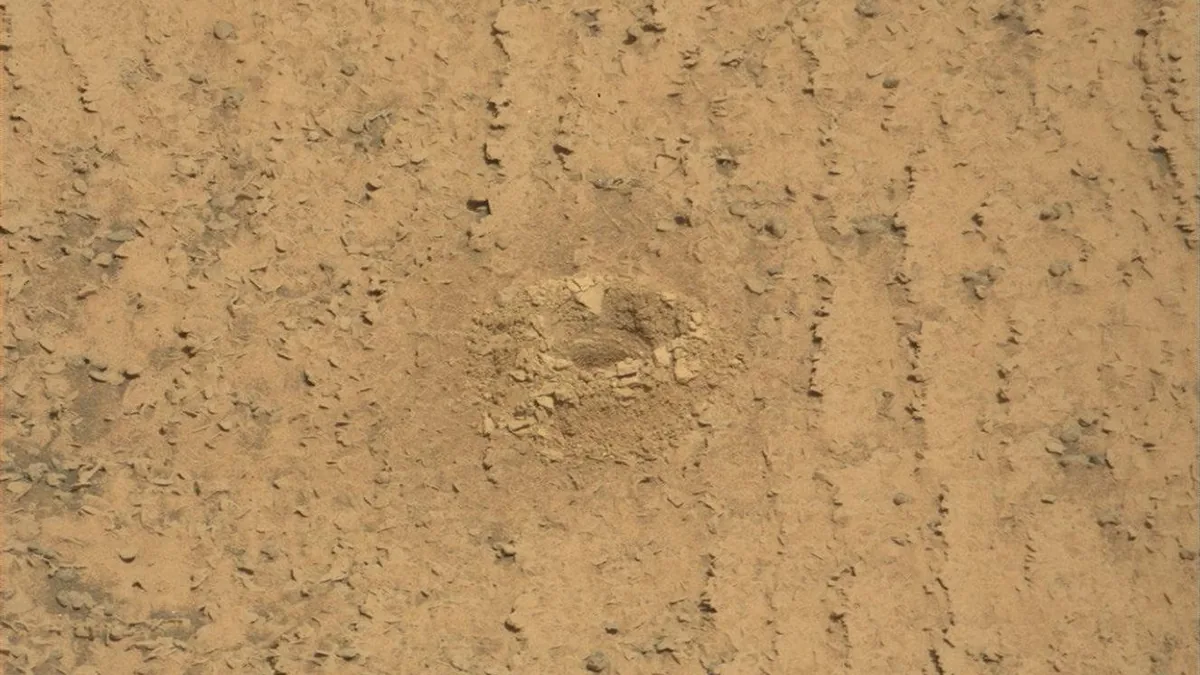
Images of Phobos when full can show sunlight reflecting off the moon and scattering in the Martian atmosphere, providing a way to estimate particle sizes in Martian clouds later in the night than solar observations allow.
A leading hypothesis holds that the disc- and needle-shaped lumps at Nazca and Chiu Chiu originally formed as crystals grew. Minerals tend to grow into specific shapes depending on their microscopic crystal structure, like salt crystals grown in a kitchen. The large sizes of the crystal forms at Nazca and Chiu Chiu provide clues about the temperature when they grew and the availability of salts and fluids.
Modern mineral composition may not match the original mineral because other minerals can replace crystals after crystallization, forming pseudomorphs. Those results should let the team understand the strange textures before drilling begins, while the collected sample will offer a fuller view of the rock.
Schwenzer notes that if the inclusions are crystals, comparing them to Earth examples could be very interesting indicators of environmental conditions. The team’s excitement is high that they found a good block to drill at Nazca, defined as one that first and foremost contains abundant potential crystals.
During the sols 5050-5055 campaign, ChemCam investigated a dark pebble named Palpala with LIBS, and the team identified another pebble, Puna, in Friday’s planning as a target for study. The team has been on the lookout for dark pebbles for a while and measures them when they are big enough, because if a pebble is too small it can move when hit by the ChemCam laser. Not all dark pebbles at the Nazca site have the same composition.
ChemCam LIBS on target Llama was planned to obtain another depth profile to check whether earlier observations are consistent across locations. Target Pacaya was measured for the disc-shaped forms that drew the team back to the Nazca region, and ChemCam planned several long-distance RMIs focused on the buttes Mishe Mokwa and Cordillera, which reveal sedimentary structures and textures.
After drilling, the team dropped off the sample to CheMin (the rover’s onboard chemistry and mineralogy instrument), and as of the November 10 blog post the results were still making their way from Mars to Earth. The team had expected results to reach Earth over the coming weekend. ChemCam also collected passive spectral and active LIBS data from the drill tailings and a LIBS measurement down the drill hole wall.





Join the discussion