Key facts
- NASA’s Curiosity rover team selected the 'Nazca' site, just a few meters from the 'Chiu Chiu' block, as the next drill target during sols 5043–5049, following the Basque Lakes drill campaign.
- The Mars Hand Lens Imager (MAHLI) will conduct a Quantitative Relief Model (QRM) observation at 'Nazca,' using five overlapping images at different angles to create a detailed 3D model of the crystal forms.
- LIBS, Dust Removal Tool (DRT), and Alpha Particle X-ray Spectrometer (APXS) instruments will analyze the surface composition of 'Nazca' before the drill preload test to ensure thorough characterization.
- A third LIBS observation will target 'Condor,' a nearby block with finely layered textures, to further investigate its composition.
NASA’s Curiosity rover team chose Nazca, a rock block just a few meters from the Chiu Chiu block in Gale Crater on Mars, as its next drill target for sols 5043-5049 (Martian days), during planning on Oct. 16, 2026.
Post-drive imaging showed the block beside Chiu Chiu filled with disc- and needle-shaped lumps, while Chiu Chiu itself proved a poor drilling candidate. Lucy Lim of NASA’s Goddard Space Flight Center led the planning as the Geology and Mineralogy Science Theme Lead on Oct. 16, 2026. She said the team moved quickly, approving drilling preparations at Nazca right after viewing the images. The drilling continued Curiosity’s work in Gale Crater after the Basque Lakes drill campaign, and the rover went back to a site a few meters from Chiu Chiu.
Researchers think the lumps formed as crystals grew, so their size offers clues about the temperature and the availability of salts and fluids when they formed. Large crystal size indicates particular environmental conditions at the time. The minerals seen today might not match the originals: pseudomorphs, minerals that keep a crystal’s shape but not its composition, may have replaced the first minerals. The minerals now in place may differ from the original crystal forms, which makes the rock’s history harder to read directly.
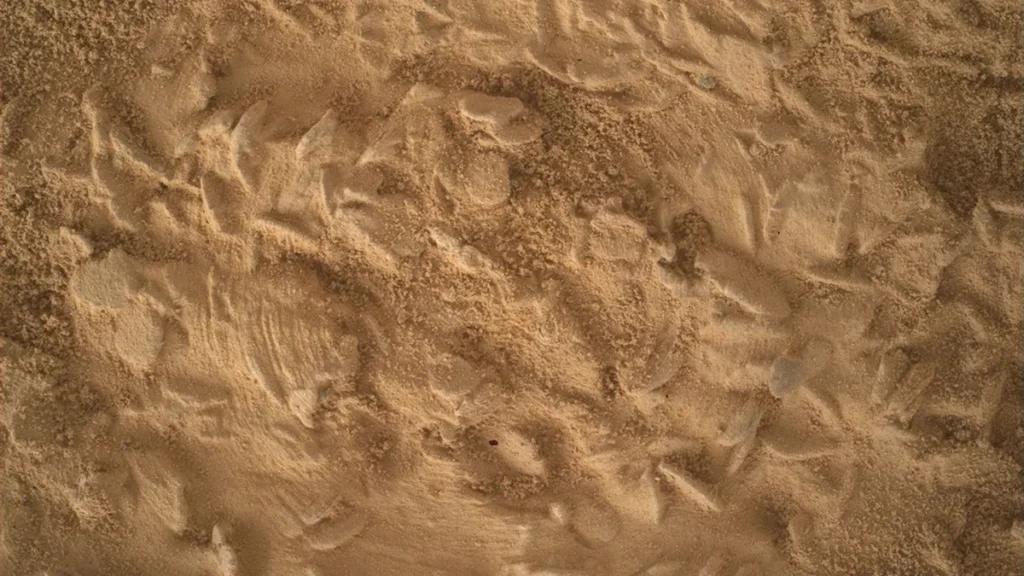
The Mars Hand Lens Imager (MAHLI), a camera on the turret at the end of the rover’s robotic arm, was to create a detailed model of the crystal forms in 3D before drilling. Its Quantitative Relief Model observation used five overlapping images taken from different angles, and the team doubled the focus mechanism steps to sharpen the highest-resolution view for a finer look at the crystal structures before drilling. MAHLI composites pictures taken at different focus positions into one close-up. The camera photographed Nazca on Oct. 18, 2026, which was Sol 5048, at 12:19:51 UTC, showing disc-shaped crystal forms and scratches left by the Dust Removal Tool (DRT), which brushes dust off rock surfaces.
ChemCam’s Laser Induced Breakdown Spectroscopy (LIBS), which fires laser shots that vaporize a tiny amount of rock into plasma, ran a depth profile on the Toucan target. Usually LIBS spreads 150 shots across five points at 30 shots each, but at Toucan all 150 shots hit one spot, penetrating about five times deeper than normal. The experiment aimed to read the composition of layers slightly below the surface and spot any changes caused by the Martian environment or by how the crystals originally formed. The team also planned a third LIBS observation on Condor to learn more about the composition of that nearby, finely layered block, which could provide complementary insights into the region’s geological history.
LIBS, the DRT, and the Alpha Particle X-ray Spectrometer (APXS) checked Nazca’s surface composition before the drill preload test assessed whether the site was suitable for sampling. The instruments provided detailed surface data to inform the drilling. The team wanted to compare the deeper material with the surface, since researchers expected the deeper crystal material to differ from the surface owing to modern exposure on Mars or the conditions under which the crystals first grew. Lucy Lim said the experiment was worth pursuing because the team wanted to check whether the deeper composition differs from the surface, and the team expected the drilled sample to give a fuller picture of the rock.
Curiosity also photographed Phobos, the larger and brighter of Mars’ two moons, at night during twilight cloud season. Sunlight reflecting off the full Phobos and scattering in the atmosphere lets researchers estimate the size of particles in high-altitude carbon dioxide clouds, later in the night than solar observations allow.


Join the discussion