Key facts
- Marco Monaci, a study author at Swinburne University of Technology, said theoretical models and simulations show dark galaxies should not rotate, making the potential rotation extremely interesting.
- Robert Minchin of the National Radio Astronomy Observatory said finding out more about the object is an essential next step, calling it intriguing and saying he wants to know more.
- Adams said once an object is no longer classed as a dark galaxy, people seem to stop caring, which she thinks is the wrong approach.
- Trujillo said Cloud 9 appears genuinely starless within the limits of current observations, but the result is not absolute proof because future instruments could reveal extremely faint signals beyond current technology.
Researchers at Swinburne University of Technology in Australia identified AGC 322753 as a candidate dark galaxy holding roughly 2 billion solar masses of hydrogen with no detectable stars, publishing the work Nov. 9, 2026 in the Monthly Notices of the Royal Astronomical Society.
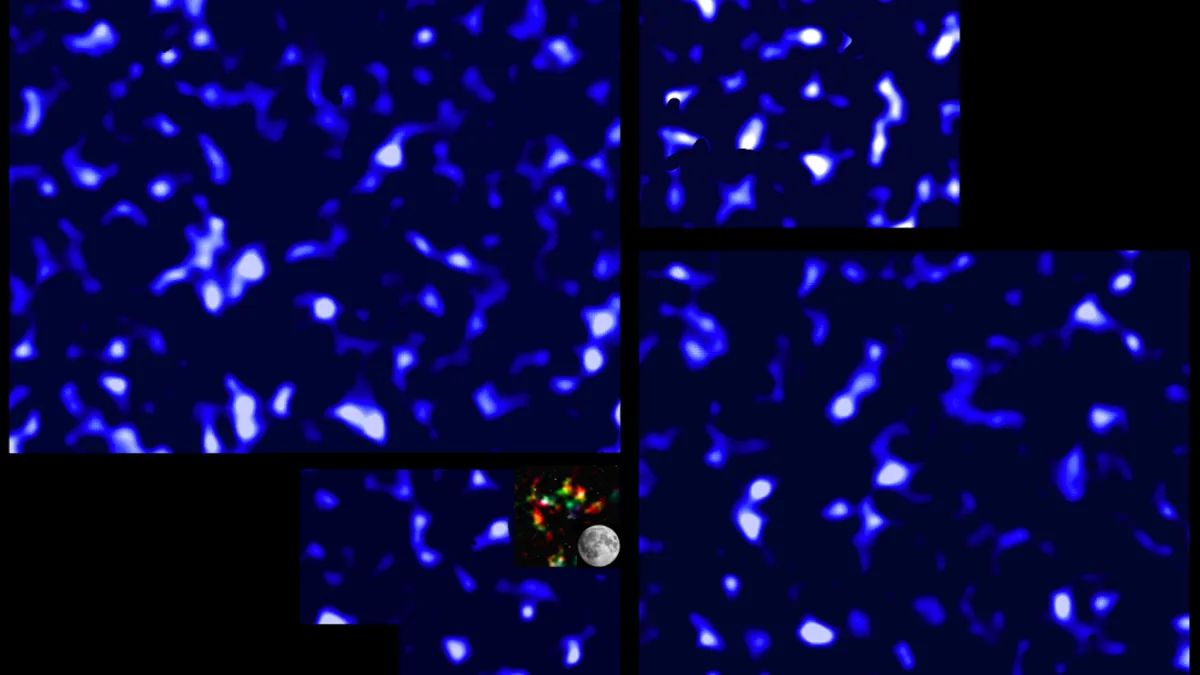
The team compared two radio surveys that both picked up the hydrogen cloud: one by the Arecibo Observatory in Puerto Rico and the other by China’s Five-Hundred-Meter Aperture Spherical Radio Telescope. The signal from AGC 322753 shows two distinct peaks, which the team read as one side moving toward Earth while the other recedes, pointing to an organized rotating structure. Optical images from the DESI Legacy Imaging Surveys reveal no starlight, and the team estimates AGC 322753 contains at least 40 times more hydrogen mass than stellar mass.
Models of galaxy formation expect a cloud this rich in hydrogen to form at least a few stars, because gravity pulls its densest gas together until it lights up. Marco Monaci, a study author at Swinburne University of Technology, said theoretical models and simulations show dark galaxies should not rotate, making the potential rotation interesting.
Robert Minchin of the National Radio Astronomy Observatory said finding out more about the object is an essential next step, calling it intriguing and saying he wants to know more.
Rhys Taylor of the Astronomical Institute of the Czech Academy of Sciences in Prague said tidal debris is unlikely to explain the observations and that reproducing the candidate’s double-peaked profile through such a process is technically possible but fantastically unlikely. Taylor and Minchin both flagged that the two radio surveys placed the hydrogen at noticeably different positions in the sky, suggesting AGC 322753 may be an extended gas cloud rather than a compact galaxy.
Further observations, including from the Very Large Array network of radio antennas in New Mexico, are needed to confirm whether AGC 322753 is truly dark or almost dark. Elisabeth Adams of the Planetary Science Institute said understanding objects like AGC 322753 could help explain why some galaxies form stars while others do not, whether the object turns out completely dark or exceptionally faint.
Adams offered two explanations for suppressed star formation: a galaxy spinning so fast its gas stays too spread out to collapse, and ultraviolet light from the universe’s earliest stars heating the gas so it stays too warm to condense. Adams said once an object is no longer classed as a dark galaxy, people seem to stop caring, which she thinks is the wrong approach.
Gas collects inside dark-matter haloes, cools, and collapses to form stars, but astronomers still do not understand why this happens in some haloes and not others; one possibility is that some haloes hold quantities of hydrogen yet form few stars, making them difficult to spot. Lambda-CDM assumes dark energy drives the accelerating expansion of the universe and cold dark matter makes up about 85 percent of the universe’s matter, with clumps of dark matter called haloes providing the gravitational scaffolding for galaxies to form and grow.
If confirmed as starless, AGC 322753 would rank among the most massive dark galaxies ever identified and could help account for the missing galaxies predicted by Lambda-CDM while testing galaxy-formation models and offering clues about dark matter.
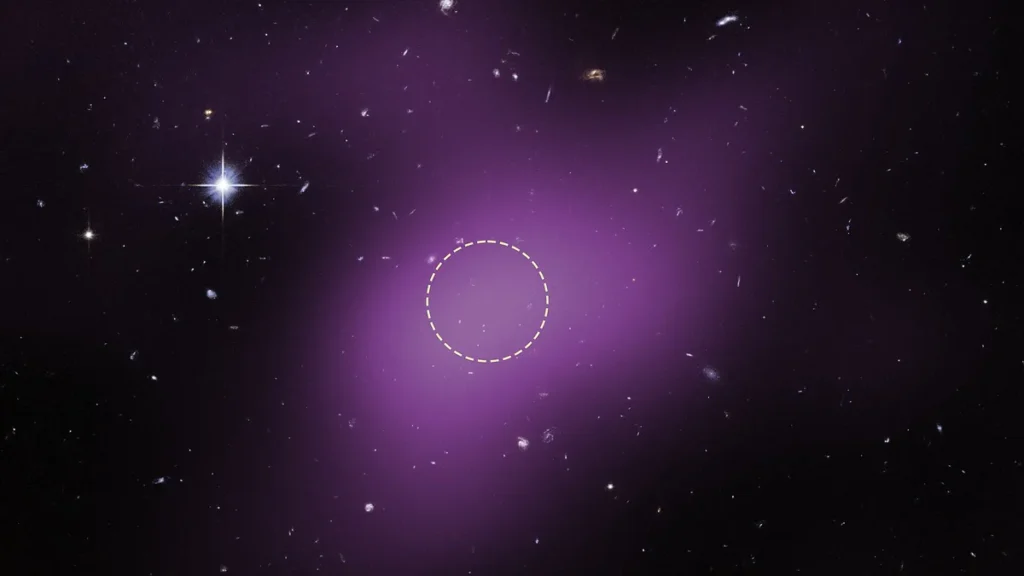
Astronomers have identified Cloud 9 as the strongest candidate yet for a galaxy without stars, reporting a massive concentration of neutral hydrogen gas with no detectable stellar light in a study on arXiv on Aug. 29, 2026. Unlike ordinary galaxies identified by starlight, the team detected Cloud 9 through neutral hydrogen emissions, and it remains almost invisible in optical observations. The team’s deep optical observations found no detectable stellar emission in the Cloud 9 region, suggesting the object contains gas without a measurable stellar population.
Ignacio Trujillo, team leader at the Instituto de Astrofísica de Canarias in Spain, said the absolute emptiness of the deep image at Cloud 9’s location was the most striking aspect and called the silence the most compelling result. Deep imaging considered an old, metal-poor stellar population and found no evidence of stars within the gas region, setting an upper limit on total stellar mass of just 16,000 solar masses. Trujillo said Cloud 9 appears genuinely starless within the limits of current observations, but the result is not absolute proof because future instruments could reveal faint signals beyond current technology.
The Hubble Space Telescope identified Cloud-9 as a gas-rich, dark matter–dominated cloud with no stars on Jan. 9, 2026, which the European Space Agency describes as a failed galaxy, a relic of early galaxy formation, and the first confirmed example of its kind observed in the Universe. Alejandro Benitez-Llambay of Milano-Bicocca University in Milan, Italy, the program’s principal investigator, called Cloud-9 a tale of a failed galaxy and said finding no stars proves the theory by revealing a primordial building block of a galaxy that has not formed.
Cloud-9 belongs to the category of Reionization-Limited H I Clouds, or RELHICs—neutral hydrogen clouds formed in the early Universe that never progressed to form stars—which scientists predicted for years but had not directly confirmed until Hubble observed Cloud-9. Gagandeep Anand of the Space Telescope Science Institute in Baltimore, the lead author, said Hubble’s Advanced Camera for Surveys ruled out the idea that Cloud-9 was a faint dwarf galaxy missed by ground-based telescopes because there is nothing there.
RELHICs are thought to be dark matter clumps that never collected enough gas to start forming stars, keeping early-Universe conditions intact, and Cloud-9 hints that many more small, dark-matter-dominated failed galaxies probably exist. At its center Cloud-9 contains neutral hydrogen spanning roughly 4900 light-years with a gas mass of about 1 million solar masses, and if gas pressure is balanced by the gravity of surrounding dark matter, dark matter accounts for most of the object’s estimated roughly 5 billion solar masses.
Whether Cloud-9 eventually becomes a galaxy depends on whether it gains mass. Cloud-9 indicates that many small objects dominated by dark matter probably exist, ones often called failed galaxies.






Join the discussion