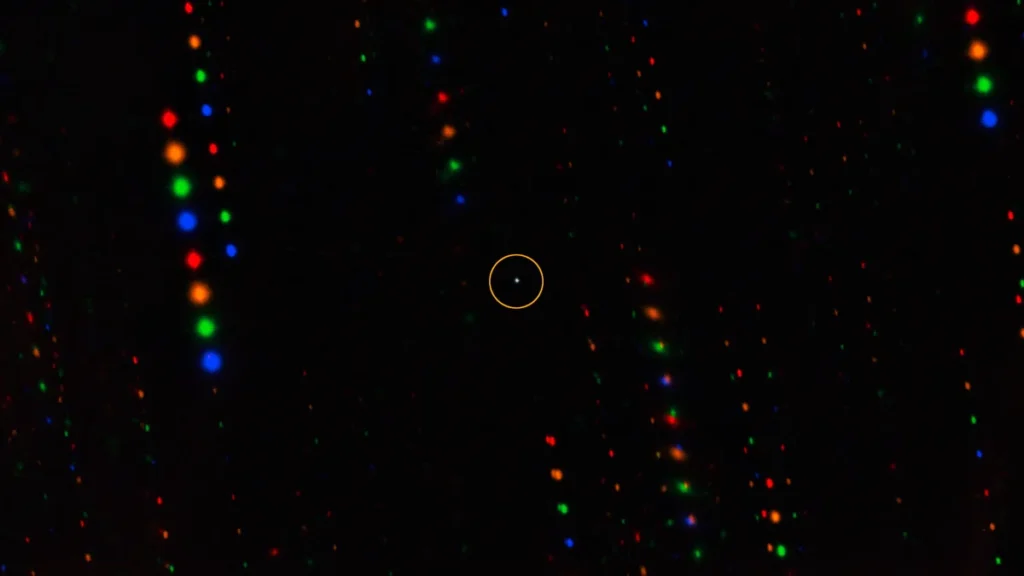
Aerospace engineers Korbin Hansen and Masatoshi Hirabayashi of the Georgia Institute of Technology said in a paper published in Icarus that asteroid 1998 KY26 is accelerating in a way that defies expectations, with unusual acceleration perpendicular to the plane of its orbit. ScienceAlert reported the research. KY26 is an 11-meter (36-foot) space rock that rotates once every 5.35 minutes.
Most asteroids follow predictable paths shaped by gravity or solar radiation pressure, but KY26 behaves differently. Hansen and Hirabayashi considered whether KY26 might be a dark comet whose invisible gas emission changes its course. They examined that dark comet hypothesis for the asteroid’s unexplained acceleration perpendicular to its orbital plane.
To estimate how cold the asteroid gets inside and out, Hansen and Hirabayashi fed its known size, path around the Sun, brightness and probable makeup into a temperature model. The model tested whether buried ice could survive long enough to explain the observed acceleration.
Hansen and Hirabayashi concluded that KY26 is too warm to retain the ice needed to power outgassing propulsion. Their Icarus paper examines the dark comet hypothesis for KY26’s unexplained acceleration perpendicular to its orbital plane.
Hansen and Hirabayashi said, “Our temperature model results indicate that the water outgassing rate on 1998 KY26 would be too high to maintain buried ice”. They based that conclusion on combining KY26’s size, orbit, reflectivity and likely composition into a temperature model rather than on direct observation of ice.
Buried water ice survives only where temperatures remain below around 145 Kelvin (-128 degrees Celsius), Hansen and Hirabayashi said. This temperature threshold is the condition the researchers applied to judge whether cometary ice could persist on the small asteroid over long periods. They used it as the test for long-term survival of a buried reservoir.
Even the coldest regions of KY26 average at least 212 Kelvin (-61 degrees Celsius) over its orbit around the Sun, Hansen and Hirabayashi found. Because even the coldest parts exceed this threshold, the finding challenges the idea that buried ice could be driving the asteroid’s motion.
Water ice making up 1% of KY26’s mass would disappear in just over 2,000 years, Hansen and Hirabayashi calculated. Ice driving the unusual acceleration would vanish in just 62 years. They calculated this ice-loss timescale to test whether buried ice could survive long enough to explain the observed acceleration. This shorter timescale applies specifically to the scenario where ice sublimation produces the unusual acceleration perpendicular to KY26’s orbital plane.
That uncertainty leaves open the possibility that KY26 retains ice despite warm surface temperatures.
An earlier paper traced KY26 to a potential asteroid belt origin. Together with the new temperature result, that earlier work shrinks the possibility that KY26 has ice and narrows the range of viable explanations for the unexpected acceleration perpendicular to its orbital plane.
Sunlight exerts a small force that could potentially be powerful enough to account for the asteroid’s unexplained acceleration if conventional cometary explanations fail.
JAXA’s Hayabusa2 spacecraft is traveling toward KY26, with a rendezvous slated for July 2031. The spacecraft is en route to the asteroid and should provide direct observations when it arrives in 2031, potentially resolving the mystery.

Join the discussion