This is a new development in a story we reported earlier: NASA schedules Artemis III for 2027 as Moon landing rehearsal.
Key facts
- Beijing's Seventh Manned Spaceflight Conference hosted the unveiling of China's four-mission roadmap for a crewed lunar landing before 2030.
- The opening mission calls for an uncrewed Long March 10A test carrying Mengzhou to low-Earth orbit in early 2027.
- An uncrewed Long March 10 rocket and Lanyue lunar lander will test lunar descent and ascent in 2028.
- Two Long March 10 rockets will launch uncrewed Mengzhou and Lanyue vehicles to dock in lunar orbit during a 2029 rehearsal mission.
China unveiled a four-mission roadmap for a crewed lunar landing before 2030 at the Seventh Manned Spaceflight Conference in Beijing, held Oct. 31 to Nov. 1, 2026. The China Manned Space Agency hosted the event at Beihang University, drawing more than 800 experts and scholars. Wang Xiang, chief designer of China’s lunar exploration program, presented the plan.
The first step is an uncrewed Long March 10A flight in early 2027 carrying Mengzhou to low-Earth orbit. In 2028, the heavier Long March 10 will launch Lanyue to lunar orbit for a descent and ascent test. A 2029 rehearsal will use two Long March 10 rockets to send uncrewed Mengzhou and Lanyue to dock in lunar orbit, followed by a crewed landing before 2030.
Three taikonauts will fly aboard Mengzhou, with two landing on the lunar surface while one remains in orbit. After docking, the landing pair will transfer to Lanyue, descend, lift off, redock with Mengzhou, and return to Earth. The surface stay will last three Earth days, with extravehicular activities each day.
China lacks a rocket as powerful as the Saturn V, so the crew ship and lander launch separately, yet the plan still uses lunar-orbit rendezvous like Apollo in the 1960s and early 1970s. The Long March 10A is a single-stick, two-stage rocket with no boosters for near-Earth flights, while the standard Long March 10 adds boosters to carry 27 metric tons. Mengzhou means “Dream Vessel” and will carry astronauts to Tiangong for human spaceflight practice nearer to Earth.
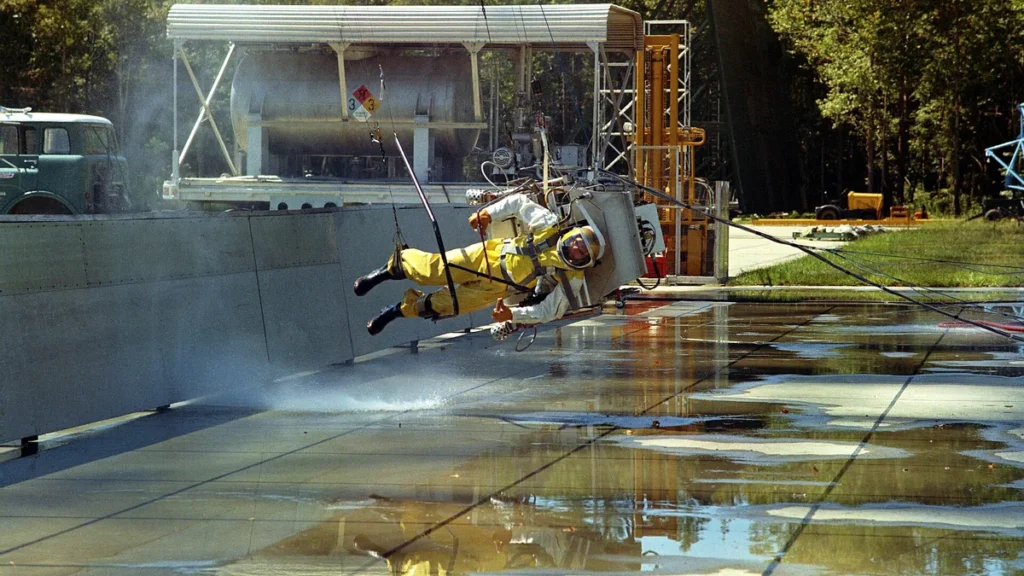
In August 2025, Chinese officials tested a 26-ton Lanyue mock-up near Beijing using tethers to simulate lunar gravity. Mengzhou completed zero-height abort and maximum dynamic pressure escape tests in June 2025, then a maximum dynamic pressure abort test on February 11 that ended with a safe sea splashdown. The Long March 10 finished a low-altitude demonstration earlier in 2026.
Mengzhou has arrived at Wenchang ahead of its 2027 test flight. The China Manned Space Agency asked Chinese institutions on October 22 to propose payloads for an uncrewed Lanyue flight, setting a March 1, 2027 deadline. Tiangong will help validate rockets, the lander, and the capsule before crewed lunar landings, and an uncrewed Lanyue flight will precede the crewed landing to gather critical environmental data on the lunar surface.
NASA sent four astronauts around the Moon on Artemis II in April 2026 after an uncrewed Artemis I circumlunar flight validated key systems. NASA plans Artemis III as a 2027 crewed Earth-orbit exercise to practice docking with SpaceX Starship and Blue Origin Blue Moon landers, with officials targeting summer 2027 but warning an on-time launch is uncertain. Starship reached Earth orbit for the first time on Sept. 28 and still must prove off-Earth refueling, while Blue Origin’s Blue Moon lander has yet to leave the ground and it will make its first uncrewed lunar flight next spring.
NASA has set early 2028 for Artemis IV, described as the first crewed lunar landing under Artemis, aiming to put astronauts down near the lunar south pole on either SpaceX’s Starship or Blue Origin’s Blue Moon, with the lander choice still open. If the schedule holds, the United States would achieve the first American crewed lunar landing since Apollo 17 in 1972.
The agency cancelled the Block 2 Space Launch System version meant to carry crews and payloads to the Moon. NASA Administrator Jared Isaacman called off the Lunar Gateway space station and planned upgrades to the Space Launch System rocket. Work on the Space Launch System rocket has spanned 15 years in the United States, with Orion development running even longer.
Both the agency and China intend to build lunar bases over the next decade, and NASA and U.S. military officials have said the nation or agency that builds first can claim the best locations, win top water ice access, and establish Moon behavior norms. Construction of the International Lunar Research Station will begin in 2031 with Long March 9 rockets. Russia’s war in Ukraine, low annual launch rates, and delays to the Yenisei super-heavy rocket have left Roscosmos’s role uncertain.
Calling the goal “before 2030” leaves room to frame a 2029 landing as an early success while treating a 2030 slip as still within the target. CNSpaceflight said the wording helps since 2029 marks the 80th anniversary of the current government, and publicly committing to 2029 would create political exposure if tests slip. China has not announced a firm date for its crewed lunar mission.
Until now, China’s lunar program operated with limited public disclosure. Zhang Hailian raised the idea of two separate Long March-10 launches in July 2023. Design work on Lanyue became public in September 2023, with the formal name arriving in early 2024, and development of the lunar lander, a moonwalk spacesuit, and a crewed lunar rover is ongoing.
Videos on Chinese social media showed large containers holding hardware lifted from a cargo ship at Wenchang spaceport. Wang Xiang told CCTV that two principles guide the planning approach, including the use of different vehicle variants for different stages, and said, “This is to ensure that the crewed flight is safe and reliable.”




Join the discussion