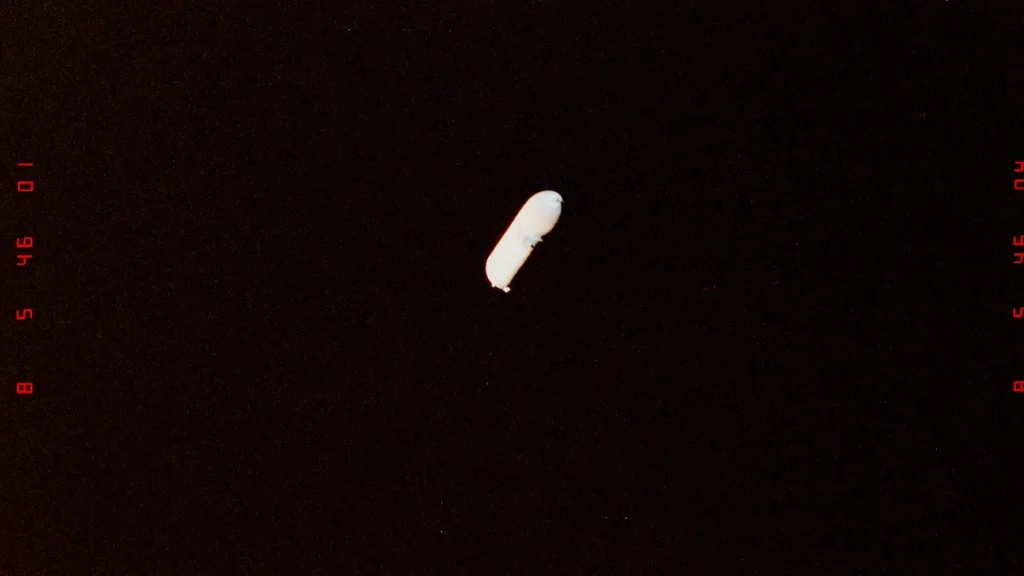
This is a new development in a story we reported earlier: NASA's Swift Observatory set for uncontrolled reentry.
Key facts
- NASA estimates that most of the Swift Observatory (about 1.5 tons) will burn up during re-entry, but denser components, including tungsten parts and mirror fragments, are expected to survive and reach Earth's surface.
- NASA and the U.S. Space Force estimate the risk of harm from Swift’s re-entry debris to be approximately 1 in 2,100, classifying it as unlikely to cause injury or damage.
- Swift’s final scientific observations concluded on October 20, 2026, when its altitude dropped to 171 miles (275 km), making stable operations impossible. NASA then shut down its systems to prepare for re-entry.
- Swift’s orbital decay accelerated due to increased solar activity over the past few years, which expanded Earth’s atmosphere and heightened atmospheric drag on the observatory.
NASA said it expects the Neil Gehrels Swift Observatory to re-enter Earth’s atmosphere on Nov. 4, 2026, around 3:30 a.m. EST, according to predictions issued Nov. 2, 2026. The U.S. Space Force issued the prediction on Nov. 2, 2026, with an uncertainty window of plus or minus 11 hours, meaning re-entry could occur from late on Nov. 3 to early afternoon on Nov. 4. The Aerospace Corporation, drawing on the same Nov. 2 tracking data, forecast re-entry between 4:11 p.m. EST on Nov. 3 and 4:11 p.m. EST on Nov. 4. NASA’s rescue attempt using Katalyst Space’s robotic probe Link failed in July 2026 because of attitude control issues, leaving the observatory on an uncontrolled path back to Earth. The probe could not approach closer than 7 to 9 miles, or 12 to 15 kilometers, and the $30 million rescue effort ended when Link re-entered Earth’s atmosphere in September 2026. NASA and the U.S. Space Force expect surviving debris to fall within a latitude band between 20.6 degrees south and 20.6 degrees north, covering parts of Africa, Australia, India, Southeast Asia, Central America and South America. NASA said most debris is likely to land in the ocean. The U.S. Space Force actively tracks the trajectory to refine predictions, though the uncontrolled descent limits precision, and NASA emphasizes that the risk to populated areas is minimal. NASA estimates that most of the observatory’s 1.5-ton mass will burn up during re-entry, but denser components, including tungsten parts and mirror fragments, are expected to reach Earth’s surface.
NASA’s Brad Cenko, the mission’s chief scientist, said those components are denser than lead and could withstand re-entry, leaving small surviving fragments. Astrophysicist Jonathan McDowell estimates that about 10 percent of the mass, roughly 100 kilograms or 220 pounds, could survive, including dense tungsten components and mirror fragments. The observatory’s mass is listed at 3,200 pounds. NASA and the U.S. Space Force estimate the risk of harm from debris at approximately 1 in 2,100, classifying it as unlikely to cause injury or damage. The assessment is based on historical re-entry data and the observatory’s expected disintegration pattern.
NASA and the Space Force will continue monitoring the event to provide updates. Swift’s final scientific observations concluded on Oct. 20, 2026, when its altitude dropped to 171 miles, or 275 kilometers, making stable operations impossible. The observatory entered safe mode that day as atmospheric drag increased, and NASA then shut down its systems to prepare for re-entry. Increased solar activity over the past few years expanded Earth’s atmosphere, heightening atmospheric drag and accelerating the observatory’s orbital decay. After the rescue mission was abandoned, Swift resumed scientific observations in late July 2026 and continued studying cosmic events until late October. Swift launched on Nov. 20, 2004, and operated for 21 years and 11 months, far exceeding its original two-year prime mission designed to study gamma-ray bursts and multiwavelength transients. Swift’s mission was originally planned for two years but operated for over 21 years, making it one of NASA’s most enduring space observatories. During its mission, Swift observed more than 2,000 gamma-ray bursts, 1,400 supernovae, comets, asteroids and tidal disruption events.
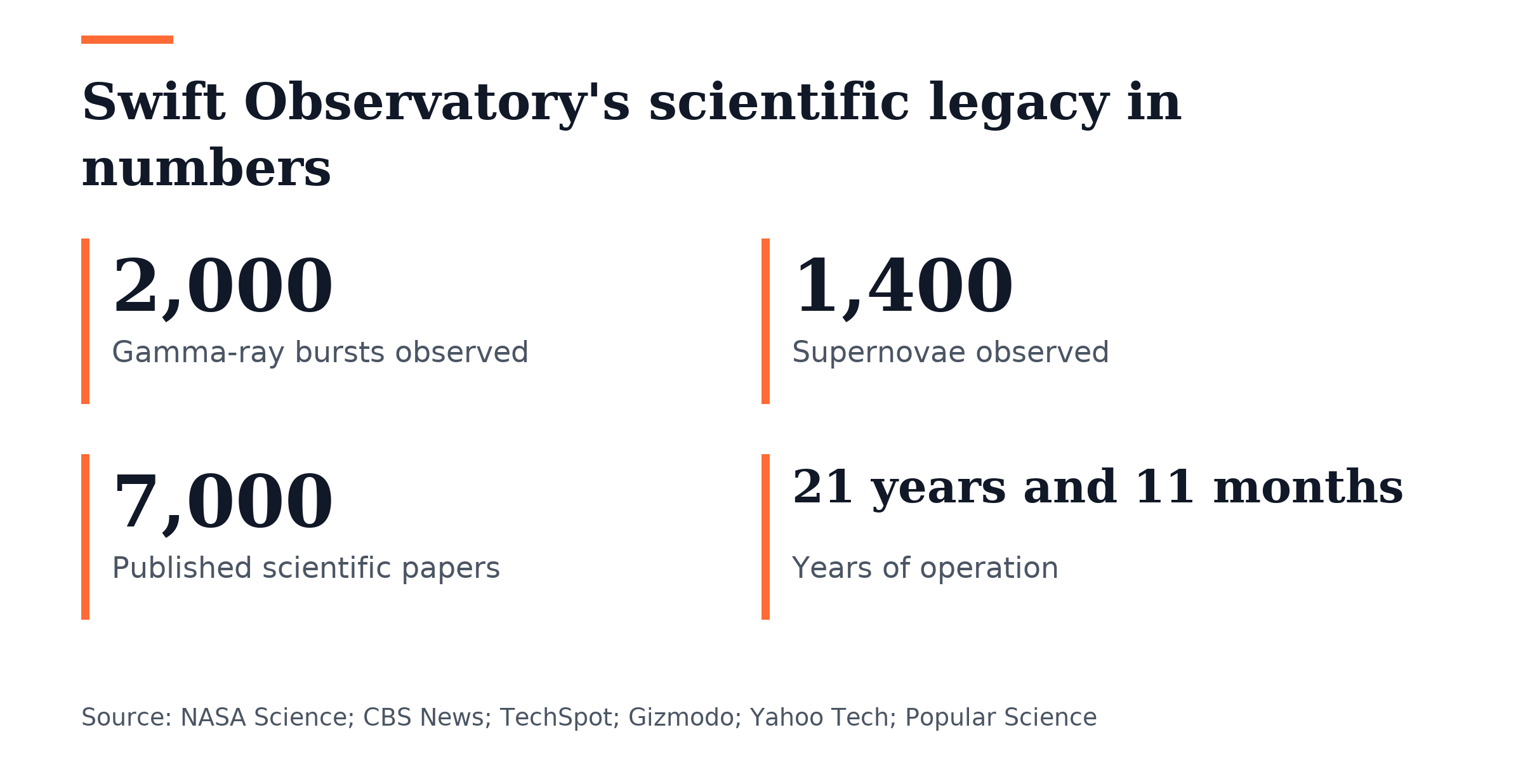
Data from the observatory contributed to more than 7,000 published scientific papers, averaging roughly six papers per week over nearly 22 years. Swift’s extensive dataset has provided a foundation for ongoing research in multiwavelength astronomy and transient cosmic events. The mission also documented comet 3I/ATLAS, the third interstellar object detected passing through the solar system, expanding its legacy beyond gamma-ray bursts and supernovae. Swift’s observations of interstellar objects contributed to broader astronomical research. NASA renamed the observatory in 2018 to honor its first principal investigator, Neil Gehrels, who died in 2017. The renaming recognized Gehrels’ pivotal role in leading the mission and his contributions to astrophysics. NASA designed Swift as a first-of-its-kind multiwavelength observatory to study gamma-ray bursts and other transient cosmic events.
Its rapid response capabilities allowed it to coordinate with telescopes such as Hubble and JWST for follow-up observations. This allowed Swift to support time-sensitive astrophysical research. Shawn Domagal-Goldman, director of NASA’s Astrophysics Division, said Swift’s success demonstrates the value of rapid-response space missions and will inform future observatory designs. In October 2026, he said the mission’s archive of multiwavelength observations will continue to fuel new discoveries for decades. He also emphasized that the mission’s prolonged life and scientific output highlight the importance of adaptable strategies despite risks to orbital sustainability.



Join the discussion