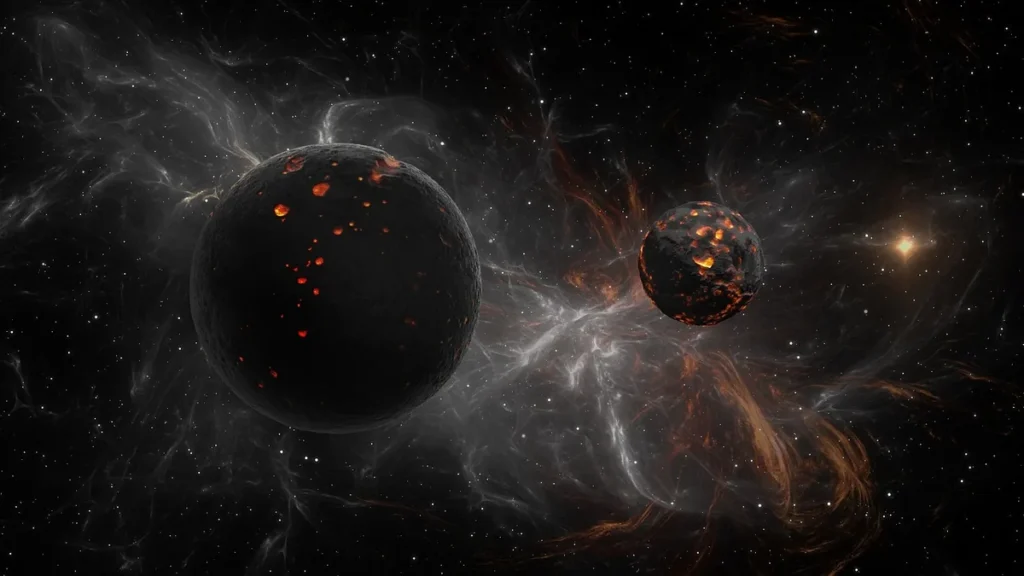
Key facts
- TOI-561 b is an ultra-short-period exoplanet that orbits its star in about 10.5 hours, well under the 24-hour threshold for this planet class and far faster than Mercury's 88-day solar orbit.
- Ultra-short-period planets orbit so close to their stars that intense stellar radiation should have stripped away their atmospheres, leaving them airless.
- TOI-561 b defies that expectation because JWST/NIRSpec phase-curve observations indicate it still has a significant atmosphere despite intense irradiation.
- The authors state that more than one of these explanations may combine to account for TOI-561 b's atmosphere.
JWST/NIRSpec phase-curve observations show that TOI-561 b, an ultra-short-period exoplanet about 280 light-years away in the constellation Sextans, keeps a significant, highly reflective atmosphere despite orbiting its star in about 10.5 hours. The study appeared in The Astronomical Journal on Sept. 29, 2026, according to Scienmag.
Samuel Boucher of the Université de Montréal is first author of the study titled A Highly Reflective Atmosphere on the Lava World TOI-561b Revealed by JWST/NIRSpec Phase Curves, which appeared in The Astronomical Journal on Sept. 29, 2026, according to Scienmag. TOI-561 b is a super-Earth located in the constellation Sextans, around 280 light-years from the solar system, with a catalog radius of about 1.397 Earth radii and a mass around 2.02 Earth masses. Super-Earth refers to size or mass, not to an Earth-like environment or life.
The planet orbits at a distance close to 0.01064 astronomical units and is thought to be tidally locked, maintaining a permanent dayside and permanent nightside. The presumed surface of TOI-561 b is a molten rock ocean or magma ocean, not an ocean of liquid water.
TOI-561 b orbits a late G/early K dwarf, a more Sun-like star, whereas most rocky planets in the current JWST census that appear to be bare rock orbit M dwarfs. Ancient astronomers thought Mercury was so fast, completing an orbit every 88 days, that they named it after the Roman god Mercury, the fast-traveling messenger of the gods, not knowing how sluggish it is compared to ultra-short-period planets. Ultra-short-period planets complete an orbit in under a day, well under the 24-hour threshold and far faster than Mercury’s 88-day solar orbit.
The 37-hour dataset covered nearly four complete orbits, giving repeated views of both the dayside and nightside. JWST’s NIRSpec monitored thermal emission in roughly the 3–5 micrometer range during those phases.
The phase-curve analysis yielded a Bond albedo of about 0.74 with uncertainty plus 0.08 minus 0.10, meaning the planet reflects roughly three-quarters of incoming starlight back to space. Models without substantial reflection produced daysides too hot for the NIRSpec measurements; the NRS1 range required a Bond albedo above 0.5, parts of the NRS2 grid needed about 0.4, and the energy-balance fit favored about 0.74. Bond albedo measures the fraction of incoming starlight a planet reflects back to space.
By tracking thermal emission as different regions rotate into view during the orbit, a phase curve separates reflected starlight from heat carried by atmospheric winds. Boucher et al. modeled stellar granulation, planetary phase variation, and dayside emission together, then compared results with general-circulation models, which simulate how atmospheric heat is transported around a planet, spanning different atmospheric pressures, compositions, and imposed reflectivities.
The Watchers reports an estimated dayside temperature of 2 048 K plus 193 minus 206 K and a nightside of 1 089 K plus 175 minus 379 K. The inferred heat-redistribution efficiency is 0.18 plus 0.14 minus 0.15, too low for atmospheric circulation alone to reproduce the observed dayside temperature. A dark, airless planet at this orbital distance would reach roughly 3 200 K, far above the measured near 2 050 K, showing the actual dayside is much cooler than a bare-rock world.
Ultra-short-period planets orbit so close to their stars that intense stellar radiation should have stripped away their atmospheres, leaving them airless. TOI-561 b defies that expectation because JWST/NIRSpec phase-curve observations indicate it still has a significant atmosphere despite intense irradiation. Doctor Anjali Piette of the University of Birmingham said the discovery challenges current theories because a heavily irradiated rocky planet like TOI-561 b should have lost its atmosphere billions of years ago. Close-in rocky planets can lose atmosphere as ultraviolet light and stellar particles heat their upper atmospheres and help gases escape; early expectations for ultra-short-period worlds favored a bare rock or only a tenuous rock-vapor shroud.
Professor Lisa Dang of the University of Waterloo, Ontario, Canada, is the project lead and stated that measuring the planet’s changing brightness and heat throughout its orbit revealed significant reflected light and heat redistribution, together pointing to an atmosphere. “Our discovery challenges current theories,” Dang said.
General circulation model comparisons pointed to a high-albedo source with Ab of 0.6, suggesting clouds or haze, since heat transport by itself could not reproduce the measured dayside fluxes or phase-curve amplitude. A general circulation model simulates how atmospheric heat and gases move around a planet. Multiple possible cloud species can form on the dayside, including magnesium silicate and silicon dioxide, with silicon dioxide potentially helping to explain the high albedo required by the model. Silicate clouds made of silicon dioxide and magnesium silicate have not been directly detected by JWST; they are model-supported candidates, not a spectroscopic identification of the atmosphere’s mineral content, and the atmosphere’s bulk gas composition remains unresolved.
Equilibrium-condensation calculations show that silicon dioxide and magnesium silicate clouds could appear in parts of the dayside atmosphere, including areas close to the boundary between day and night. A conservative silicon dioxide run for the hottest zero-albedo circulation model found that clouds in that zone added roughly 0.24 to the globally averaged albedo. In the proposed cloud scenario, extreme heat from the magma ocean vaporizes rock, and the resulting mineral vapor condenses into reflective cloud layers in the upper atmosphere, cooling the planet.
Earlier JWST observations reported by Teske et al. in 2025 measured TOI-561 b during secondary eclipse and found a spectrum inconsistent with a bare-rock surface at high statistical significance, indicating a thick volatile atmosphere over a magma-rich surface. The 2026 phase-curve study complements rather than replaces the December 2025 NASA findings, which had already indicated a substantial atmosphere inconsistent with the simplest bare-rock interpretation.
The researchers propose that TOI-561 b may have begun as a volatile-rich sub-Neptune with a massive atmosphere that has been worn away over time, or that it now hosts a secondary atmosphere because primary hydrogen/helium envelopes are more easily stripped than secondary atmospheres. Migration may explain the atmosphere’s survival if the planet formed farther from its star while the star was younger and more radiative, then moved closer as the star calmed down, reducing its total radiation exposure. A fourth explanation, called option d, is that originally accreted atmospheric volatiles were sequestered into the planet’s interior during its magma-ocean phase and later outgassed. The authors state that more than one of these explanations may combine to account for TOI-561 b’s atmosphere.
Neither the total atmospheric pressure nor a definitive recipe for gas abundances has been established by the phase-curve study. Several model combinations can fit overlapping parts of the data, and although Webb’s long baseline and treatment of stellar variability reduce ambiguity, they do not eliminate every degeneracy in atmospheric composition. The JWST data do not establish the long-term mechanism by which TOI-561 b’s atmosphere is replenished through volatile exchange with its molten interior.
NIRSpec sampled only part of the planet’s thermal emission spectrum, and detector-dependent uncertainty affects the nightside constraint, so longer-wavelength observations would provide an independent test of the energy-budget interpretation. Scientists still need information about TOI-561 b’s original volatile inventory, interior chemistry, stellar radiation history, and escape processes before determining whether interior-atmosphere volatile exchange operates on the planet. If the magma ocean continuously releases gases, dissolved volatiles may outgas while other compounds are reabsorbed or react with the surface; if replenishment offsets losses, an atmosphere can persist, though this is a hypothesis rather than evidence of observed eruptions.
Future work will compare TOI-561 b’s atmosphere to Venus or an extreme version of Io, and observations at longer wavelengths with JWST could determine which analogy fits and how the planet has held an atmosphere for billions of years. The next observational steps to improve constraints on TOI-561 b include transmission spectroscopy with JWST, radial-velocity campaigns with high-resolution ground-based spectrographs, and additional phase-curve measurements from space photometry.
Exoplanet science has moved beyond simple discovery into comparative characterization, with more than five thousand confirmed planets known, making atmospheric composition, internal structure, orbital history, and population statistics the productive questions. Population-level questions such as how common atmospheres are around small rocky planets require well-characterized individual data points like TOI-561 b before statistical patterns become meaningful.
The study does not claim habitability, and the atmosphere is not evidence of oceans of water, biology, breathable air, or Earth-like weather; the planet remains extraordinarily hot. Future observations could test carbon dioxide-rich and sulfur dioxide-rich atmospheres, according to the University of Waterloo research team.
The 2025 paper based on limited JWST observations suggested TOI-561 b had an atmosphere made of volatiles such as water and carbon dioxide. A NASA model spectrum displayed in 2025 used an atmosphere consisting of 100% water vapor as a test case, and this was not the chemical composition detected on TOI-561 b.


Join the discussion