
Key facts
- Tim Rush of Gallagher Aerospace stated on Oct. 29, 2026, that current satellite insurance excludes war risks.
- Tim Rush said any future space war coverage would likely exclude conflicts involving the U.S., U.K., France, Russia, or China.
- Tim Rush reported that national security programs account for less than 1% of the recent annual $500 million average space insurance premium.
- Tim Rush stated that only a few brokers and underwriters currently possess the necessary clearances to insure classified programs.
Gallagher Aerospace’s Tim Rush said on Oct. 29, 2026, that current satellite insurance policies exclude war and cyber risks, making them uninsurable. Rush spoke at the MilSat Symposium during Silicon Valley Space Week, where he explained the structure of satellite property coverage in detail. Insurers write those policies on an “all-risk” basis, meaning they cover malfunctions and loss of use under normal operating conditions, but they specifically exclude war and cyber events. The exclusion means that if hostile action destroys or degrades a satellite, the operator has no recourse through standard insurance markets.
“Right now, those are not insurable risks. These are excluded events,” Rush said, as reported by satnews.com in its coverage of the symposium.
Rush described the absence of war risk coverage as a chicken-and-egg problem rooted in insufficient demand. He noted that the International Union of Aerospace Insurers had discussed space war risk at its recent annual meeting, but that discussion has not yet produced available coverage. The lack of market interest perpetuates the coverage gap: without established policies, operators cannot buy protection, and without purchased protection, the market has no basis to develop offerings. The International Union of Aerospace Insurers’ discussion, while acknowledging the issue, has not yet translated into product development.
Even if war risk policies do eventually emerge, Rush said they would likely exclude conflicts involving the U.S., U.K., France, Russia, or China. He suggested that any future coverage would be imperfect and would not extend to major nuclear powers.
National security programs account for less than 1% of the recent annual $500 million average space insurance premium, Rush reported. The low participation of classified programs in the commercial insurance market stems from the difficulty of obtaining insurance for classified systems. National security programs operate under classification constraints that make it difficult to provide underwriters with the information they need to assess risk.
Only a couple of brokers and underwriters currently have the necessary clearances to insure classified programs, according to Rush. The shortage of cleared professionals stems from the fact that underwriters must understand classified satellite architecture, redundancy, and margins to price coverage correctly. This technical knowledge, combined with security requirements, limits the pool of potential insurers to a small number of firms.
Rush explained that only defense contractors working under a program of record can sponsor an insurer for a security clearance. This creates significant delays and expenses for companies seeking coverage for classified assets, further constraining the availability of insurance for national security space programs. The sponsorship model means that an insurer cannot apply for a clearance; an established contractor must sponsor it, which adds time and cost to the process and limits the number of firms that can enter the market for classified satellite insurance.
Rush suggested the Space Force ACES program could assist in clearing insurers.
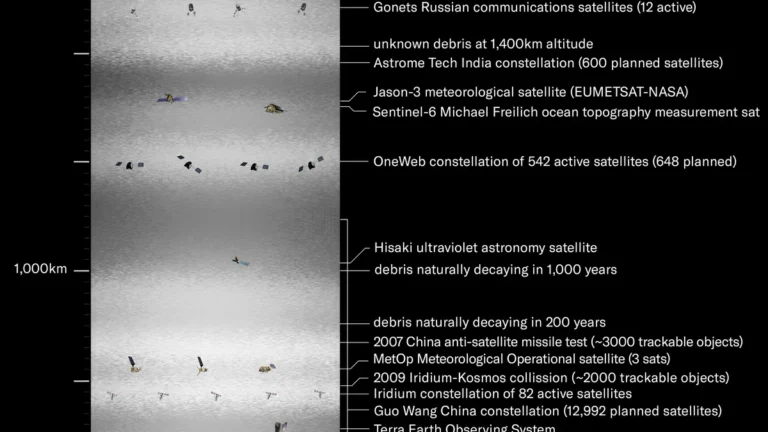
The context for Rush’s remarks lies in a broader shift in how military powers view space. Satellites used for military operations are increasingly viewed as legitimate targets, as noted in reporting on the evolving doctrine of space warfare. Military powers are racing to weaponize space, transforming it into a critical battleground, according to a NOVA report on space conflicts. Orbital debris traveling at 17,000 miles per hour poses a significant threat to satellite safety, the same NOVA report notes.

Join the discussion