Key facts
- NASA astronaut Anil Menon and Canadian Space Agency astronaut Joshua Kutryk started a spacewalk at 7:57 a.m. EDT on Oct. 29, 2026, switching suits to battery power for a six-and-a-half-hour excursion.
- The two spacewalks are intended to install the final pair of International Space Station roll-out solar arrays, completing a multi-year upgrade of the station's aging power system.
- IROSAs are smaller than original panels and use more efficient state-of-the-art solar cells.
- The seventh IROSA was to be mounted on a support fixture at the base of a left-side inboard solar wing on the port side of the truss.
NASA astronaut Anil Menon and Canadian Space Agency astronaut Joshua Kutryk began a spacewalk outside the International Space Station at 7:57 a.m. EDT on Oct. 29, 2026, switching their suits to battery power for a six-and-a-half-hour excursion to install the seventh roll-out solar array.
NASA scheduled the outing for Oct. 29, 2026. It was Menon’s fourth spacewalk and Kutryk’s first extra-vehicular activity. The excursion opened two spacewalks spaced one week apart and marked the eighth spacewalk of the year and the 285th since station assembly began in 1998. Menon and Kutryk will conduct a second spacewalk on Nov. 5, 2026, mirroring the Oct. 29, 2026 steps to install the final IROSA on a solar wing at the end of the power truss.
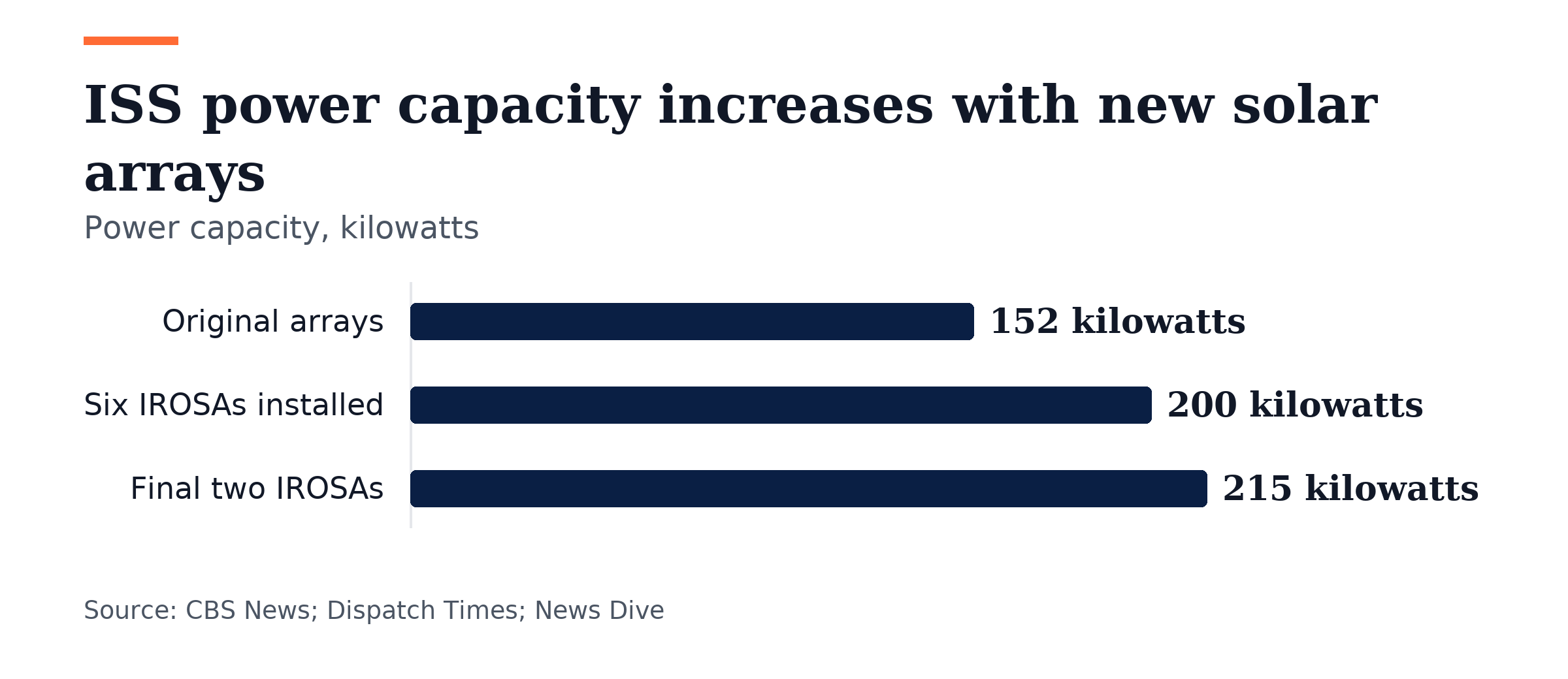
The pair completes the final set of International Space Station roll-out solar arrays, known as IROSAs, finishing a multi-year upgrade of the station’s aging power system that began in 2021. Six IROSAs were installed before this pair, bringing the total to eight. Before the upgrades, the station’s original arrays generated about 152 kilowatts. Six installed IROSAs raised power to about 200 kilowatts, and the final two sets will provide about 215 kilowatts through the station’s 2030 retirement and de-orbiting, helping research and visiting vehicles.
IROSAs are smaller than the original panels and use newer, more efficient solar cells. Each folded IROSA weighs about 750 pounds and is about 10 feet long, a mass that made handling difficult during the robot-arm transfer. The blankets deploy without motors, using stored energy to unroll like a reverse tape measure or snap bracelet, with magnets guiding steady extension over about 10 minutes.
Menon rode the station’s robot arm to the mounting point, which was farther outboard along the power truss at the base of a left-side inboard solar wing on the port side. The astronauts intended to attach the folded IROSA to its frame, open its two sections, and fasten them together. Mechanical assembly precedes the electrical hookup that integrates the blanket into power.
They also planned to make electrical connections tying the array into power channel 2A while the station was on Earth’s night side and the arrays were not generating power. Work in darkness avoids live power, and the array unrolls after connections are complete. Spacewalk flight director Garrett Hehn said controllers devised maneuvers to rotate the array around its center of mass rather than the crew member, reducing fatigue for the holder during the robot-arm transfer.
Hehn compared the deployment to a snap bracelet, saying magnets along the array give it enough energy to keep rolling out steadily for about 10 minutes. The crew began work as the station passed through shadow, a period used for later electrical work because the arrays make no power then. As the station was in orbital darkness, Kutryk remarked, “the night is dark and full of wonders.”
Because the robot arm cannot reach the far end of the truss, the astronauts will pass the folded array between them in a leapfrog fashion to reach the waiting support frame during the Nov. 5 outing. NASA’s blog assigned that second spacewalk to the starboard side of the truss, where it would be the final array. Gaurang Patel, a senior manager in NASA’s Low Earth Orbit Program, said the Nov. 5 outing will install and deploy the final set of IROSAs and essentially complete the station’s power augmentation upgrades.
On Oct. 19, 2026, Menon cleaned cooling loops in a pair of spacesuits inside the Quest airlock while Kutryk filled suit tanks and liquid cooling and ventilation garments with clean water. The spacewalkers joined Luke Delaney and Jessica Watkins for a pre-spacewalk conference, calling down to mission controllers as part of preparations.
On Aug. 6, 2026, NASA astronauts Jessica Meir and Anil Menon conducted the 281st spacewalk to prepare the 3B power channel for the future installation of an IROSA. The final two IROSAs arrived at the station in October 2026 aboard a SpaceX Cargo Dragon capsule, folded in half and stowed in the spacecraft’s unpressurized trunk. Controllers used the station’s robot arm to remove the arrays from Dragon, and the arm, operated remotely by flight controllers at the Johnson Space Center in Houston, stowed them on the left side of the power truss. This placement kept the folded blankets near the worksite before installation began.
NASA managers planned a news conference from Johnson Space Center on Tuesday, Oct. 20, 2026, at 2 p.m. EDT, and streamed it on platforms including YouTube. NASA scheduled it before Oct. 29, 2026.
Join the discussion