
Key facts
- Matthew Holman of the Harvard & Smithsonian Center for Astrophysics found the object two weeks before the report by running Vera C. Rubin Observatory data through a program he built with Kevin Napier.
- The International Astronomical Union's Minor Planet Center announced 2026 ED138 as a dwarf planet candidate on Wednesday.
- Holman said he reacted with excited disbelief and immediately checked whether he or the code had erred, since objects like this are very rare.
- After the initial find, the team assembled a detailed picture of ED138 and its stretched solar orbit in three days by pairing Rubin's repeated sky scans with archival images from other telescopes.
Matthew Holman of the Harvard & Smithsonian Center for Astrophysics found candidate dwarf planet ED138 beyond Pluto two weeks ago by running Vera C. Rubin Observatory data through a program he built with Kevin Napier.
The International Astronomical Union’s Minor Planet Center announced ED138 as a dwarf planet candidate on Wednesday. It assigned the object the provisional designation ED138, a temporary label used while the object remains a candidate awaiting further confirmation.
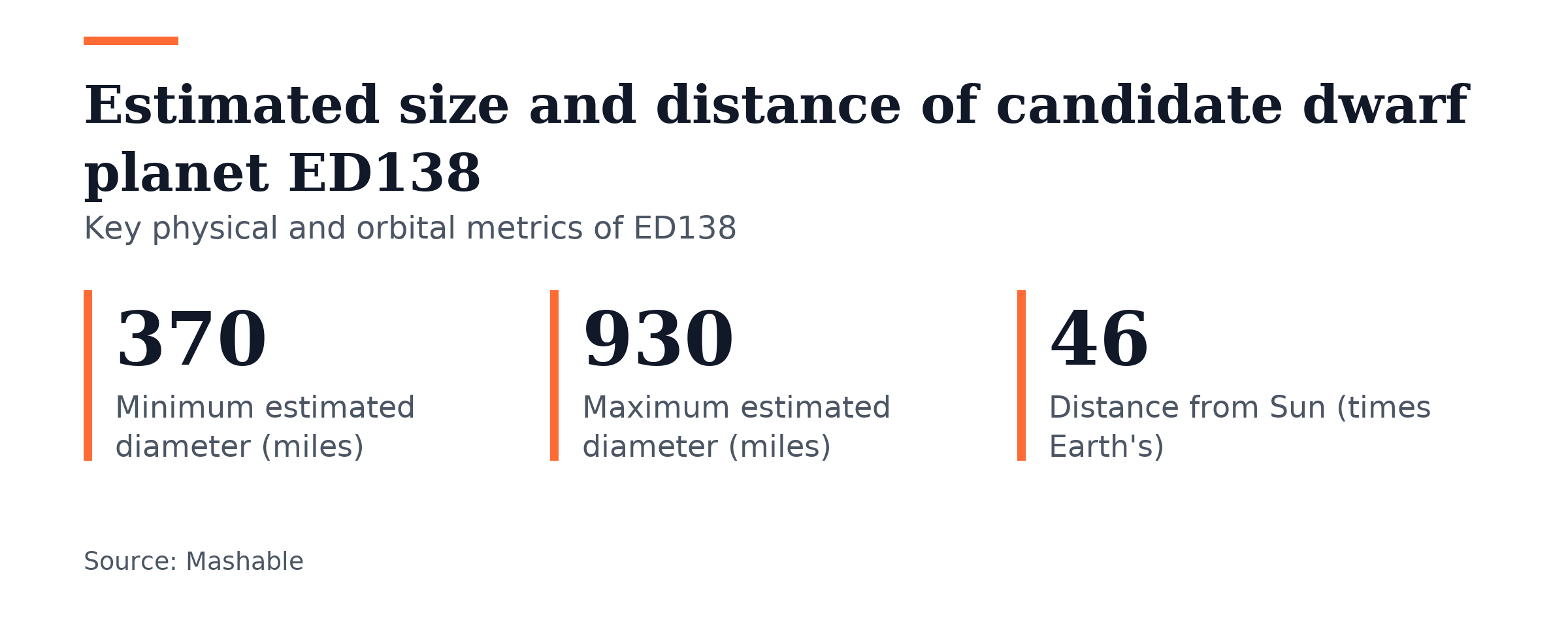
Astronomers identified 2026 ED138 about two weeks before the report’s publication, estimating the object at 370 to 930 miles wide and its orbit at roughly 46 times farther from the sun than Earth. They say the object is bright enough to be visible through small telescopes, but it likely went unnoticed because it sits in the crowded band of stars along the plane of the Milky Way, a region filled with millions of stars. Rubin’s regular monitoring and powerful data algorithms spotted the object moving within that crowded stellar field.
Rubin’s Simonyi Survey Telescope observed ED138 about 30 times between March 4 and July 11, and the ADAM Precovery tool later found it in 2016 Dark Energy Camera images from Chile. The combined Rubin and archival data let astronomers trace ED138’s path across roughly ten years.
After the initial find, the team assembled a detailed picture of ED138 and its stretched solar orbit in three days by pairing Rubin’s repeated sky scans with archival images from other telescopes. This rapid analysis offers a new accelerated way of doing astronomy that helps determine orbits and understand the distant solar system more quickly and accurately.
Mario Jurić, Rubin’s lead solar system scientist at the University of Washington, said precovering objects in old images is transforming how quickly and accurately astronomers determine orbits of distant solar system bodies. Researchers can search back months or even decades to find newly identified objects in images where nobody knew to look. Holman said he reacted with excited disbelief. He immediately checked whether he or the code had made an error because objects like this are rare.
Scientists still must prove ED138 is round to confirm dwarf-planet status, and they plan to use infrared observations with other telescopes to pin down its exact size and other details. Icy bodies of this scale typically take a round form because of their own gravity, though scientists still want direct confirmation. If confirmed, 2026 ED138 would become the sixth officially recognized dwarf planet after Ceres, Pluto, Haumea, Makemake, and Eris.

Pluto was demoted from planet status in 2006 because other icy bodies cross its orbit, and a dwarf planet is not massive enough to clear such objects from its path like a regular planet does. A dwarf planet is a scaled-down planet held in orbit by its own gravity but lacking the mass to clear other space rocks from its path.
Distant objects such as ED138 are artifacts from the era when Earth and other planets formed. Scientists say these relics could help explain how the solar system and its giant planets came together. These distant bodies could shed light on the assembly of the solar system and its giant planets.
Over the next decade, Rubin will repeatedly photograph the entire southern sky, and scientists expect this detection to be the first of many discoveries of objects earlier surveys missed. Holman said any objects hiding in places skipped by earlier surveys are now within reach of Rubin’s observations.
In April, Rubin submitted observations of more than 11,000 new asteroids, and ED138 is among the many solar system objects the observatory has found this year. The NSF–DOE Vera C. Rubin Observatory announced the discovery of a large possible dwarf planet beyond Pluto in preliminary analysis on Oct. 27, 2026, and said it may be one of the largest dwarf planet candidates ever found.
Rubin Observatory is jointly funded by the U.S. National Science Foundation and the U.S. Department of Energy’s Office of Science. Its enormous camera, the largest ever created, captures changes across the southern hemisphere sky. The NSF release credits the observatory’s speed and camera for enabling the detection of this distant solar system object.
Scientists using other observatories can now conduct follow-up observations of ED138 to learn more about its nature. The public can explore the object on the Orbitviewer interactive web app, which lets students, teachers, and the public explore solar system objects through an intuitive web app.




Join the discussion